

Kate Eickelberg’s Pearl and Ball Bearing Necklace
Classic Twist
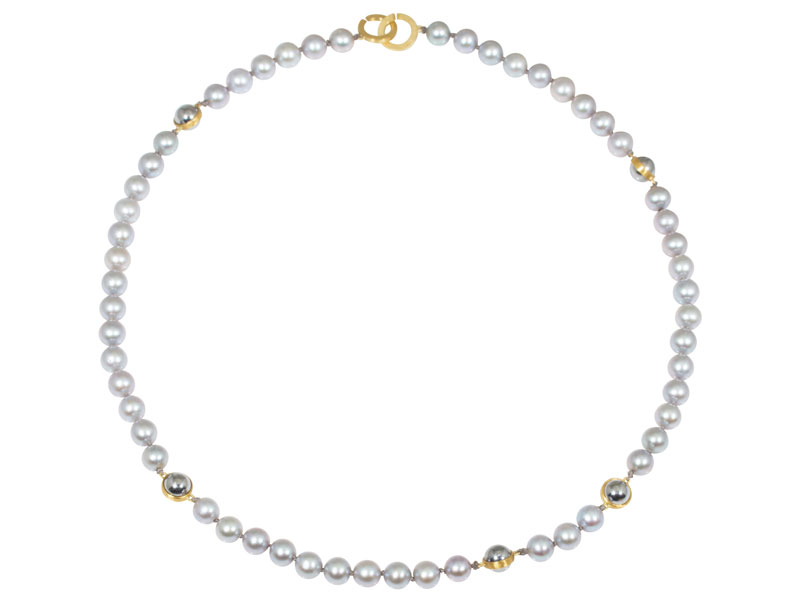
Designer Kate Eickelberg takes a modern and fresh approach to a classic pearl necklace
By Tina Snyder
There’s nothing more inspiring to Kate Eickelberg than cruising the aisles of a hardware store.
“While people don’t generally think much about the everyday items and parts found in a hardware store, to me, they are delightful,” she exclaims. Eickelberg’s family appreciates this quirky fascination of hers, often sending her steel odds and ends that they come across. When her brother, an engineer, gifted her with a handful of steel ball bearings, she couldn’t wait to incorporate them into her fine jewelry line.
“The first thing that struck me was just how perfect and round they were,” she says. “I just knew they had to be made into a necklace.”
Coincidentally, around the time she received the ball bearings, the gallery she works at—Shibumi in Berkeley, California—was planning a jewelry show titled “Modern Classics.” Eickelberg immediately got the idea to incorporate the steel ball bearings into a classic pearl necklace.
“There is nothing more classic than a pearl necklace,” she says. “But at the same time, younger generations think of them as ‘grandma’s jewelry.’ I loved the idea of doing a twist on a classic that would make it fresh and new, juxtaposing industrial steel with natural pearls.”

Kate Eikelberg
Berkeley, CA
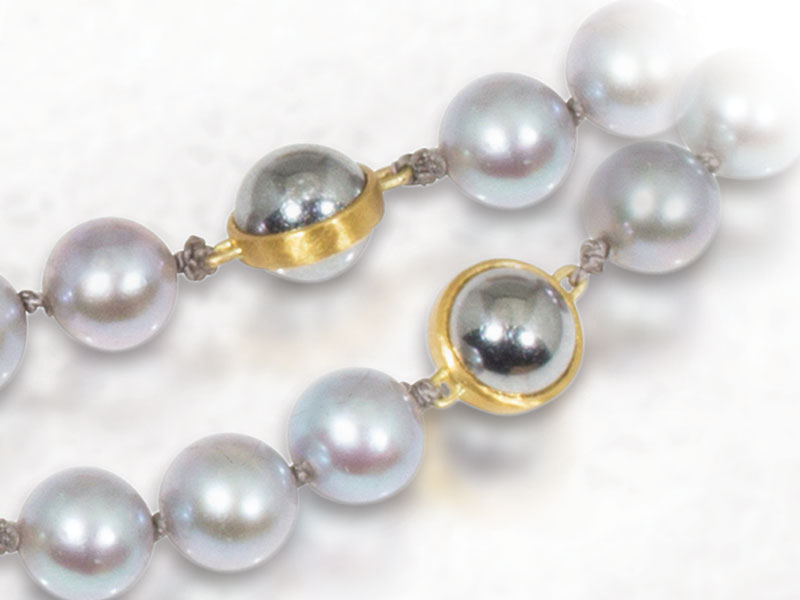
The biggest challenge of the design was incorporating the ball bearings in such a way that they would have movement. “I wanted the ball bearings to be secure yet able to spin freely in their settings,” says Eickelberg.
To accomplish this, she used a unique setting method to curve a narrow strip of 22k gold around the ball bearing to hold it in place with tension.
“I thought multiple times that I should save myself some trouble and set them in wider bezels, but the feeling of them floating magically in just a hint of 22k was irresistible to me,” she says. “It’s taken a fair amount of trial and error and scrap, but I’ve figured out that with just the right length of bezel wire, the perfect setting method, and a certain order of operations, I can make it work.”
And who would ever think that the perfect setting method would involve unsharpened pencils, a clothespin, and a pony clamp? “In most settings, you push the metal against the stone, but with these I make the bezels into settings before I pop the ball bearings in.”
Using a steel hammer handpiece, she shaped the 22k bezel around a thick unsharpened colored pencil, which was braced with a clothespin that supported the bezel beneath without marring the soft 22k gold. This entire assembly was held in place with a pony clamp, which Eickelberg admits “looks ridiculous but gets the job done.”
Once one side of the bezel was set, the opening was too small for the original colored pencil, so she swapped it for a standard no. 2, which was just right.
“If the ball bearings were inside the bezels when I set them, the gold would just be mashed between the steel,” she explains. “Also, I want the ball bearings to remain as pristine as possible and popping them in once the setting is totally done allows me to clean the setting up easily and worry-free.”
“I like taking something classic, fancy, and precious and adding a little edge with steel to make it modern and fresh.”
Not a fan of perfect symmetry, Eickelberg scattered the ball bearings around the necklace to make it more appealing to the eye. The 18k clasp is simple and sturdy, echoing the 22k settings around the ball bearings and bringing an aesthetic continuity to the piece.
One of the first pieces Eickelberg made with steel ball bearings, the necklace was such a success that she has since incorporated the tiny steel balls into pendants and earrings in her line.
“For me, the combination of classic gold and pearls with steel is just so fun,” she says. “I like taking something classic, fancy, and precious and adding a little edge with steel to make it modern and fresh.”