

Adopting 5S in the Small Shop or Studio
New Order
Small shops can implement the 5S component of lean manufacturing to improve efficiency and organization
By Carol McCarthy
(First published in May 2008 MJSA Journal)
As a small shop owner, you may wonder what lean manufacturing has to do with you. Most of what you read about the process is geared toward large production facilities. It may have worked for companies with hundreds of employees, but what can it do for your small business?
According to Andrea Hill of Hill Management Consulting, shops that apply the component of lean manufacturing known as 5S will benefit greatly from the efficiency and organization that it promotes. The principle of 5S, which stands for the Japanese words seiri (organization), seiton (neatness), seiso (cleaning), seiketsu (standardization), and shitsuke (discipline), is “setting yourself up to work in the most efficient and smart way possible,” says Hill, whose company is headquartered in Wisconsin with employees in the Midwest/Great Lakes area, Massachusetts, Georgia, New Mexico, Canada, and Italy.
To determine if 5S is right for your shop, Hill suggests asking yourself this simple question: How many times have you spent two minutes digging for pliers in a drawer? If the answer is twice a day, that’s 20 minutes each workweek, or more than two full work days lost each year. That’s time you can reclaim to do whatever you want with: create, earn, train—even loaf. “Any use of that time would be better than that act of digging for things in a drawer,” says Hill.
Last year Hill helped Revere Academy in San Francisco, a training institute for jewelers that taught 1,100 students in 2007, adapt 5S to its needs. In this article, Revere’s emiko oye discusses how the school applied 5S to its administrative office and classrooms. Many of the steps taken can be applied in the small shop environment.
Case Study:
Revere Academy Adopts 5S
One of the first things that should be said about applying lean manufacturing principles in the small shop is that you can adapt them to suit your specific needs. Revere followed the jewelry-industry-specific 5S approach taught by Hill, which is actually a 6S approach: She changed the five Ss to sorting, simplifying, systematic cleaning, standardizing, and sustaining, and added a sixth “S” for safety to address the dangerous machinery and potentially hazardous chemicals used by jewelers. Revere implemented this 6S process using the steps outlined in this article.
OFFICE ORGANIZATION
Sorting, simplifying, and systematic cleaning
Oye decided that the most logical place to start implementing
Revere’s 6S program was in the school’s administrative office, which houses six administrators and their possessions.
One of her first tasks was to create more storage space in the small office. Lack of space is a common complaint among small shops, says Hill, and organizing along 6S parameters results in “finding” more space. To begin, oye charged the Revere administration to sort through their belongings and place each item in one of five categories: keep (item is used often), store (item is used infrequently), needs repair, discard, and sell/recycle.
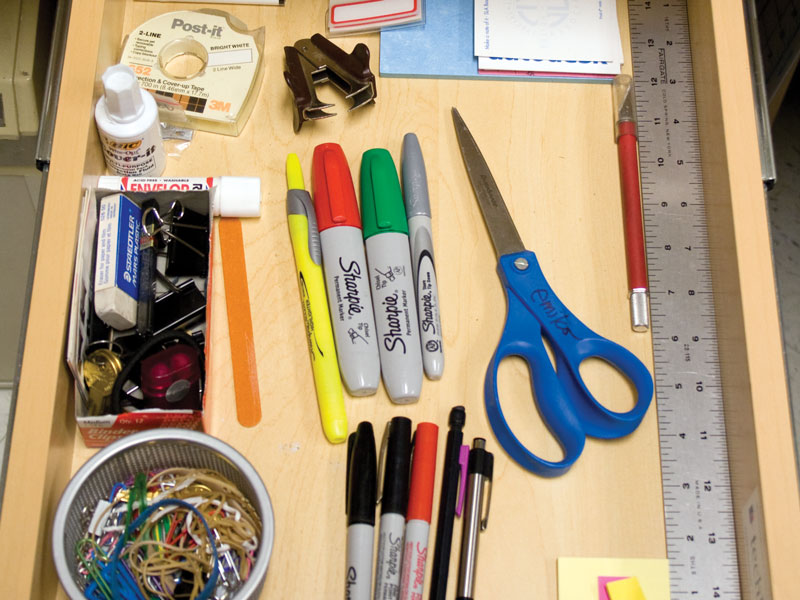
When it comes to cleaning up your shop, don’t neglect the office. An organized office drawer prevents wasted time spent hunting for a paper clip or sticky note.
“We did a really deep cleaning, and for artists, that was the most painful part,” oye says. “We tend to keep things for a long time, to think we might be inspired by something. You really need to take a Zen approach in a way and detach yourself.”
oye advises small shop owners who want to do this process but work alone to invite a friend over to help. Let the friend ask the hard questions, such as, Why do you have this? When did you last use it? Can someone else benefit from it instead? “It’s much easier to part with things when you have an objective person there to encourage you,” she says.
BENCH AND TOOL ORGANIZATION
Sorting, simplifying, systematic cleaning, and safety
Once the office was organized, it was time to move on to the classrooms. The same principles of sorting, simplifying, and cleaning apply, but when it comes to the bench tools you own, there probably isn’t much excess. The goal here is organizing your tools for maximum efficiency.
The studio manager at Revere organized the instructors’ benches for general use, keeping the most common tools close at hand and storing those less frequently used in a walk-in storage area on shelving units.
When organizing your own bench, Hill suggests grouping tools in the following categories: used daily/all day, used daily/once, used weekly, or used seldom. Store the tools used most frequently closest to your body
in the easiest-to-reach locations, and store those used less frequently farther out, in descending order by usage category.
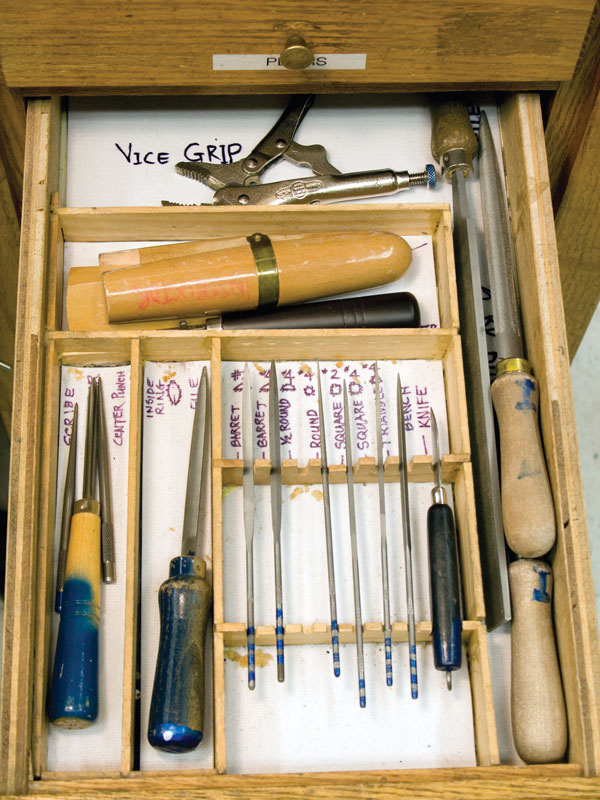
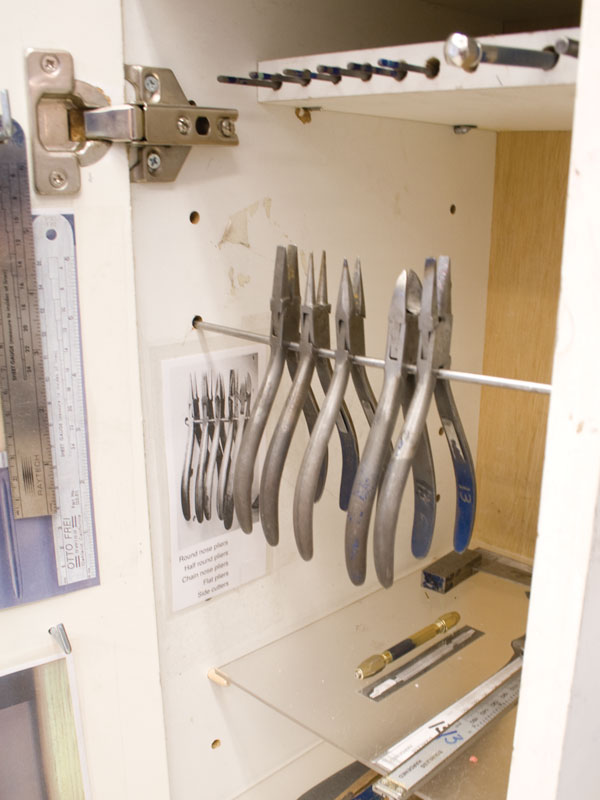
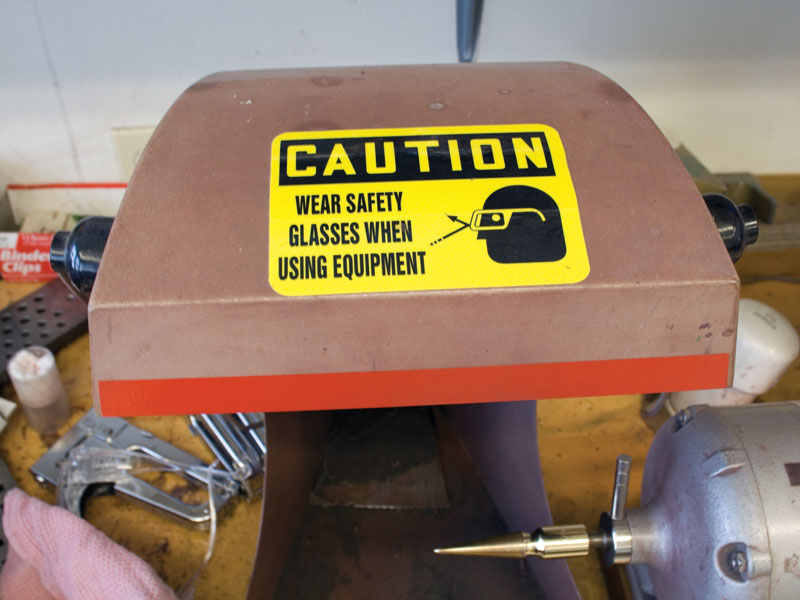
At Revere, only one layer of tools is allowed per drawer (top left). The students’ tool lockers have laminated photos of the tools on the inside door and shelves (top right), so it’s easy to see where the tools go and whether anything is missing. Equipment is clearly labeled with safety reminders and instructions.
“Organize your bench well and your body will know where things are, saving time and physical strain,” says oye. Having the right tool handy also means you’ll be less likely to make do with a tool that is not quite right for the job. Making do can have a negative impact on quality, Hill says, and 6S has been shown to improve quality, as well as the bottom line.
“Both Honda and Toyota reported that they reduced quality defects 25 to 30 percent when they implemented 5S,” says Hill. “When you calculate how much that mattered in terms of rework, repair, and returns, that’s huge.”
In addition to organizing the instructors’ benches, the staff at Revere wanted to make sure the students were participating in the 6S effort, as well. To keep the students’ tool lockers organized, the staff attached laminated photos of the tools to the inside door and shelves of each tool locker, so it’s easy to see where the tools go and whether anything is missing. When it comes to drawer storage, only one layer of items is allowed per drawer. This prevents wasting time digging around to find a specific item—everything is in its place.
Along with tool organization, one of the most critical components of 6S in the classroom or workshop is safety. “We started thinking about safety and clearly labeling everything,” oye says. The labels range from instructions on how to turn on and off oxygen and propane tanks, to reminders to wear safety goggles. Hill says such labeling is even more critical with less-used items in which struggling to remember how to use them could pose a safety hazard.
After more than a month of sorting, simplifying, and cleaning, the staff had an entire classroom filled with items to sell, donate, recycle, or discard. Money earned from the sale of the items was used to reward the staff with a celebratory dinner.
COMMUNICATION AND MONITORING
Standardizing
In a small shop with a few employees, one of the most crucial aspects in implementing a 5S system is communication. At Revere, a job wheel keeps everyone apprised of who is responsible for routine tasks, such as cleaning and studio maintenance. The Wheel of Jobs (below, bottom right) is for the kitchen and office areas of Revere. Duties shift weekly to ensure that one member of the staff isn’t stuck with the same task for too long. There is a separate job wheel for the classroom, as well as a student job wheel. An Action Register (below, bottom left) is used to record who is responsible for other tasks at hand.
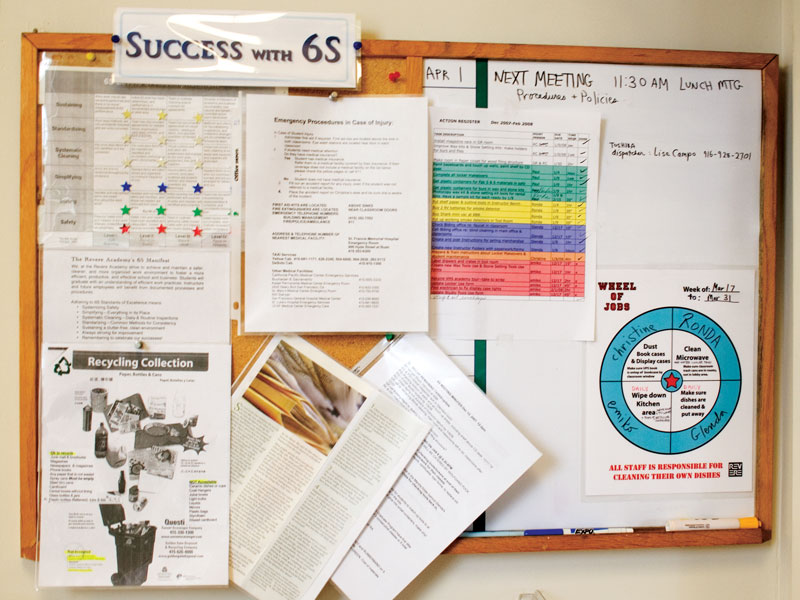
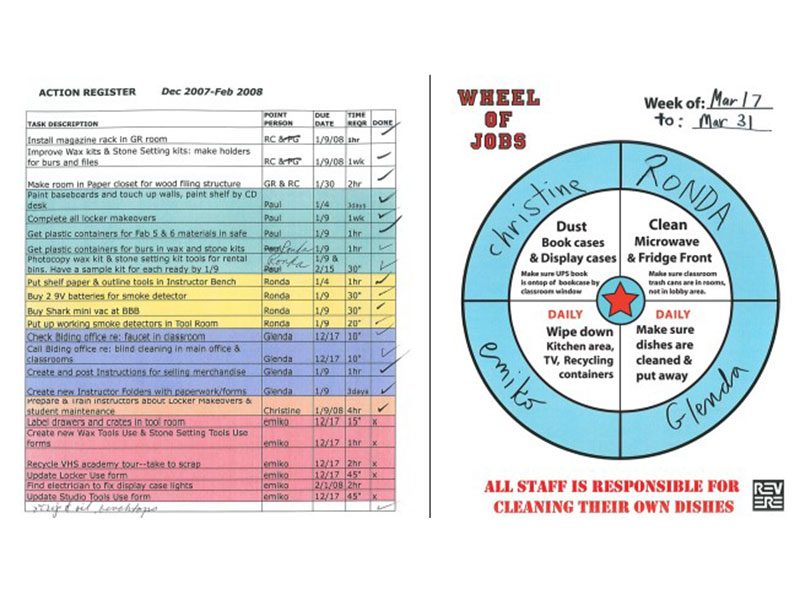
It’s helpful to create a Communications Board (top) to keep track of all 6S activities in one place. The Wheel of Jobs (bottom right) keeps everyone appraised of who is responsible for routine tasks, such as cleaning and maintenance. The Action Register (bottom left) is used to keep track of the progress of other specific tasks.
The Action Register includes a description of the task, the name of the point person on the job, the due date, the time required to do the job, and an area to check off when the job has been completed.
It’s helpful to create a Communication Board to keep track of all 6S activities in one place. Since many of the staff at Revere are not there at the same time, the 6S Communication Board helps them keep track of what each is doing. Centrally located so it’s easily visible by all staff, the Communication Board includes the staff job wheel, Action Register, a calendar, 6S meeting minutes, and other 6S-related
materials.
PROGRESS
Sustaining
After the program has been implemented, the difficult task of
maintaining momentum must begin. Otherwise, a company will have the expense but not the benefits of the program, Hill notes. When it comes to 6S, the expense is really time. oye estimates that the Revere staff donated a week of time to 6S at the outset. “Your daily business needs to take a back seat for that first week of super cleaning and reorganizing,” she says. “But, in the end, we are actually making money by running a more efficient ship.”
The success at Revere Academy has much to do with founder Alan Revere’s participation. “Top-level involvement is needed for the success of a program that relies on plenty of work up front with a payoff down the line,” Hill says.
“It really is a big task,” adds oye. “Everyone has to be on board and want to do it.” There are other hurdles to be overcome, too, such as arguments from employees that cleaning and organizing are beneath them, or that there is no point in cleaning because the area will get messy again. To overcome these hurdles, Hill suggests leading by example.
“If the shop owner starts with his own bench, takes a ‘before’ photo, implements 6S, and takes an ‘after’ photo, he can show the difference to his employees,” she says. “It’s hard to argue with the notion that the ‘after’ photo will provide the bench jeweler more efficiency.”
oye agrees that sustaining momentum is not easy. Originally, the Revere Academy’s staff had 6S momentum meetings monthly; now they meet every two months. “We have to nudge each other,” says oye. “You don’t just do it once and stop,” she says. To gauge their success, the staff measures progress along several levels of accomplishment, ranging from just beginning to continuously improving. oye says that while the work is never over, the benefits show on a daily basis.
“The office and classrooms look more professional, our staff is better at communicating with each other, and we have an atmosphere of mutual respect,” she says. “The students take notice, and respect
begets respect.”