

Advice for Finding and Buying Tools
Tool Up
Jewelers share details about their tool buying habits
Sponsored by:
By Shawna Kulpa
There’s no denying it: Jewelers love tools. But the process of filling a workshop with the tools and equipment needed to make jewelry day-in, day-out can be intimidating. How do you learn about the tools out there and what they do? Where do you go to find tools? How do you know if a tool purchase will pay off, or if you’re just going to wind up with an expensive paperweight?
To help make the process a little easier, we checked in with industry veterans about their tool-buying habits. On the following pages they share their approaches to finding and buying tools, as well as a few lessons they’ve learned over the years.
A Little Birdie Told Me…
There are myriad ways to learn about and shop for tools and equipment beyond just the latest catalogs, though those remain a good way to learn about tools.
While they’ve been limited this past year due to COVID-19, in-person events continue to be a great place to discover new tools. Whether it’s a trade show with aisle after aisle of booths or a conference with a handful of select exhibitors, events offer the chance to learn about the latest tools, see them in action, and even try them out for yourself.
A big believer in industry shows, Adam Foster of Adam Foster Fine Jewelry in Frontenac, Missouri, says that they’re a great place to find “something that might not be on my radar.” However, he recommends jewelers vary the type of trade shows they attend, so they can encounter a greater variety of tool companies. “JCK is great, but not everyone can afford to be in a ballroom in Vegas. Go to the smaller shows, too, where booth costs are less.” Foster likes to check out the smaller hotel and conference shows in Tucson.
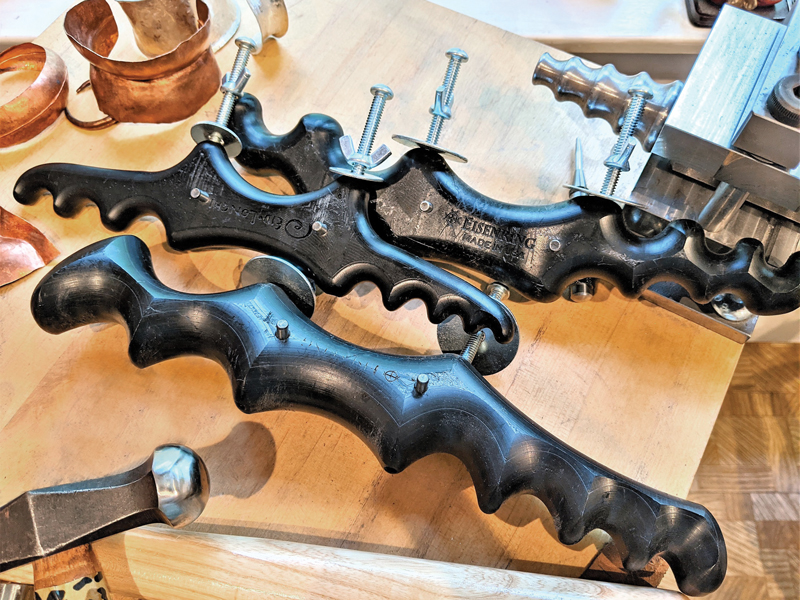
Jewelry classes can help expose jewelers to a range of new tools that they may decide to add to their own studio. Martha Seely knows that firsthand, having invested in a set of forming stakes after getting to use them in a class.
Martha Seely of Martha Seely Design in Carlisle, Massachusetts, also admits to having great luck at shows. “At MJSA Expo, I’ll wander into a booth and learn about tools I didn’t even know about,” she says. She notes that shows are a great option for not only seeing the tools, but also trying them out and getting to talk with people from the companies about them. Such conversations, she says, can help her quickly identify if a tool or piece of equipment can do what she needs it to do.
And those conversations don’t have to be limited to just the tools featured on the show floor. Foster often asks the companies about other tools that might accomplish what he needs. “Suppliers buy tools all day long; they know what’s out there,” he explains. “Even if they don’t sell something, they might use it in their factories.”
For Catherine Jensen of Michael Jensen Designs in Rio Rancho, New Mexico, the conversations go beyond just those with the tool suppliers. She likes how in-person events give her the chance to talk with other jewelers about what they’re doing (and the tools they’re using to do it). “That’s one of the great parts of our industry,” she says. “Nine times out of 10, people will share information. The coolest thing is to sit and talk with them.” Even if the event is a conference that doesn’t have exhibitors on hand, the information gleaned from other attendees can still be invaluable.
Another one of Seely’s favorite ways to learn about tools is to take classes. Not only does she get to see what other people use in their work, the class gives her the opportunity to get some hands-on experience with different tools. She’s recently been taking classes at Metalwerx, a jewelry school and community studio in Waltham, Massachusetts. There, she says, “I’ve been able to experience all the various hammers, saws, files, polishers.”
Michelle Pajak-Reynolds of Michelle Pajak-Reynolds Studios in Stow, Ohio, loves to ask her fellow jewelers for tool suggestions. If she sees someone doing something interesting, she won’t hesitate to ask how and what they used to do it. In fact, that’s how she first learned about the tool that currently sits atop her Most Wanted list: a hydrogen water torch. She stumbled across an Italian jeweler online making “the most incredible, teeny-tiny pieces that are soldered together.” She reached out to him to ask about the type of torch he used. After learning that he worked with a hydrogen torch, Pajak-Reynolds investigated the technology and determined that it could be an ideal and safe soldering tool for her home-based studio (and around her six-year-old assistant).
Alex Boyd of Alex Boyd Studio in Denver will also reach out to jewelers he sees doing interesting things to learn more about how it was done. “I would say a lot I find in the community of jewelers that I’m friends with,” says Boyd, who’s a big believer in peer reviews. “On Facebook, they’ll post a new tool. Or if I’m visiting them and see a tool they have, I get the ‘wants’ real bad. Then I have to go buy it.”
Decisions, Decisions
Although jewelers love tools, they don’t often have limitless budgets that allow them to buy any tool that catches their eye. Instead, they must weigh the cost against the benefit the tool could provide to their business.
Whenever Foster must decide on whether to make a tool purchase, he asks himself a series of questions: Can it make my life easier? Can I make the product faster or better? Can I make more money?
“As a designer, I think differently than as a business owner,” Foster explains. As a designer, he wants to make cool stuff, and if a new tool would help with that, great. But as a business owner, he recognizes that he might not make a profit on those cool pieces that may be labor intensive, even with the new tool. “There are two sides of the equation.”
For Boyd, tool purchases come down to two factors: “There’s either some sort of technique or look I want to incorporate into my work, or there is the fact that it can make me money,” he says. “Sometimes the Venn diagram crosses over. But sometimes it’s more that I want to achieve some sort of new technique, even if it’s not going to make me more money, but it’ll be fun to do.”
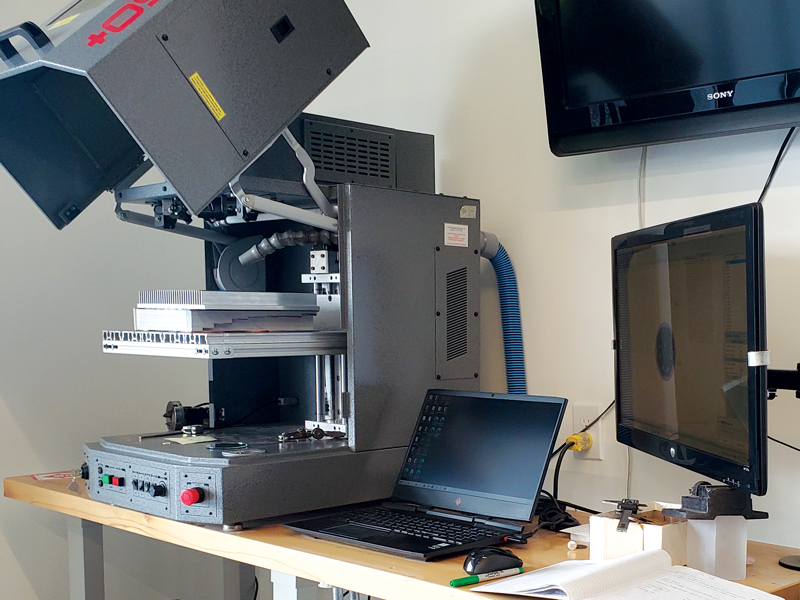
Industry trade shows are a great place to discover new tools. One of the things that Adam Foster likes most about shows is the ability to ask questions about the tools as well as try them out, especially before investing in expensive equipment, such as this laser engraving system Foster purchased at one show.
Michael Jensen of Michael Jensen Designs follows a similar perspective, depending on the price of the tool. If a tool is priced at more than $1,000, Jensen will research it and try to determine how much use of it he will get. “Will it return whatever the investment is in time or the ability to do something I can’t do any other way?”
However, for inexpensive tools, “I’ll make a snap judgement,” he says. “If it looks like it’s going to be good, I’ll invest.” One of his impulse buys, an electric melting furnace, has become an essential part of his casting process.
Tool decisions can also depend on where a jeweler is in their career.
Jeweler and metalsmith Andy Cooperman of Seattle admits that his tool-buying process has changed over the years. “When I was younger and starting out, anything that might relate or somehow be adaptable for the studio, I would buy,” he says.
As he’s gotten older, he’s become more particular about the tools he buys. “If I identify a need, I will find something out there that will fill the need.” For example, recognizing that he’s not getting any younger, he recently bought a power rolling mill. “I’m getting older and was looking down the road.”
Because this is her second career, Seely thinks she has a unique perspective. “Because I entered the business late, I look at it differently,” she explains. If she wants to learn or explore a new technique, she won’t invest a lot of money in the tools for it. If she later decides to add that technique to her repertoire, she’ll invest in better quality equipment to do it.
While many jewelers get swept up in the “I want it” feeling of buying a new tool, Pajak-Reynolds comes at her purchasing decisions from a business-centered perspective. She uses the financial analysis skills she picked up while earning her MBA to consider the cost-benefit analysis of a purchase.
“How often am I going to use?” she asks herself. “If it’s going to be a really cool ‘dust collector,’ then it’s not worth it for me. Otherwise, you can just collect a bunch of tools and have no cash for other things.”
That good financial sense is what has stopped her so far from pulling the trigger on that $1.5k hydrogen torch she desires. “It’s a big chunk of money,” she explains. “That could be travel costs for a trade show. Do I go to the show and try stuff out or do I buy the tool? Am I going to do enough fine detail work? I don’t do repair work beyond what I make—that’s a headache I don’t want. That’s why I’m so hesitant to pull the trigger on the torch.”
But for Pajak-Reynolds, sometimes loosening the purse strings and buying tools does make financial sense. Around this time of the year, she starts thinking about what she’s going to make for the holiday season as well as early the following year. Also, by this time she has a good idea of what her tax liability as a self-employed jeweler will be for the year.
Knowing all of that, she looks over her tool wishlist and will pull the trigger on some purchases to off-set some of her profits, helping to fill her studio while also lowering her tax liability. “More profits equal more taxes,” she explains. “If I spend X, I don’t have to give this to Uncle Sam.”
But even she has moments when the desire for tools overrides her financial sense. “My accountant told me to put [some of the money] in my 401k, but I wanted tools,” she admits.
Quality vs. Price
Once a jeweler has decided that a tool deserves a place in their workshop, the question then becomes which version of the tool to buy. As with many products, jewelry tools come in a range of quality levels. While every jeweler would always like to buy the best on the market, their budgets don’t always allow for that. So, when does it make sense to buy the top of the line? It depends on the jeweler and the tool.
Some jewelers analyze the cost benefit of the more expensive version of a tool versus a cheaper model. Foster’s philosophy is to “buy the highest quality for the job needed to be done,” he says. “Don’t buy the Ferrari when the Volkswagen will do just fine for now.”
Cooperman uses a similar philosophy based on use. “If it’s something I’m going to use once in a blue moon, I buy the economy version,” he says. “If it’s something I’m going to use every day, I look for a used but higher quality version. Something German or Italian. I’ll buy a well-taken-care-of used tool if I can.”
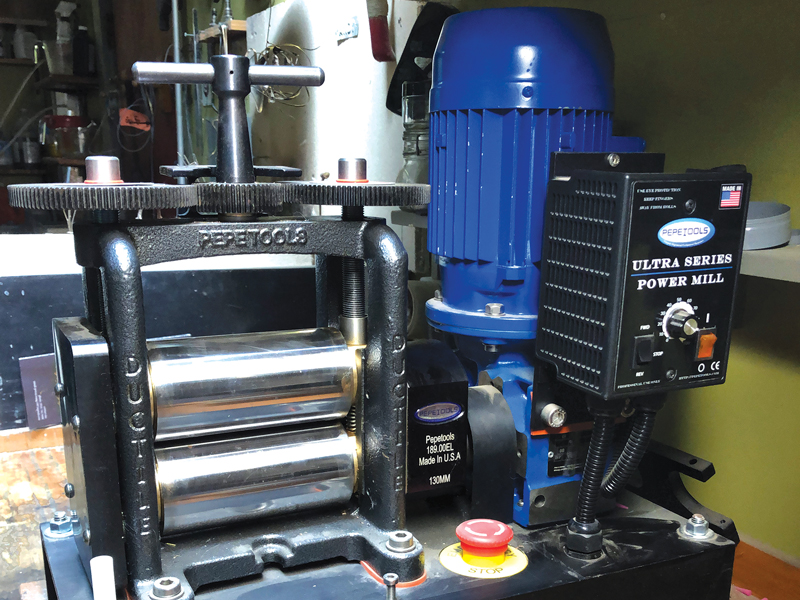
Deciding on whether to invest in a new tool or piece of equipment can often depend on where a jeweler is in his career. Andy Cooperman has gotten more selective about his tool purchases as he’s aged, with many decisions being made with a focus on comfort, such as his purchase of a power rolling mill.
For some less expensive tools, Cooperman will often buy multiple copies of them, such as dividers or millimeter gauges. “It’s better to spend the money on multiples than the time it takes to find the one you own,” he explains. “I’ll buy several and scatter them around the workshop.”
Sometimes the decision on what to buy simply comes down to a jeweler’s experience level with a technique. Jewelers looking to try something new out often opt for the economical option, at least at first.
“I will not invest in the most expensive,” says Seely. “I won’t go whole-hog until I see if I’ve used it enough. If I just want to test something out, I’ll try it on the lower-end scale.”
And sometimes jewelers opt for the higher-end model simply because it will be nicer to use.
“There’s something about a really well-made tool,” says Boyd. “There’s a tactile pleasure in using it. For me, so much of why I make jewelry are those moments when I’m making something, being in that moment. If a really nice tool feels better to use, even if it gets the same result at the end, I’m going to go with that tool for the experience. If you can appreciate the moment better because of a nice pair of dividers, you’re living a better life.”
Give It a Test Run
Tools often act as extensions of a jeweler’s hands so it’s no wonder that many jewelers want to use ones that feel comfortable. After all, if they’re going to be gripping something day-in, day-out, they want it to feel good. But how does a jeweler know which tools are going to feel “just right” in their hands if they don’t get to first try one out at a trade show or in a colleague’s studio?
For many jewelers, that’s where reviews and recommendations come in.
“It depends on who’s making the recommendation and if they know me,” says Seely. For example, she’s good friends with fellow jewelry designer Jayne Redman, who has also designed a line of successful bench tools. “If Jane says, ‘You have to try this,’ I’ll try it.”
On the other hand, if a tool supplier recommends something, she’s more inclined to wait until after she’s had a chance to try it out before pulling the trigger on the purchase. “It has to come from someone I know, someone that I’ve worked with, who says ‘I think this tool will help you.’”
Boyd says he’s comfortable buying tools he hasn’t had a chance to test out for himself, but it’s not from lack of desire. “Usually, my tool-buying decisions are more impulsive,” he explains. “I’m not someone who agonizes over purchases; I commit and do it and don’t look back.”
That said, he will slow down for tools that require a substantial investment, such as a laser welder. “I’m more likely to reach out directly to people who use those machines first.”
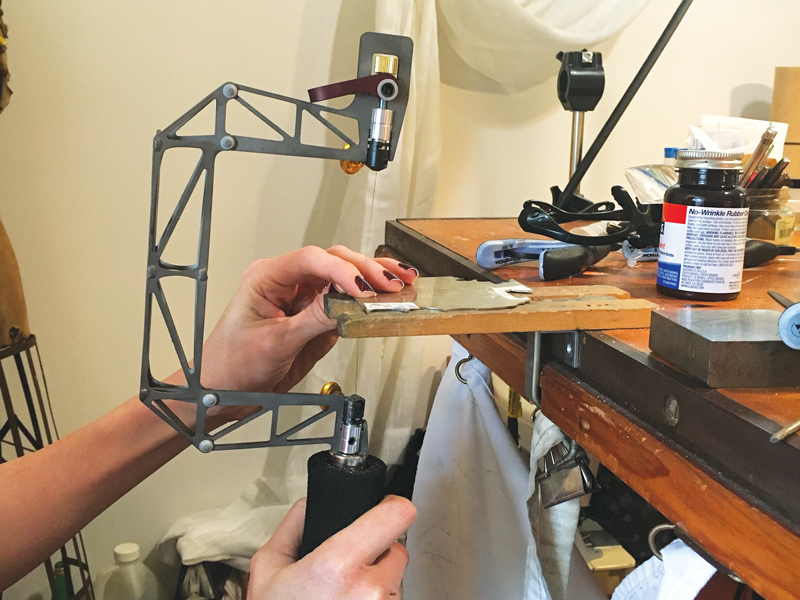
Michelle Pajak-Reynolds loves to ask her fellow jewelers for tool suggestions. If she sees someone doing something interesting, she’ll ask how and what they used to do it.
Foster is a firm believer in trying things out first, not just to get a feel for it, but also to see if the tool will do what the manufacturer claims it will do. “I want to see what a tool produces,” he says. “If it’s a rolling mill, I want to see the blank pieces and the patterns. Give me the demo.”
He recommends jewelers bring a sample of the material they’re using to a trade show to try out with the tools. “Get a demo with the actual material you’re going to use,” he says. “Take castings to the trade show and ask, ‘Can you show me how the product will work for me?’ The pro can tell you what works best for what you need.”
Cooperman falls somewhere in the middle, preferring to try things out when possible, but he’s also not afraid of buying an untested tool, especially if the supplier has a reasonable return or exchange policy. “You’ll know the first time you use it if you made the right decision or not,” he says. If it’s not the right fit, jewelers can reach out to the seller to find one that might be better.
Look at Other Industries
Jewelers needn’t feel that they must limit their tool and equipment purchases to just those items designed for the industry. Most jewelers have found success sourcing tools from other industries, including the dental, automotive, and even the food service industry.
The probes, scrapers, and cleaners that some people fear at the dentist office have found a place in many jewelers’ shops, as they’re ideal for carving wax. Although jewelers can often order them direct from dental suppliers, some have lucked out at their neighborhood dentist office.
“I was at the dentist a few weeks ago and asked about old scrapers that they can’t use anymore,” says Pajak-Reynolds. “I asked them to save them for me. I don’t do wax carving, but they’re great for trying to pick a piece of dirt out of pin-set gem clusters. I don’t specifically look at the dental industry, but I do ask for hand-me-downs.”
Boyd has also sourced tools from the dental industry, having luck finding dental supply houses online. “Not all companies will sell to jewelers,” he warns. “But I’ve usually been able to find what I’m looking for eventually from a supplier that doesn’t require an account with them to prove you’re a dentist.”
A major benefit that Boyd has found with sourcing tools from dental supply houses is the cost.
“I’ve found that a lot of dental supplies for very similar tools are a lot more affordable,” he says, estimating that the dental tools often tend to be about half the cost of similar tools from jewelry industry suppliers. He attributes the price difference to sheer volume, believing that the number of dentists dwarfs that of jewelers. And even though dental companies may charge him a little more since he’s not a dentist, “it’s still cheaper.”
Many jewelers have also lucked out sourcing tools from the automotive industry.
Pajak-Reynolds is married to a semi-truck mechanic who frequently brings home truck catalogs. She was flipping through one when she realized that her Lindstrom tools were the same as the Snap-On tools in the catalogs, albeit with differently colored handles, with comparable prices. In fact, when she contacted Lindstrom regarding a warranty issue, the response she received was from someone at Snap-On.
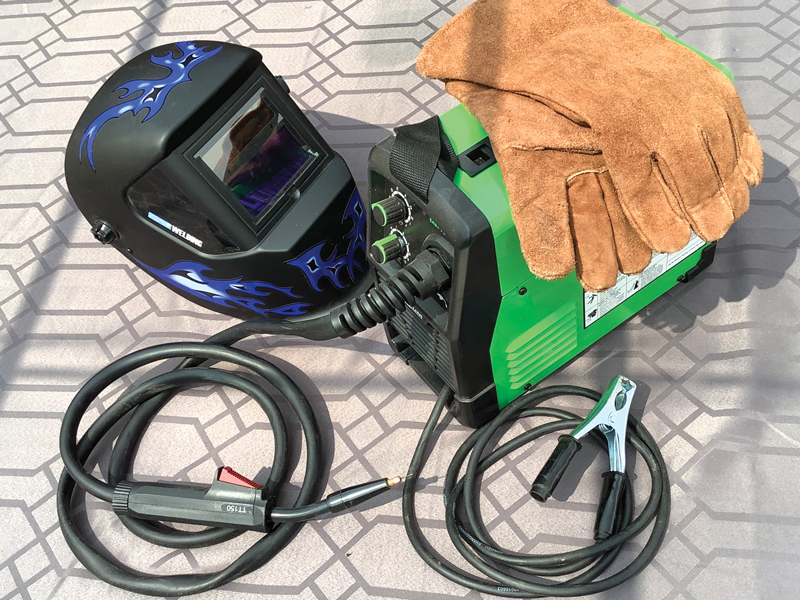
Jewelers aren’t limited to sourcing tools from within the industry. When Michael Jensen walks into an auto-part store, he looks around at the tools and wonders what he might be able to put to work in his shop. On one trip, he spotted an arc welder that he now uses to create jigs for his jewelry work.
As a self-described “gearhead,” Jensen spends a good deal of time in auto-part stores. “I may pick up something and think, is this for making jewelry?” he says. On one such trip, he wound up buying an arc welder. While he can’t use it on jewelry, he does use it to create jigs for his jewelry work. “If I’m making an item more than once, I’ll make a jig so that every time I make that piece, it’s exactly the same. The welder helps me weld the steel together for the jig.”
And sometimes jewelers can find tools in industries they never expected.
Seely initially bought a cheap heat lamp to use when she’s setting pearls with epoxy. Because she’s been focused on slowly building her business, she didn’t spend much on the lamp, so she wasn’t overly surprised when it eventually fell apart. “It was cheap, but I got annoyed with myself,” she explains.
Not wanting to make the same mistake twice, she looked outside the industry for heating devices and wound up finding an industrial heat lamp from the food industry. Originally designed to keep food warm, the lamp is sturdy and works well, and Seely doesn’t regret splurging a little on its $200 price tag. “I didn’t want one with a clamp that could slip,” she explains. “This sits high and isn’t going to touch anything. It’s really secure. I turn it on and don’t worry about a fire.”
Mistakes Will Be Made
Even when jewelers do their homework and take all the right steps—doing research into the tool, getting reviews, trying it out, sourcing it from a company that offers great technical support—sometimes a tool purchase will wind up being the wrong one. And that’s ok, say most jewelers, who view these mistakes as learning experiences.
For Boyd, his one purchasing regret is the time he opted for a cheaper version of a tool. “I once bought a really underpowered rolling mill,” he recalls. “I used it once and knew I had made a terrible mistake.” Luckily, he was able to return it to the company and upgrade to a higher model. “Most places are good about letting you ship things back when you say, ‘I want to spend more money with you.’”
Foster has learned that sometimes newer isn’t always better.
“We bought one of the first digital diamond drag engraving systems,” he recalls. “It was terrible. It worked, but not all the time. There was no tech support. The software wasn’t designed by the company, was not integrated well, and was buggy. It would damage the jewelry and we wound up having to do more work.” It now sits in the back of Foster’s shop as a giant paperweight. “It works, but it wasn’t the end-all, be-all.
“I should have just gone with the old version rather than going with the new technology,” he continues. “The manual system has been around forever. The digital version was putting the human error on the computer.”
Although Cooperman admits to having a few tool-buying regrets over the years, the first (and most memorable) was made as he was starting out years ago. Having just gotten married, Cooperman and his new wife were driving cross country to Seattle. They stopped off in Montana for a few weeks to stay with a former professor. While there, they met someone who was selling his whole electroforming setup. “We had just gotten married, so we had cash,” he explains. “I bought the whole plating outfit.” When the couple finally made it to Seattle a few weeks later, they found themselves in a new place and out of cash, having spent nearly all of it on the equipment. “My new wife sat on the steps of our pick-up and sobbed!”
Now, many years later, he and his wife laugh about the purchase. Although he hasn’t used it in years, the plater still sits on a shelf in his studio—a reminder of how important it is to think carefully about each tool purchase.

How to Make the Proper Investments in Tools & Technologies
Original Airdate: 9.9.21: For more guidance on tool buying, check out the MJSA Webinar on making investments in tools and technologies. Premier MJSA members can watch replays for free; Associate members pay only $15, a 70% discount off the $50 price for non-members.