

Achieving Success with Social Commerce
Another Tool in the Sales Chest
How to take advantage of the lateset social commerce tools
By Andrea Hill
Until 20 years ago, small to medium-sized businesses chose one distribution channel, and that was enough. Adding additional channels represented significant risks related to marketing and sales investment as well as related logistics and operations challenges—risks that only made sense as part of an aggressive growth strategy.
The world of digital commerce upended that approach to business. Business owners today must grapple with the staffing, costs, and learning curve of not one, not two, but three or more channels of distribution. The retail sector is now facing the costs of resisting online sales as well as the changes to the customer experience and merchandising those online sales require. Wholesalers and brands have struggled (and continue to struggle) with the decision to stick by declining retail partners or venture into direct sales online.
While online adoption had been growing in the jewelry industry before 2020, the industry still really had only one foot in the web waters. Then came the COVID-19 pandemic, and businesses without sufficient website services made the leap to social commerce, with many of them skipping the step of creating strong websites entirely.

As with any rapid development in technology, accelerated adoption comes with a mixed bag of both good information and bad. Practitioners test and revise on the fly, making things up as they go and sharing insights along the way. The good news is that the world of social commerce is stabilizing, and with that comes the opportunity to define and dissect the channel. And that is important, because social commerce brings the minimum number of channels a retailer must master to three (physical store, website, and social commerce) and offers interesting opportunities to direct-to-consumer and hybrid brands and manufacturers.
What is Social Commerce?
Social commerce is the practice of selling products and services via social channels, such as Facebook and Instagram. It includes paid and unpaid posts featuring products for sale and linking respondents to the product pages of a website.
The term social commerce also covers the use of influencers to promote and sell products through their own social channels with links to product pages.
And now, social commerce includes using the selling tools embedded in the social channel, taking customers from interest to checkout without ever leaving the social network.
The ad world has recently started refining the term social commerce to mean only promotions that offer in-app purchases. But the broader definition of social commerce still has relevance, particularly in a channel that is evolving rapidly.
What is not included in the definition of social commerce? Social commerce is not Google Ads, selling through marketplaces such as Amazon and Google Shopping, search engine marketing, display advertising, retargeting, e-mail/remarketing, or non-interactive ads on social channels. To qualify as social commerce, the promotions must be native to the social channel’s interactive experience, and not just a banner that shows up in someone’s news feed.
A simple way to remember what social commerce is (and is not) is that social commerce capitalizes on the opportunity to create ads that include highly public, two-way communication between brands and consumers. In social commerce, selling, service, and social proof are all blended into one integrated sales experience.
Different Types of Social Commerce
Just as there are a lot of different ways to throw a party, there are many ways to approach social commerce. While it is possible to choose one type as your sole distribution channel, most brands will require more than one digital channel to achieve their sales and growth aspirations. Besides, each selling channel has unique benefits and drawbacks. Savvy sellers will combine multiple channels to achieve the highest overall exposure while mitigating the drawbacks of individual channels.
• Social Posts (Paid and Free)
The most familiar approach is to post products on social media and invite people to buy them. If the post is a free page post, then approximately two percent of the page’s followers will see it. For greater exposure than a free post will generate, you can run a paid post.
There is a difference between showing a post of your latest design and creating a social commerce post. A basic display post can generate conversation and likes, but it won’t directly drive sales. To turn a post into a social commerce activity, it must show a price and link to a product page or straight to a shopping cart or checkout feature.
Unless you have an extremely large (50,000+) and very devoted social following, an unpaid product post is unlikely to lead to many sales. To get the most out of free social commerce posts, use a syndication software such as MeetEdgar or Smarter Queue. Syndication software allows you to create a catalog of social media links for all your products, and then schedule those posts to go out in a rotation. Once the system has cycled through all your products, it starts over, and you can add new products to the list at any time.
Paid social ads are different from posts because they allow you to set goals, choose an audience, and keep the ad in rotation on the social channel for the life of your budget. They are different from banner ads and ad words because they place your ad into the social media experience like any other post. Each social media channel has its own set of advertising types, some of which are interactive (social) and some of which are just traditional ads (banners, ad words) that display in their newsfeeds. In other words, just because an ad is on a social network doesn’t mean it’s social commerce.
• Influencer Selling
Influencer marketing has been around at least since Wedgwood made its first tea set for the wife of King George III. And while most people refer to this category as influencer marketing, influencer selling is more accurate. For anyone who still struggles to understand the value of influencer marketing, consider this: At one time, cosmetics companies placed well-trained salespeople at the makeup counters of every department store. These salespeople engaged with customers, offering everything from color advice to makeovers, and drove significant foot traffic through their clienteling efforts. One of their most valuable activities was to show customers how to use the products, because cosmetics are a more complex sale than most people realize, and repeat purchases depend on showing customers how to use them.

Using influencers to promote and sell products is one type of social commerce. Micro-influencers can be a good way to reach local or targeted interest groups.
In the mid 2000s, cosmetics companies realized they could pay individual influencers to test, demonstrate, and build demand for their products. It was the perfect replacement for the labor-intensive practice of training salespeople to staff retail counters. Influencer selling has dramatically changed the beauty industry through storytelling, product demonstrations, and honest and credible reviews.
Initially, influencer selling happened in the blogosphere, but by 2017 most influencers had migrated to social media channels. Today, influencer selling is a sophisticated channel, with top influencers represented by talent agencies. Micro-influencers (those with between 1,000 and 100,000 followers) can be a good way to reach local or very targeted interest groups.
In the early years of influencer marketing, it was very challenging to know if you were getting a return on ad spend. Today it is much easier to measure the impact of influencers by using shortlinks, deep links, and other tracking tools. If you plan to use the influencer social commerce model, use a tool such as JotURL or Rebrandly, combined with campaign features in Google Analytics, to track and validate campaign performance.
To find an influencer, I recommend using an influencer agency, such as Viral Nation, Neoreach Agency, or Audiencly. You can also use an influencer marketplace, such as Upfluence or GoImpact. Companies should plan to enlist some help when they go after influencers because contracting and monitoring them and actually proving the work was done and getting results can be challenging.
• Pure Social Commerce
A social marketplace is the equivalent of an ice-cream vendor walking the beach with a cooler. Why wait for your audience to come to you, if you can take the goods to them? Customers can buy a product at the moment of greatest interest, without ever leaving their beach blanket. With social in-app purchases, instead of advertising with a link that brings a customer to your website, you can provide them with a “Buy Now” button that allows them to complete the transaction without ever leaving the social app. This removal of friction from the shopping experience leads to faster conversions, because convenience + the ability to research and ask questions + multitudes of endorsements = easier buying decisions.
All major social media platforms offer in-app purchasing, though it can still be challenging to set up, understand, and use. Instagram shopping is notoriously difficult to set up, and would-be sellers have been known to wait for months to get approvals and start selling. Some e-commerce platforms (notably Shopify and BigCommerce) offer direct links to Facebook and Instagram markets, which can reduce administrative costs of social commerce by feeding the products on your website directly to your social catalogs, which are feeds of your products displayed inside the social media app.
Although the costs for all three of these types of social commerce are similar (depending on the individual influencer), companies should start their efforts with paid posts that link to a product page on their website first. Once they get good at that and know how to drive product sales from good social advertising, they can then try a marketplace or an influencer.
Yes, You Still Need a Website
Social commerce is meant to complement a company’s other distribution channels, not replace them. If you’re selling via posts (paid or free), social ads, or influencers, you will need a website to handle the sales transaction.
But do you need a website if you use pure social commerce? You really do. Social commerce allows you to promote your products one group at a time or one product at a time, but it’s very product centric. This is great if you’re a distributor that just wants to blow out one unique product after another. But if you’re a brand or business building a loyal following, pure social commerce is not sufficient to tell your story.
A website is necessary for customers who need more information before they can commit. Social commerce ads provide a lot of detail—from product information and prices to sometimes lengthy threads of discussion among past and potential customers. But what it doesn’t provide is the brand information that builds trust and leads to buyer confidence. Of all the social channels, only Facebook makes it easy to share a lot of brand information, but even there it’s not organized in a way that makes sense to most online buyers. Websites are uniquely positioned to tell the story of a brand beyond the product.
Social Commerce vs. Advertising Commerce
In 1999, Americans were exposed to 1,500 ads per day. By 2019, that figure was 5,000 ads per day, and post-pandemic it is estimated that we encounter anywhere from 6,000 to 10,000 ads per day.
How many people really, really want to see your ad banner? How many people genuinely need what you sell, but are unconsciously tuning out all the advertising noise and skipping the ads at the top of search to get to the “real” search results?
The key to a good paid ad campaign is to have such powerful advertising creative that your banner simply can’t be skipped (hint, that’s not another picture of jewelry or diamonds).
With a “non-social” digital advertising campaign, once you have their attention you must send them to a page that does the following things:
- Tells the rest of the product story.
- Helps prospects apply the benefits to their own needs.
- Builds confidence through sharing testimonials and reviews.
- Incentivizes the capture of e-mail addresses in case the customer doesn’t buy immediately.
- Facilitates the sale with add-to-cart and payment systems.
Do banner advertising and ad words well, and they can be very effective. It’s just useful to know that social commerce can provide a full buyer experience without leaving the app, and with the added advantage of inviting the customer into a larger conversation with peers and sellers.
The Operations and Logistics of Social Commerce
If you plan to sell only a handful of products on social channels, adding a product for sale is as simple as setting up a display ad. But if you want to sell your entire web store on social apps, you must connect your website to the social media platform via an application programming interface (API) or upload your catalog using a spreadsheet.
Take time at the beginning to set up a good process for synchronizing your website, social marketplace, and POS or ERP system. Otherwise, you risk creating a tremendous amount of administrative work for yourself, and possibly breaking trust with customers if your prices or stock levels fall out of sync.
If you are using social posts and ads to send links to your own website, then you don’t have to worry about adding pay methods and new fees. But if you’re selling through a social channel’s in-app marketplace, be prepared to add a layer of accounting administration and oversight to your operations.
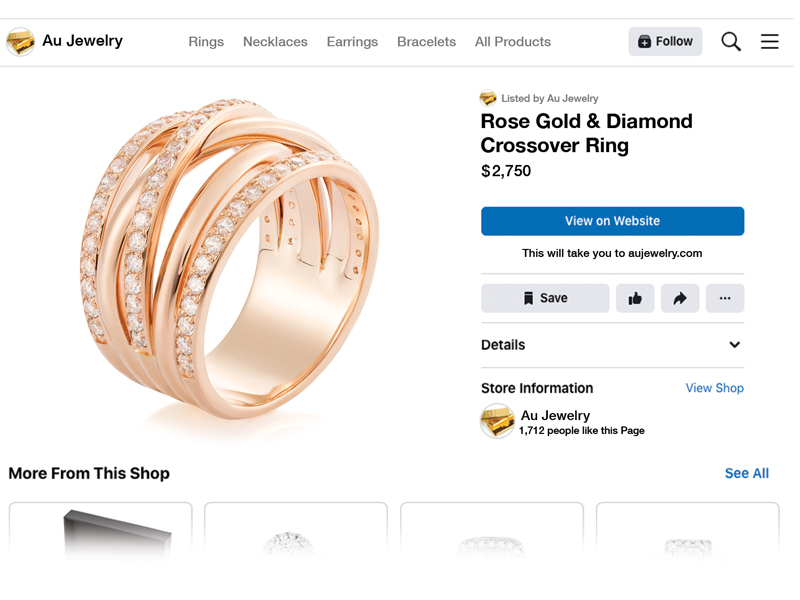
To sell through a social platform such as Facebook Marketplace, you’ll need to add a layer of accounting administration and oversight to your operations.
Let’s use the most mature in-app social commerce platform—Facebook—as an example. When you sell through Facebook’s marketplace, you get paid 15 to 20 days after you mark the item as shipped and enter a shipment tracking number. Facebook’s selling fee is 5 percent (or $0.40 minimum per order). The fee is based on the total of the item price, shipping cost, and sales tax. For example, if an item costs $20, shipping costs $5, and the tax is $1, then you will pay a fee of $1.30, which is 5 percent of $26. The payout goes directly to your bank account.
Facebook collects taxes at checkout, but only for 43 of 50 states, which they refer to as their Marketplace Facilitator (MPF) states. These are the states that Facebook is required to collect sales tax in. But they don’t collect in the other seven states, and they don’t collect item-based excise taxes, fees, surcharges, or orders placed for local pickup. If your state requires any special sales taxes (for example, California’s e-waste tax), or if you are in a non-MPF state, then you are responsible for collecting and remitting sales taxes.
Each social platform handles marketplace fees, payouts, and taxes differently, and their policies change fairly often. It is very important to have your accountant review your marketplace plans to ensure you have the correct GL codes set up, tax plans in place, and a good process for tracking and reconciling the accounting transactions.
Order processing and shipping logistics can also create an administrative burden if not planned properly. It is best to set up systems that integrate with your preferred shipper and insurer, produce shipping labels automatically, and make it easy to track and manage the expenses related to shipping costs. This will save you a lot of time and help you monitor operational costs.
At this point you may be wondering if selling via a social marketplace is worth it. The answer is, it depends. The first step is to see if you can produce significant volume at sufficient margins to pay for the administrative, operational, and accounting overhead. If you can, the next step is to analyze how selling on any social channel furthers your growth goals, and if paying attention to a social channel sub-optimizes a more strategic part of your business.
Achieving Social Commerce Success
In the 1980s, it was next-to-impossible to run an ad without professional assistance. Most companies did not have the ability to do art layout (or a studio to record voice-overs), and they didn’t have the advertising contacts to buy media. Digital graphics programs and online ad buys democratized all that, but do you know what is still missing?
Professional knowledge about how to connect messages to audiences.
That’s the other thing that ad agencies and media buyers brought to the table—the skill to define and target an audience, and to make sure that messaging and graphics spoke to them in the most compelling way. The biggest mistake companies make in social commerce is failing to define the target audience correctly or even choosing the wrong social media platform.
What you need to succeed in social commerce is good advertising behavior: A clearly defined target audience, input and insight from that audience about what they are interested in and what matters to them, engaging content that conveys your primary message quickly, and the discipline to focus on one message at a time.
If you’re just starting out with social commerce, plan to spend time learning the ins and outs of each platform. If you worked in an advertising agency, you would never just run one ad to see if it worked. You would test ads in a controlled way, sometimes changing the headline, the image, or the copy, but never changing more than one variable at a time. You might then test an identical ad in two different platforms to see how they perform comparatively. You would learn to use an iterative process to gain the most insight about what doesn’t work, what has potential, and what drives the most sales.

Social commerce is new and still changing rapidly but can be managed with solid strategy, thoughtful budgets, and excellent discipline.
And be patient. The social platforms themselves are new to pure social commerce and are changing things rapidly, sometimes weekly. These commerce platforms can be confusing to navigate and will require you to dig in and learn them. But they can be mastered with a bit of tenacity.
Social commerce is arguably the closest buying experience to entering a brick-and-mortar store. Like a physical store, in a social platform other people are coming and going, conversations are happening, and customers can listen in to other conversations and decide if and when to engage. You can (and should) make your website as interactive as possible. But unless you have as many website visitors as Nike, it still won’t be the same as hanging out on a social network.
Unlike typical social media management, social commerce is a sales strategy. It is a channel of distribution, and just like opening a new store, engaging a new sales agent, or staffing a sales department, it must be managed with solid strategy, thoughtful budgets, and excellent discipline.

Finding Success with Social Commerce
Original Airdate: September 23, 2021: For more advice on how you can take advantage of social commerce tools, check out the upcoming MJSA Webinar on September 23, hosted by Andrea Hill. In this session, Hill covers and how Facebook, Instagram, TikTok, and other social media giants are adding shops, catalogs, and other “social commerce” tools to their platforms, and how you can use this trend to capture, track, and convert more customers.