

Bench Envy: Tom Okner
Tom Okner’s spacious jewelry operating room
By Tom Okner, M.D.
Editor’s Note: Dr. Tom Okner, a retired ear, nose, and throat specialist, took up metalsmithing and jewelry fabrication as a hobby 25 years ago. His first workspace was a general-purpose work bench he set up in his home’s basement in St. Paul, Minnesota. Over the next 20 years, his workspace and the equipment and resources filling it gradually grew. After retiring from his surgical practice and relocating to Florida five years ago, Okner decided to rebuild his bench space from scratch in his three-car garage. His workspace takes up about a third of the garage, leaving plenty of room for two cars.
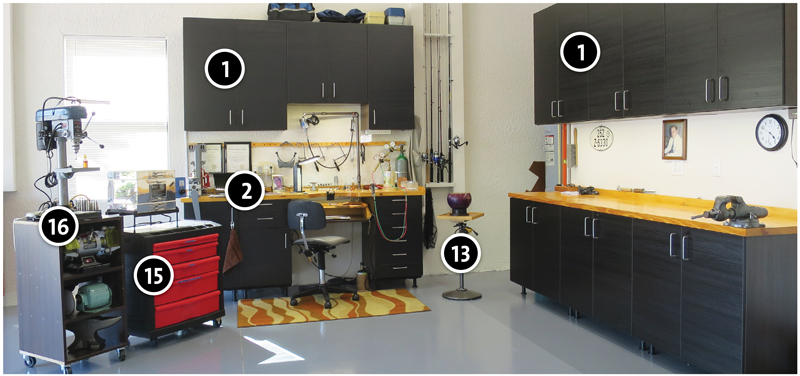
1. I chose IKEA’s kitchen cabinet line for my infrastructure. The line’s waterproof plastic legs, availability, and price point played into my decision. (Old habits die hard: My wife refers to my shop as the “operating room” because of its cleanliness. The cabinet legs give me easy access to the floor for cleaning or to retrieve any small parts I may have dropped.) I selected the dark finish since it would best conceal dirty finger marks. The work surfaces on top of the lower cabinets are made from three construction grade 2×10 boards. I ripped the edges so they are square, then screwed and glued them together to achieve the 25 inch depth. I finished the benchtop with a maple stain and two thin coats of polyurethane.
2. My 7 foot long benchtop holds a Durston Combo Mini Mill, a 20-ton press, a Foredom flex-shaft, a Smith Little Torch, a propane/air torch, an assortment of burs and polishing wheels, and a few odds and ends that I frequently use. There is ample room for a laptop and books when needed. I generally keep my workspace uncluttered and set it up as needed for different tasks.
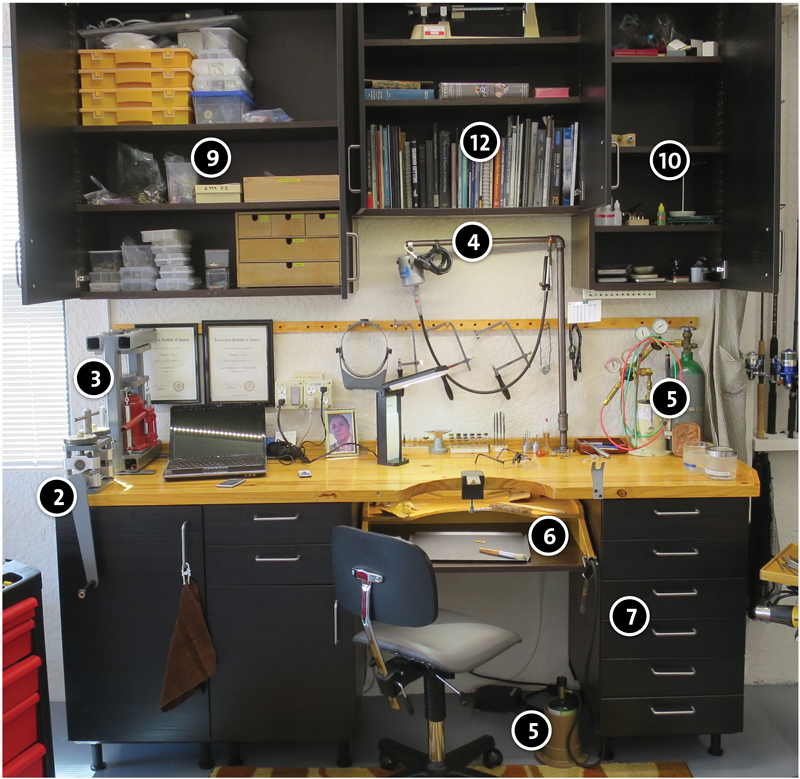
3. I enjoy building out my bench as much as I do making a piece of jewelry. I made my 20-ton press from lengths of 2 inch square steel tubing, some springs, and a bottle jack that I found in an auto store.
4. My flex-shaft motor hangs from thread-ed-steel plumbing pipes that can swivel out into a comfortable position.
5. I use PVC pipe to hold my propane tanks. This keeps them upright and prevents them from getting easily knocked over.
6. I mounted a sweeps tray on standard drawer runners so that I can pull it out when needed. I collect any filings on a Teflon cookie sheet.
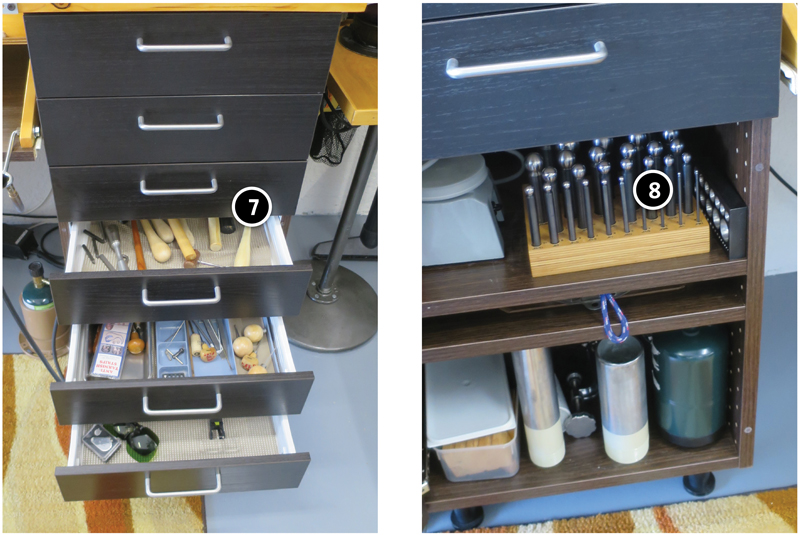
7. The bench has eight drawers. They hold files, pliers, gravers, layout and measuring tools, magnifiers and loops, draw plates, drafting supplies, and hammers. I lined the drawers with a rubber liner to prevent my tools from sliding around on the metal drawer surface.
8. In the lower cabinets, I keep dapping tools, sandpaper, chemical supplies, and a hanging file for journal/technical articles, industry resources, and sketching paper.
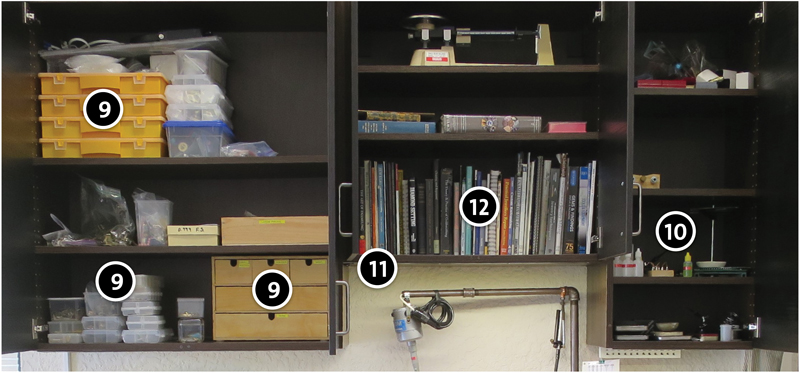
9. I use the upper cabinets to store a range of supplies. The left upper cabinet contains raw materials, findings, solders, and scavenged pieces of unwanted jewelry waiting to be repurposed. Most of the small items are kept in various sized flat, transparent fishing tackle boxes; they easily stack, and I don’t have to open each one to see what’s inside. For really small items such as solder chips, I use old plastic 35 mm film canisters that I color coded to indicate their content. A small wooden chest of drawers organizes my modest silver sheet and wire inventory.
10. The right upper cabinet holds soldering supplies as well as a few presentation boxes.
11. Under-cabinet LED strips illuminate my bench surface. A tiny remote allows me to vary the intensity when soldering.
12. The upper cabinet is the soul of my bench. My modest library is the repository of other craftsmen’s wisdom, thus making it an asset that exceeds the value of all my precious metals.
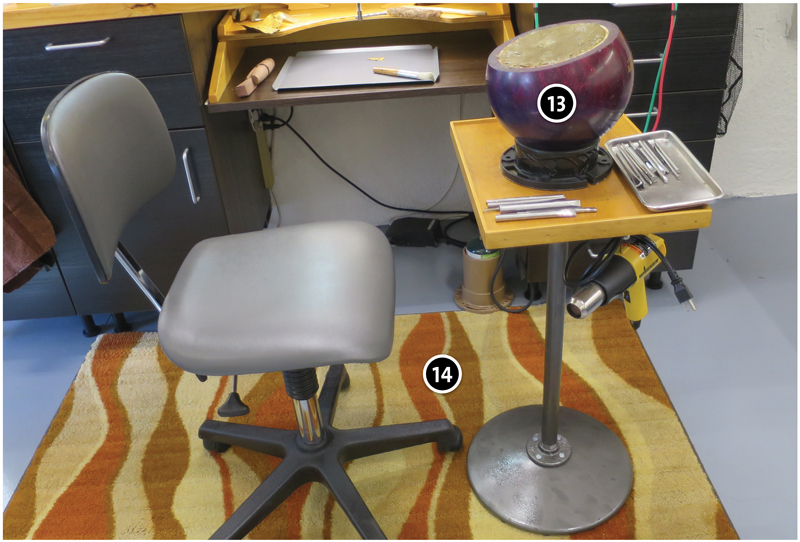
13. Situated around the bench are several peripheral units that complement my bench. Among them is a chasing table I built from an old heavy duty industrial lamp base. The pitch bowl is an old bowling ball that I cut and partially hollowed with a router. It swivels in a 4 inch PVC toilet flange.
14. I have a small rug that fits partially under the workbench that helps to establish a boundary for my “sacred space.” It’s been a mixed blessing: Sometimes it keeps a dropped item from bouncing or rolling too far away, and other times it swallows up things, such as solder chips.
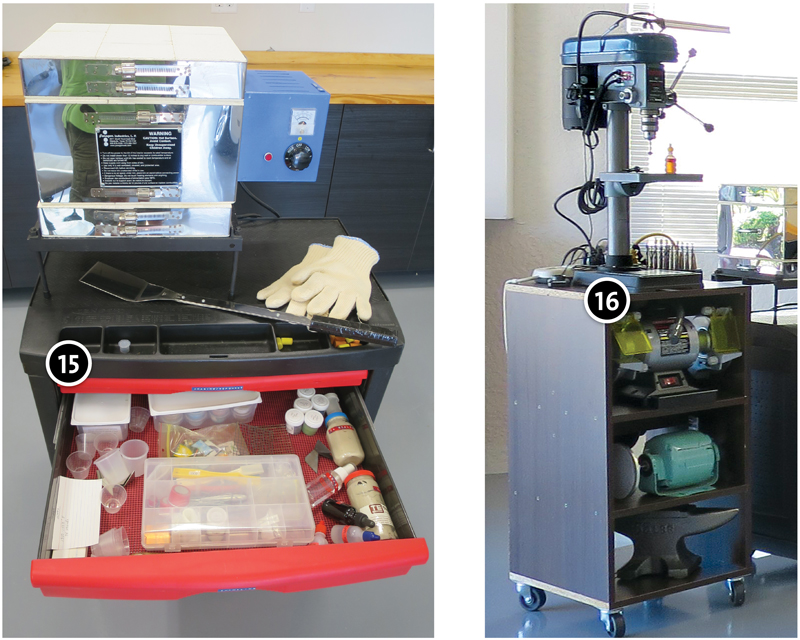
15. Another unit I keep nearby is a Rubbermaid cart with five drawers that hold chasing and repoussé tools, enameling supplies, polishing supplies, aprons, and other miscellaneous supplies. I have a small kiln that I can place on the cart when enameling.
16. A homemade cart holds a drill press, grinder, and sanding/polishing lathe. At the bottom there is a 55 lb. anvil-shaped piece of cast metal that is more than adequate for my needs. A real blacksmith would laugh at it, but for soft metals, it was the right price.
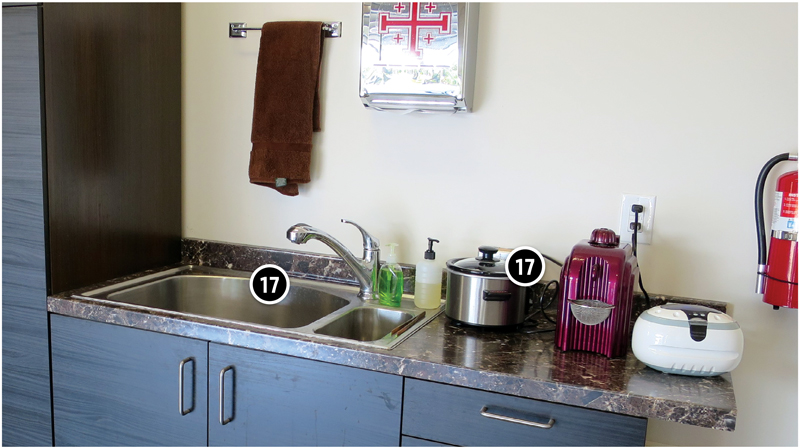
17. A large stainless-steel kitchen sink and pickle station are located a few steps from my bench. I find it more convenient to keep the pickle pot near running water. I also have a small steamer and ultrasonic cleaner near the sink.