

Stitched Up
Suzanne Schwartz’s Squares All Around Necklace
By Tina Snyder
Growing up, Suzanne Schwartz’s grandmother LeeLee taught her how to knit and sew at a young age. “There was something about learning how to stitch and work with textiles that introduced me to this freedom art could bring me,” she says. “It opened up my world.”
Today, the New York–based designer employs the handcraft passed down by her grandmother in her jewelry work. “I try to capture the flow and drape of textiles in metal,” she says.
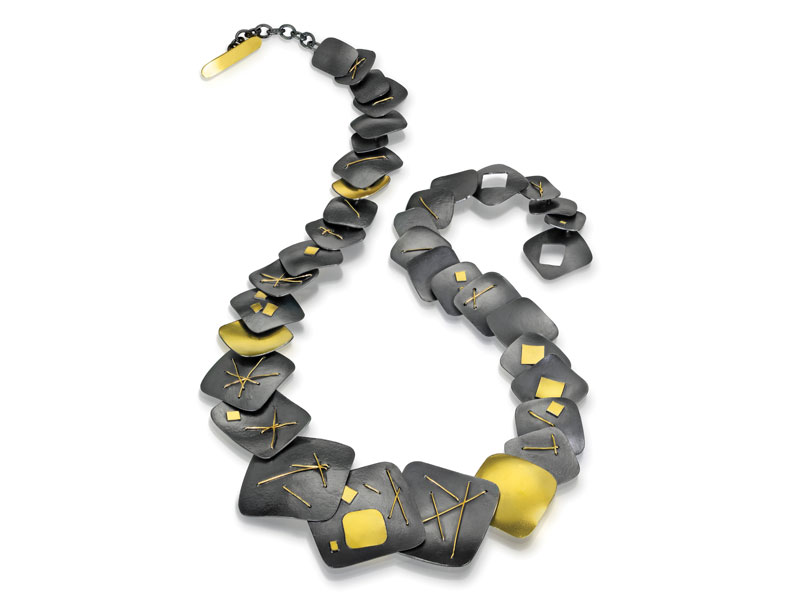
In her Squares All Around Necklace, Schwartz decoratively stitches Argentium silver squares using 26-gauge 22k gold wire, creating a layered look with elements that overlap much like fabric would drape around the neck.
The design began with a sketch in which Schwartz planned out not only the pattern of squares, but also the 22k gold stitching on them as well as the 22k gold bimetal accents in the shape of smaller squares that embellish some of the components. “It looks like the stitches are haphazard, but really, it’s all planned out,” she says.
Once the design was composed on paper, Schwartz created a prototype in copper. The design often evolves and im-proves from the copper model: Sometimes elements are added or removed to balance the necklace out and even the flow.
The final piece began with Schwartz cutting the silver components from Argentium sheet, as well as the smaller 22k gold bimetal components. She then used an antique Dumore drill to bore the tiny holes in each component for the 22k gold wire stitching, as well as for the silver “stem”: Each square has a little wire fused to the corner that will be inserted into a corresponding hole in the square beside it to link the necklace together.
With the holes drilled, Schwartz domed the squares into concave and convex shapes that will fit nicely together and drape naturally around the neck. She likewise domed the tiny accent squares of 22k gold bimetal to match the shape of the component and soldered them in place.
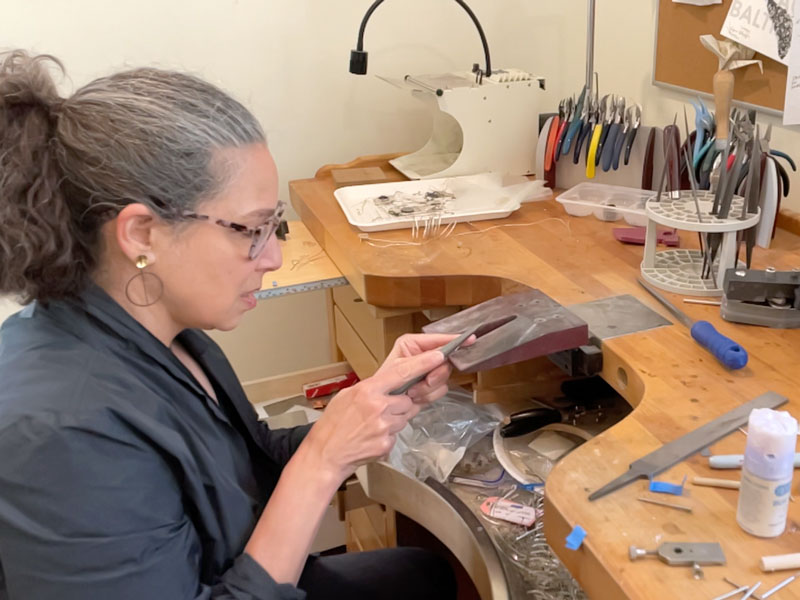
To stitch the components, she balled up one end of the 22k wire and inserted it through the back of one hole, then wove it through the other holes in the desired pattern using pliers.
“The trick is getting enough tension and stretching the wire without it becoming too brittle and breaking off,” she says. When the stitch is complete, she crimps it up and hits it quickly with a torch to finish. Schwartz applied the same care to the back of each component, ensuring the necklace is just as beautiful from the back as it is from the front.
A toggle clasp was inserted through holes in two squares at the back of the necklace, enabling the wearer to have both a 17-inch and 19-inch look.
Not until all the components were completed did Schwartz connect them with the stems and bend them over to test the piece. “I look at every single way it comes together and will go back and continue fixing it until it looks great to me,” she says. Once happy with how it flowed and fell on the neck, she cut the connectors short and balled them up to complete the necklace, and then oxidized it with Gosiba to achieve the dark patina on the metal.
“To me it’s really important that every piece of jewelry I make has an elegance and a flow to it and that it’s a clear reflection of my perspective,” she says. “If not, it won’t make it out to the selling floor at all. Sometimes I have things sit for a year or two trying to figure out how to get them exactly [the way] I want them to be.”
Achieving that imperfect perfection is a labor of love and patience—and one of which Schwartz knows her grandmother would approve.