

Telling a Different Story: Part 2
Profiles of two of the industry’s leaders in responsible sourcing
Click here to read part one: Eric Braunwart’s Responsible Story

Rising to the Challenge
Toby Pomeroy on his mission to banish mercury from mining
Jewelry designer Toby Pomeroy was born and raised to do good. The son of missionaries, Pomeroy grew up among the “poor but playful and generous” Garwali people in the foothills of the Himalayan mountains in northern India.
“I’ve always known I wanted to do something that makes a difference—to the planet, to people,” he says.
He’s carried this desire into his career as a jewelry designer. In 2004, he discovered Earthworks’ No Dirty Gold Campaign, which is working to ensure that gold mining operations respect human rights and the environment. He learned about the campaign and the dirty side of gold mining, including the air, ground, and water pollution caused by the toxic chemicals used to separate gold from ore, as well as the dangers it posed to the health of workers and communities. Pomeroy knew he had to try to make a difference.
“It was such a rude awakening,” he recalls. “I knew I had to do something.”
He started by contacting his metal supplier, Hoover & Strong Inc. in North Chesterfield, Virginia, to request that it create a program to provide refined and alloyed gold that had been acquired entirely from reclaimed or recycled metal. His repeated requests were eventually fulfilled when, in 2007, Hoover & Strong launched its Harmony line of precious metals that are all 100 percent certified recycled by SCS Global Services.
“Others may have asked them about supplying reclaimed gold, but it just happened that [my company] was the first to receive H&S reclaimed gold,” he says.
Over time, though, he began to feel that he could still do more. “While using recycled metal felt good, it wasn’t enough,” he says. “I wanted to see mining itself get cleaned up. I also wanted to let the mining industry know that, as an industry, we were paying attention and that it mattered to us and our customers.”
He started looking into how precious metals were being mined and learned that small-scale and artisanal miners were still using mercury to extract gold from ore—and suffering health problems from the resulting toxic fumes. That inspired him to create the Mercury Free Mining Challenge in 2017, with the aim to entice scientists and entrepreneurs to find an alternative to mercury that’s safer to use and also more effective, offering greater prosperity for miners.
Mercury has been used by miners for centuries, but as the dangers involved with using mercury have become known, larger gold mining operations have invested in safer ways of extracting gold from ore. But that hasn’t been the case for many small-scale and artisanal miners, who often lack the resources needed to invest in better methods.
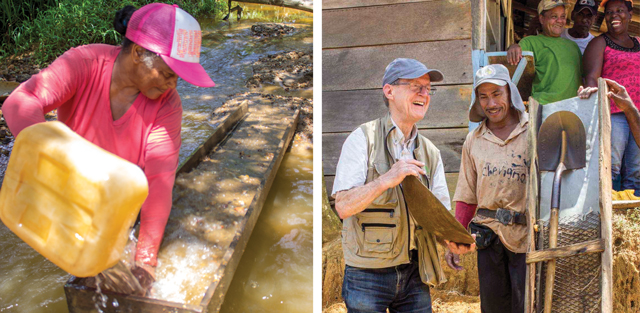
“When they dig up the earth, they run the gravel through a sluice,” Pomeroy says. That sluice, he says, contains riffles to capture the sediment’s heavier particles (including the gold). Mercury is added to the sediment, and the miners “start mixing it by hand, kneading and working it [into a ball], creating a putty-like amalgam.” They then heat these balls to evaporate the mercury, leaving only pure gold.
When evaporated, the mercury will turn into a toxic vapor that, according to the World Health Organization, can harm the nervous, digestive, and immune systems, as well as the lung and kidneys. “[The miners are] currently releasing approximately 8,000 pounds of mercury a day into the environment,” he says. “Mercury is highly toxic, but miners don’t have an alternative. It’s readily available, affordable, and reasonably effective at capturing fine gold particles. There are safer methods, but often they’re more expensive, slower to deliver the gold, or technically challenging to use. If the alternative process won’t make them more money faster than by using mercury, they’ll keep using the toxin.”
For example, larger, more organized miners use cyanide to extract gold, which is far safer than mercury. But that requires tanks, pumps, electricity, and some scientific knowledge. “Small-scale miners are fundamentally poor; they can’t afford the mechanization that would allow them to be more efficient and safer,” Pomeroy says. “They accept that mercury is poisonous, but they have to eat.” Even in countries that have banned the use of mercury, the miners will simply take the amalgam balls into the privacy of their own homes and heat them there, which not only limits the ventilation, but also puts their families at risk.
Since the jewelry industry buys 53 percent of the world’s gold, Pomeroy feels that it’s incumbent on the industry to play a major role in eliminating the use of mercury in gold mining.
“Our industry has been founded on a commitment of love, appreciation, and celebration,” he says. “Jewelry is thought of as something meant to celebrate, but we haven’t been able to extend that to our artisanal miners. There’s a power in that story that could benefit our industry. It could elevate us in our customers’ eyes. This is a chance for our industry to stand up for finding a solution to this tragic mercury issue.”
After forming Mercury Free Mining (MFM) as a 501(c)3 nonprofit, Pomeroy (who serves as executive director) announced the challenge during the 2017 Jewelry Industry Summit in Tucson. The organization’s goal is to raise $1 million in prize money that will be awarded to the individual or group that creates a breakthrough solution that will replace the use of mercury in gold mining. This new process must be environmentally safe, cost no more than mercury, be readily available, have the ability to be transported to remote locations, and be equally or more effective in capturing gold than the current mercury-gold process.
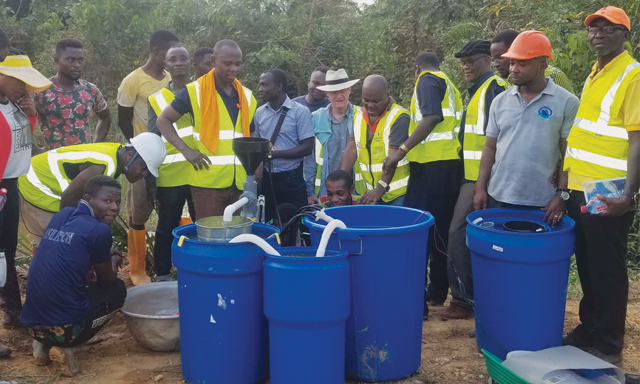
In January 2020, Pomeroy joined the GNASSM team at several mines in Ghana to test the Goldrop system. Initial test results are promising, with one leader noting that the system captured about 95 percent of the alluvial gold being processed.
Technically, the challenge has not yet officially been launched to the public—MFM is still working to raise the prize money. Even so, it has already begun initial tests on one potential system that was brought to its attention. Developed by John Richmond of Sluice Goose Industries in Albany, Oregon, the Goldrop is a gravity-based elutriation system. Through an assemblage of hoses and valves—all inexpensive items—it uses recirculating water to carry the lighter minerals in the ore into a tailings bucket, while the heavier minerals, such as gold, fall into a collection jar at the base of the system.
Packaged as an all-in-one kit, it uses two drums, which weigh no more than 50 pounds, and a motor that runs off solar power and a battery. It can recirculate 200 gallons of water. “It’s a simple, compact, lightweight system,” says Pomeroy. “It has the potential to be highly efficient.” (It’s also available without the drums, which can be obtained locally.)
The system is so promising that earlier this year the Ghana National Artisanal and Small Scale Miners Association (GNASSM) coordinated with MFM and the University of Mines and Technology in Tarkwa, Ghana,to arrange to test the system at three mining communities in Ghana’s Ashanti region.
Pomeroy traveled to Ghana to witness the tests. In a blog post he made while on-site during the testing, he reported that “ these miners pick up the Goldrop almost immediately; we’re learning a lot about the tool’s capabilities as well as possible improvements upon return.”
He says that the results from the tests are encouraging. At one testing location, one of the GNASSM leaders commented that it appeared that the Goldrop captured about 95 percent of the alluvial gold the miners were processing. (Pomeroy notes that on a good day, miners can capture about 50 percent of the gold with mercury.) However, they also discovered some adjustments that need to be made. For example, the system originally had valves that could not be adjusted to control water flow effectively. Based on the test results, Richmond has already introduced a new valve that has the precision needed. He’s also doing testing using finer materials, which Pomeroy views as critical. “If this machine can efficiently capture 400 mesh gold (which is very fine, like the consistency of flour), it will be a breakthrough for the world.”
Pomeroy notes that the testing team also requested modifications of the machine so that it can accommodate larger quantities of material, as some of the mining operations process a large volume. The system can currently process about two tons of concentrate material a day.
“For some of the productions, it would take quite a few of the systems to process the amount of material they process every day using mercury,” he says.
One thing that Pomeroy doesn’t think will be an obstacle is the cost of the machine. Presently, it’s priced at $1,995. “The people in Ghana felt it was reasonable,” he says. “It appears to be very affordable compared to anything else out there, especially if it proves to be efficient at capturing more gold faster than with mercury.”
According to Pomeroy, the next step will be to bring ore samples from a variety of mines in Ghana to Richmond’s factory in Oregon. There, the Sluice Goose team, miners from Ghana, and at least one third-party engineer will test the Goldrop’s effectiveness on various hard rock and alluvial ore matrix concentrates commonly seen at the country’s small mining sites. He’s not sure if or when those tests will be conducted, as the groups are working on raising funding to cover the costs of bringing in representatives from Ghana as well as the independent engineer to oversee the test. “It’s costly,” says Pomeroy, who estimates that the testing could run between $30,000 and $40,000.
And the Goldrop isn’t the only possible solution for eliminating mercury from gold mining operations. Although it’s too soon to share many details, Pomeroy says that he’s been in talks with a number of other inventors about systems that are in the works.
“I’m hearing from people who have what they consider to be a great process but don’t have a patent on it yet, so they can’t talk about it,” he says. Eventually, if everything with these systems comes together, Pomeroy plans to test them simultaneously with the Goldrop to comparatively determine which is the best to use.
Although such testing is still up in the air at this point, Pomeroy is optimistic and excited about having other possible devices to offer miners. “It’s exciting to imagine that we might be on the brink of discovering something that can explode throughout the world in terms of demand.”
While the world waits for a solution to the use of mercury in gold mining, Pomeroy encourages jewelers to use the best possible gold that they can. “Fairmined, Fair Trade, and Just Gold are great ways to go. They’re traceable and responsibly sourced,” he says. For jewelers unsure about the origins of the gold in their shop, they should ask their suppliers, “Where did this come from? Was it responsibly sourced?”
“Don’t settle for an easy answer,” he says. “Keep digging, asking questions that will let them know you’re committed to having a transparent gold supply chain. Our customers and the public demand it.”