

Stop and Think: Process Mapping
Stop and Think
Process mapping can improve every aspect of your business
By Andrea Hill
Your business is a collection of processes. Selling, marketing, making things, accounting, purchasing, hiring, training…all these things are accomplished by executing a series of processes. The better you do those processes, the better your results will be.
An entire philosophy, called process thinking, has evolved to help individuals, organizations, and communities achieve better results by focusing on processes. Sports teams use process thinking to achieve peak performance. Psychologists use process thinking to create healthier mental habits. You can use process thinking to update and strengthen your business.

- When things go wrong in business, it’s almost always due to bad process:
- A process is broken.
- Conditions have changed and the process has become outdated.
- A process step is missing or has been skipped.
- Someone doesn’t understand the process, or isn’t following the process.
- Someone changed the process, but didn’t test it or communicate about the change with others.
Let’s look at a few examples to illustrate this point.
The Missing Step Example
A large production company that releases new products several times a year has repeated problems with new product quality. Their regular production quality is excellent, but their reputation for releasing slap-dash products is hurting their brand. Customers report that they do not try a new product from this company until it has been on the market for at least a year.
The product development team is convinced that the problem is that they do product development too fast. But upon reviewing their timelines, new product development consistently takes three to six months longer than planned. Once development speed has been eliminated as a cause, the team is at a loss. Why can’t they produce quality new products?
Using a process map, the team discovers that a critical step is missing from their product development project plans. They have no defined steps for internal or customer testing. Skipping the testing phases means that they get all their test feedback after they release each product. In fact, their product releases are simply live tests. Once the team added testing steps to their product development process, the product launch problems stopped.
The Broke-the-Process-With-a-Metric Example
A service company that requires phone contact with its customers discovers that customer loyalty has dropped dramatically in the past two years. They ask a consultant to coach the service teams on product knowledge, communication skills, and problem solving. But the consultant notices that customer satisfaction scores regarding agent effectiveness and knowledge is very high. However, when customers were asked a different question, “Do you think our agents care about you?,” the customer satisfaction scores drop dramatically.
That interesting insight led to a bit of digging, and the consultant discovered that two years ago, the company started measuring the service team on how many calls they handled per day. With the pressure to answer more calls, the service team felt pressure to rush each customer so they could move on to the next. The process was broken due to imbalanced focus on one metric.
The Missing Process Example
A manufacturing company started experiencing constant quality complaints after years of high customer satisfaction for quality. They scheduled their operators for more training, increased the number of supervisors monitoring the work, and started doing quality checks on 100 percent of items (all very expensive remedies). But the quality problems did not improve. So they asked a consultant to analyze the problem and propose different solutions.
Upon mapping their processes, the consultant found the cause of the decline in a different department—purchasing. The purchasing department manager, concerned about upcoming budget cuts, challenged the purchasing team to reduce the cost of raw materials by 25 percent across the board. Because there was no process in place to guarantee that production and product development were consulted before making any change in raw materials, the purchasing team reduced product quality inadvertently when they shopped for lower-cost raw materials.
Once in a great while, something goes wrong due to bad luck or a careless person. But the vast majority of the time, business problems are due to process problems. So how do you eliminate process problems? By fortifying your processes. And you fortify a process by analyzing it, which is best done with a process map.
What Is a Process Map?
Process maps are often used to quickly express ideas—one of their most exciting qualities. They also can be used to solve problems, make decisions, provide training and post-training support, and to find process problems. More specifically, you can use process mapping to:
- Find and fix hidden problems and inefficiencies
- Make your supply chain more transparent and resilient
- Alter your strategy
- Identify new product and service offerings
- Automate anything
- Improve your marketing and sales approach
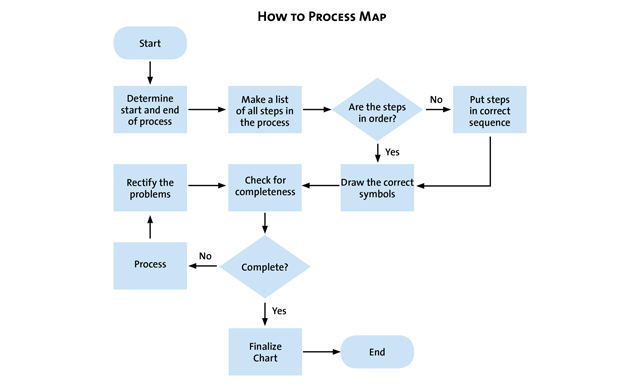
The creation of a process map is quite simple. It involves these steps:
- Determine the start and end of a process. For example, does the purchasing department authority include selecting products and alternatives autonomously, or does their responsibility start after the product is selected?
- Make a list of all the steps in the process.
- Put the steps in order.
- Check the list for completeness.
- Draw boxes and arrows to indicate the relationships between the steps.
That’s only a five-step list, and if you watch someone do it one time, you’ll understand completely. And Figure 1 shows how much easier it is to understand that instruction when it is presented as a process map.
Process maps are powerful because they are visual. Most people have less mental resistance to visuals than they have to reading sentences and paragraphs. People tend to retain graphical information more readily than written information. And presenting the relationships between steps is much clearer when illustrated with boxes and arrows.
Getting Started
The creation of a process map is deceptively simple. You start by creating an initial diagram. It’s best to do this fast, without too much editing—it’s just to provide a general overview of the process. After you have done the first pass, it’s time to go back and analyze each step. One excellent way to do this is to hand the process document to another person, and ask them to do the process exactly as it is written on the page. They cannot do anything that is not written, and they cannot skip anything that is written. As they attempt to follow your instruction, make note of every comment, question, and criticism. Redraw the process map with the insight of all the things that were left out, unclear, or incorrect on your first pass.
Have you ever trained someone to do a process, observed that they were doing it correctly, and left them to manage that process, only to discover a few weeks or months later that something is not working? One way to figure out what is going wrong is to ask that person to map the process for you. Have them draw each step that they do, exactly as they do it. When you examine the map together, you are likely to discover that a step is either being skipped or done incorrectly. It’s tempting to think that people are just being sloppy, but most business problems are process problems—not people problems!
Mind Mapping
Some people prefer to start complex process maps with a different sort of map: a mind map. A mind map is a type of diagram that is more organic looking than a process map. It is used to represent how things are linked together in a non-linear way. You may want to start your process map with a mind map when you are creating a new process in your business.
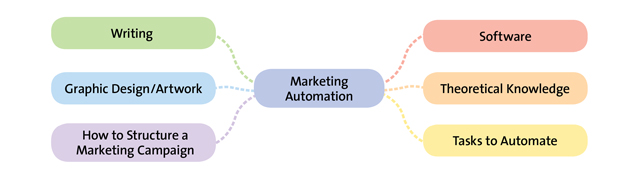
To build a mind map, you start with a central concept. For this example, let’s say that your central concept is marketing automation. Next, you think about the different aspects of marketing automation you must master. Perhaps you come up with a list like this:
- Software
- Theoretical knowledge
- Practical knowledge about how to structure a marketing campaign
- Determine which tasks to automate
- Write content
- Create graphics or artwork
At this point, your mind map looks like the figure below:
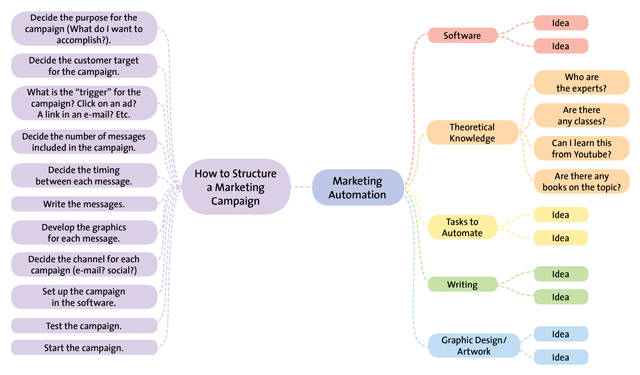
The next step is to take each of the secondary concepts, and brainstorm them in turn. For instance, for theoretical knowledge you might list:
- Who are the experts?
- Are there any classes?
- Are there any Youtube videos?
- Are there books on the topic?
At this point, your mind map is more about learning how to do a process than doing the process. But by the time you complete all your mind-map branches, you will be ready to brainstorm the steps to actually produce an automated marketing campaign. The chart below shows that the elements in the “How to Structure a Marketing Campaign” branch are very close to being a defined process.
Once you get to this point, you’re ready to turn your mind map into an actual process.
You don’t have to start with a mind map, but many people find it easier to start brainstorming this way, and then get to the more logical, boxes-and-arrows structure of the process map once they have created a mind map.
Fill in the Details
Your initial map will almost always require additional information. You will find it useful to have the following six questions on a note card, which you can retrieve and review every time you get to this part of your process-map creation.
- What is the goal of this process? What must we achieve by doing it?
- What triggers the start of the process?
- What are the activities in each step, and who is involved in each activity?
- Who are the people that are affected by the process?
- Are there any alternate routes in the process?
- What signals the end of the process?
Asking these questions will help you create processes that deliver value.
Be extremely specific when creating process maps. One common mistake is that people use one word with many different meanings. For example, what does it mean to “send” something? Does it mean to carry it to the next room? E-mail it? Snail mail? Use a shipper? Which shipper? Repeatedly put your process map in front of other people and ask them what they think the steps mean, and what they would do if they were required to follow the process map as written.
Eventually, you will have a map that is completely clear and correctly ordered. Now, you take another pass with another set of questions.
- Are there any steps missing that, if added, would improve quality or ultimate customer satisfaction?
- Are there any steps that are redundant and could be eliminated without losing value?
- Are there steps that we are doing manually that could be automated?
- Where in the process do we currently make mistakes? Put a big “X” on that spot and then ask why. If this is a new process you are creating, ask “Where in this process do I think it is likely that we will make mistakes and why?”
Asking these questions will help you dig deeper and think harder, activities we tend to avoid but which bring tremendous value when we invest in them.
Once you complete a process map, it should be given a version number, a date, published, and distributed to everyone who does the process. Why? Because processes are not static! They must evolve over time, as your business evolves. Updating processes is one of the most effective ways to continuously improve your business.
When it comes time to update or change a process, there are two simple rules to guarantee you make the right changes and anticipate all the potential implications of change:
Rule 1: When changing a process, always start with the current process map.
Rule 2: Never change a process without completing the entire process mapping process as defined here.
Reap the Benefits
Now that you know how to process map, let’s review the reasons and benefits for doing all this work. Process mapping:
- Makes it possible to look at the big picture.
- Makes it easy to imagine multiple scenarios when making plans and implementing new activities.
- Helps you see how processes can be changed and improved.
- Gives you a visual aid to help spot problems.
- Gives you a visual aid that keeps everyone doing the same work in the same way.
- Reduces errors.
- Helps you prevent costly changes and corrections.
- Helps you visualize and forecast future outcomes.
- Helps you make better decisions with greater confidence.
Another big benefit of process mapping is that it makes thinking more fun. Because thinking is hard work, people tend to avoid it. By providing a structure and making concepts tangible and visible, the hard work of thinking becomes more accessible, and therefore, more fun.
One of the hallmarks of teenagers is that they tend to do things without thinking about them, often with undesirable consequences. We all assume we’ve grown out of that phase, but when we change processes without thinking about them first or when we make decisions without modeling the possible outcomes, we’re doing work without thinking about it. Process mapping ensures that you stop and think about it, and that everyone you work with learns to do that too.
Create a process map for just one business process. See if you can make an improvement, find hidden value, or simply develop a training document that helps your team be more consistent. Once you have created your first process map, create one new map every week. Eventually, you will train yourself to think in a different way about business processes. You’ll instinctively begin to look for the cause of errors before they occur. You’ll find yourself looking for hidden business value in places you never looked before.