

Social Media How-To

Platforms and tactics for custom jewelers
By Irina Missiuro
If you’re not on social media, you’re missing out on great opportunities to familiarize potential clients with your business, share a successful heirloom redesign with your fans, learn patrons’ opinions and preferences, and bring new customers to your store. To find out what networks make the most sense for your brand and how to use them to your advantage, check out these custom jewelers’ social media strategies.

Identify Your Audience First, Platform Second
Gigi Gruber, owner of Atelier Gigi Inc. in San Francisco, advises, “Know your audience! If you don’t know who you are trying to reach, you’ll be wasting much of your effort.” Think about your aesthetic and your typical client. What kind of person appreciates your jewelry the most? What types of customers do you usually design for?
Then you can move on to figuring out which social media sites would best suit that dominant demographic. (See “Social Media Demographics” on page 49 for suggestions on reaching specific groups.) Once you decide on the appropriate platforms, link to them from your e-mail signature, your website, and your e-mail blasts.
Be Consistent
When it comes to marketing yourself on social media, consistency is key, regardless of the platforms you use. Here are four areas to focus on:
• Content
Ensure that followers can easily distinguish your posts by adhering to a unique style. For example, stick to a white background, but include a touch of your signature color in the photo. The visual cue will become your trademark, allowing your images to stand out.
You can incorporate some innovative video options to mirror your photographs and reinforce your brand image. Facebook’s 360 Video is a great way to record 360 degrees at once. Are you proud of a certain diamond ring and want to show it off? By turning their devices or dragging their fingers, viewers will be able to watch it shine from multiple angles.
Also, Facebook Live permits a way to connect through streaming—sharing with your audience what’s happening with your brand at that specific moment. How much more authentic can you get? So, if you’re exhibiting at a show, holding a store opening, or executing a custom order, your followers can experience it all along with you.
• Voice
Stick to being yourself. Michelle Pajak-Reynolds of Michelle Pajak-Reynolds Studios in Stow, Ohio, recommends you routinely use your own voice. “People can sniff out BS,” she says. Gary Dawson of Gary Dawson Designs in Eugene, Oregon, is always representative of his views in his posts. He feels that “you don’t necessarily need to appeal to everybody,” and sees the commitment to a platform as an upfront investment, which will eventually pay off. His followers appreciate his reliably authentic style, “My Twitter account is finally gaining momentum after a year.”
• Timing
Research has shown that regular engagement on social media is most effective. Test some variables and figure out which days and times make the most sense for you to post. Then, adhere to a schedule so that your followers start to anticipate your posts.
There are also a number of tools available to help you figure out the best time to reach your online audience. To determine the best time to tweet, you can use a tool such as Tweriod. It analyzes your tweets and your followers’ tweets to inform you when you’re most likely to reach your audience. If you’re looking for the prime time to post on Facebook, consult Page Insights, a tool found in the dropdown menu of your business page. It will enable you to know not only when your fans are online, but also when the least overall posting is occurring while the majority of your audience is on Facebook. To figure out the most favorable Instagram posting time, a tool such as Iconosquare comes in handy. It provides important information, including weekly impressions, reach, profile views, clicks to site, top posts, and followers. To determine the most advantageous time to post on Pinterest, use a third-party tool such as Tailwind, which will inform you when your audience is most engaged.
If you don’t have time to test, here are some research-based recommendations from CoSchedule: Facebook, one post per day, 1-4 p.m.; Instagram, one to two posts per day, 8-9 a.m., 2 a.m.; Pinterest, 11 pins per day, spread out; Twitter, 15 tweets per day, spread out.
Jenifer Bellefleur, vice president of Uniquely Yours Custom Designed Jewelry Inc. in Minneapolis, suggests that busy designers post at opportune times from their cell phones. An Instagram user, she says, “I can have the photos on my iPhone and post when I’m not at the studio, making the process easy to fit in.”
Pajak-Reynolds says she posts once a day, always from 10 to 11 p.m. eastern time. Her metrics revealed that her Instagram followers leave the most comments and hearts then. The window also works well for her European followers, who are just getting up in the morning and tend to catch up on social media then.
Dawson prefers to share content either in the morning or in mid-afternoon. He feels that those are the best times to reach people, and that Tuesday and Wednesday are the days to post: “Everybody’s hungover on Monday, and by Thursday, they’re thinking about the weekend.”
• Engagement
Keep in mind that posting is not the only variable that matters. It’s just as important to respond to comments on a regular basis—thanking your fans for their compliments, addressing negative or rude interactions, and answering questions. Gruber says, “If someone takes their time to do more than like my post, I feel it’s important to acknowledge their feedback.” She believes in growing a relationship with your audience, “It is much better to have a few followers that really care about you and your product, than hordes of people who only follow you so that you will follow them back.”
Be Relevant
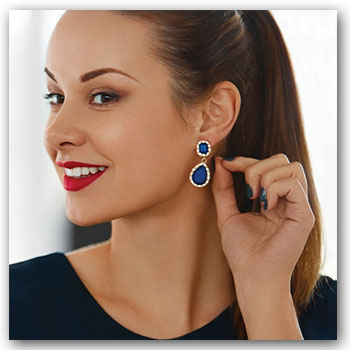
Help your customers interact with your brand by showing them how they might do so. Don’t just photograph the jewelry—snap a model representing a key member of your audience wearing it. Let the photo reveal something about the wearer’s lifestyle—illustrate how the earrings she helped design add to her enjoyment; how the ring redesign makes her feel; how the now-contemporary bracelet adds to her style—something the old-fashioned one couldn’t claim. Do you let your clients participate in the actual making of their piece, such as melting down their heirlooms or helping with the casting? If so, snap photos and post them so your fans can see the process and how involved they could be in it. Remember that saying about a picture being worth a thousand words? Allow your images to speak.
Then, give prospective clients a hint to the way they should perceive the photo by including a couple of hashtags in the comments. Mix up your brand name and the jewelry terms you’d use to identify the piece—that way, other potential clients will see your post.
Inspired by the success of hashtags, sites are including other helpful ways your posts can reach perspective followers. For instance, Twitter has recently added a New Message Button to make it easy for users to share tweets. Dawson sees Twitter’s format as an ideal one for the current culture. “People don’t pay much attention, so 140 characters work well,” he says. All you have to do is make your posts share-worthy. No pressure.
During the holidays, you can accomplish that with viral campaigns. Pajak-Reynolds has created them a couple of years in a row now. Last year, she prepared a successful one featuring a jewelry advent calendar, which she posted throughout December. This year, she worked on a Twelve Days of Christmas series. In addition to the jewelry, each photo contained some text in plain, black font that let the followers know the day of the series, the name of the piece, and her site. She decided to add the text because she learned that Instagram users often disregard the captions. Pajak-Reynolds feels that these campaigns are an effective tactic and shares them on four platforms, tweaking the wording slightly for each.
Sometimes, you can even increase your following by sharing jewelry-related news that is not relevant to your brand. For instance, Gruber says that, in addition to announcements and snaps of finished pieces and the process, she posts interesting stories, such as an article about a diamond that was grown out of peanut butter, and her encounter with Doris Payne, the international jewelry thief. Likewise, Pajak-Reynolds posts about an animal shelter from which she adopted her pets to let followers know that 10 percent of sales go to benefit it.
Pay to Play
In addition to organic posts that your followers see, social media sites offer the option to advertise posts to increase reach (unique people who may have seen your content) and impressions (number of times your posts are displayed). Dawson likes the targeted marketing that Facebook allows—specifically, the ability to pinpoint the gender, age, and location of users who will see the paid content.
Determine which ad styles work best for your audience. For example, Facebook lets you know which of your ads were served (delivered) and viewed (appeared on the screen). Once you have metrics, you’ll know whether photo collages (carousel ads) or images that include text are the way to go.
Keep at It
To assess how successful your campaign is, monitor the buzz surrounding it by setting up search streams for hashtags, landing pages, and blog posts related to the campaign, and keyword streams for campaign mentions that don’t use your hashtags or links. If you’re seeing minimal engagement, re-evaluate your strategy. Analytics tools, such as HootSuite, enable you to know which areas and demographics are lacking in interaction, so you could direct social advertising at them. Even if you go with the platform’s free plan, you’ll be able to track your follower growth and see which posts evoke the biggest reactions.
Feeling overwhelmed? Don’t be. Dawson recommends you be persistent instead. “If you’re not on social media already, just jump into it,” he says. “It will feel awkward in the beginning. You will spend a lot of time feeling out the market and developing your voice. Keep doing it.”