

Precious Damage
Christopher Taylor Timberlake’s wabi-sabi ring
By Tina Snyder

Christopher Taylor Timberlake
Christopher Taylor Timberlake – Austin, Texas
The Japanese call it wabi-sabi. It’s the idea of seeing beauty in imperfection—and it’s the concept that one of Christopher Taylor Timberlake’s clients wanted represented in his wedding band.
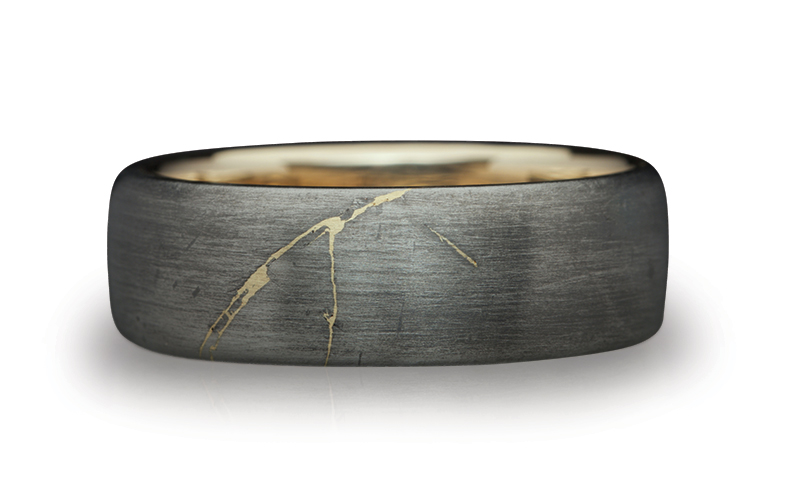
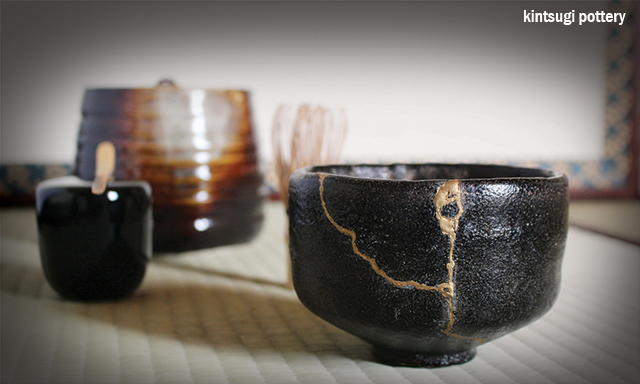
“My client wanted cracks in his wedding ring, referencing one source of inspiration as kintsugi,” recalls the Austin-based fine art jeweler. Kintsugi is the Japanese art of fixing broken pottery in which rather than hiding the cracks, they are embraced and emphasized as part of the design. “I began by researching the technique used for ceramics.”
Fortuitously, Timberlake’s assistant had a friend who is a Japanese-trained ceramicist. She taught him about kintsugi and the special lacquer made with a Japanese formula that glues the pottery back together. “On the top layer of the lacquer, gold dust is mixed in to fill the crack, so the metal stands out against the ceramic.”
Timberlake set out to mimic the technique in metal—a feat that would bring with it much trial and error. The first challenge was selecting a metal for the wedding band.
“One of the key realizations I made when first looking into this project was that others had made jewelry to mimic kintsugi, but the cracks their designs employed were contrived and unrealistic,” he says. “I sought metal that I could crack and then ‘repair’ with gold, as well as metal that I could blacken that would be suitable for jewelry and remain dark with wear.”
The process of finding the best metal for the job started with testing four different options: titanium, stainless steel, a palladium-silver alloy, and nickel bronze. Experiments with each metal involved mechanical distress using a hydraulic press, cold forging, and applying as much stress as possible to effect natural looking cracks.
“The titanium and stainless took a lot of tonnage but just squished,” reports Timberlake. “I’m sure it’s possible to get them to crack—and at one point I considered purchasing liquid nitrogen to do it—but it just seemed like too much work.”
The palladium silver, he says, cracked too straight, while the nickel bronze cracked nicely. However, the nickel content in the alloy made Timberlake hesitate to use it for a wedding band worn daily.
“Also, although the nickel bronze was the clear winner in terms of organic looking cracks from all the cold working and mechanical distress, its melting point is lower than the 18k gold I planned to use to fuse the cracks, which would result in pitting and bubbling,” he explains.
And then it dawned on him: Gibeon meteorite. “I make a lot of meteorite rings,” he says. “It’s not ideal when they crack—but in this case, it was actually perfect.”
Timberlake began by fabricating an 18k gold liner from 26-gauge sheet to the correct finger size. He then put a slice of the nickel-iron meteorite through a rolling mill without annealing to encourage cracking. Next, he carved a donut shape out of the meteorite that fit precisely over the liner, leaving almost no gap between the two where he will later solder them together. He then hammered it on a mandrel, again without annealing, which caused yet more jagged, natural-looking cracks to grow and break the ring apart in three pieces. “It’s pretty brittle, so if you don’t hot roll or hot forge, it’s prone to crack.”
The next technical challenge was fusing the 18k gold into the cracks. “Soldering gold to meteorite is tricky,” he says. An article on soldering stainless steel with black flux by James Binnion proved instrumental in the success of this ring.
“The black flux doesn’t burn off as fast as white paste flux, and it shields the metal for longer,” says Timberlake. “It prevents the iron from oxidizing up until the point where the gold flows.”
With the ring assembled and finished, Timberlake blackened the meteorite by heating it and dropping it into machine oil—a trick he learned from his blacksmith friends. A treatment with Renaissance wax sealed the color in, and the precious damage was complete.