

Hot Stuff
Robin Waynee’s Fire and Ice ring
By Tina Snyder

Robin Waynee
Santa Fe, New Mexico
Having last won a Saul Bell Design Award in 2012, Robin Waynee of Santa Fe, New Mexico, was inspired to once again throw her hat in the ring with Fire and Ice, a statement-making 18k palladium white gold, diamond, and sapphire ring showcasing a striking rutilated quartz cut by lapidary Falk Burger.
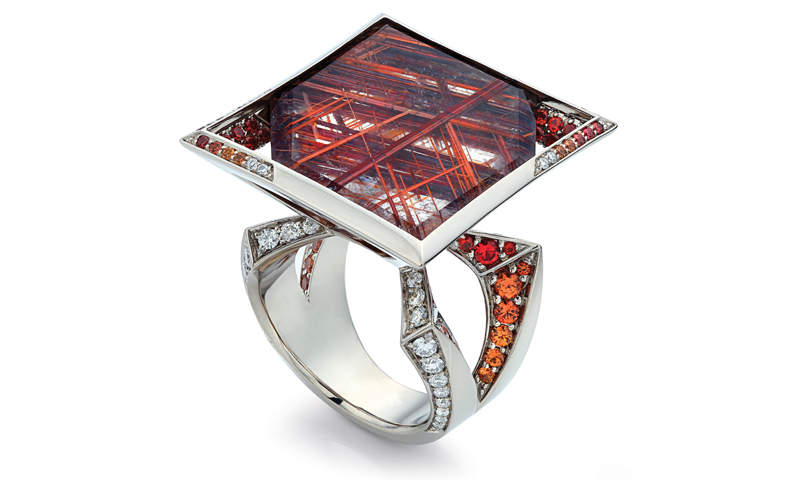
“Falk’s stone was the inspiration for this piece,” says Waynee. “It’s a very clear rutilated quartz with intense red striations. Once I completed the piece, I knew I had to enter it in the Saul Bell competition.”
And the judges were glad she did, awarding Fire and Ice first place in the Gold/Platinum Division this year.
Waynee says the design for the ring came to her rather effortlessly, informed by the six-sided shape of the center stone and the colors within. “I wanted to frame the stone in a square bezel setting, leaving open spaces in the two corners to enable light to flow through the stone and give ita floating effect,” she says. “I also designed the head of the ring with an open space beneath the stone to encourage light flow and reflection in the metal.”
With the help of her husband, jeweler Ryan Roberts, Waynee translated her vision for the design of the ring into CAD. “The precision of CAD allows you to really dial things in,” says Waynee. “We scanned the stone and were able to construct the setting in two sections: the base of the head, in which the stone is nestled, and the top plate that sandwiches the stone in place.”
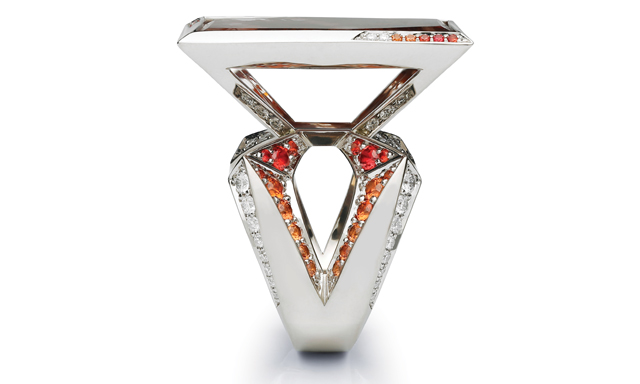
The band, designed with unique angles and open space to complement the setting, is the third component of the ring. With all three models made, it was time for casting in 18k palladium white gold, which proved to be the first challenge.
“Our Neutec casting machine is not a high-temp casting machine,” says Waynee. “We can’t cast platinum, for example. It’s maximum casting temperature is 2,200°F, which means that we’re very close to max in order to cast palladium white gold. We had a few failed palladium white gold castings prior to casting this ring, where the crucible stand melted, causing the crucible to slump unevenly, which made the metal leak into the flask chamber prior to casting.”
She mentioned the issue with the machine’s manufacturer. “They jumped on the problem as soon as we contacted them about it,” she says. “They went back to the drawing board and sent us two new experimental crucible stands that would withstand the heat. Both worked properly.”
With the three components cast successfully and cleaned up, Waynee began by pavé setting the diamonds and sapphires along the band and the inside corners of the head. Next, she soldered the head component to the band using regular white gold solder as opposed to palladium white gold solder.
“The lower melting temperature of the regular white gold solder was within the safe temperature range for the sapphires and diamonds,” she says. “I then laser-welded palladium white gold over the solder joint to make sure the color would match.”
The quartz was then set, with the laser used exclusively to attach the top frame component to the head, sandwiching the center stone in place. Finally, she pavé set the diamonds and sapphire along the top edge of the head.
The finished piece is a triumph of color and reflectivity, with bright red and orange sapphires reflecting in the cool white metal, creating depth and intrigue.