

Growth Strategy
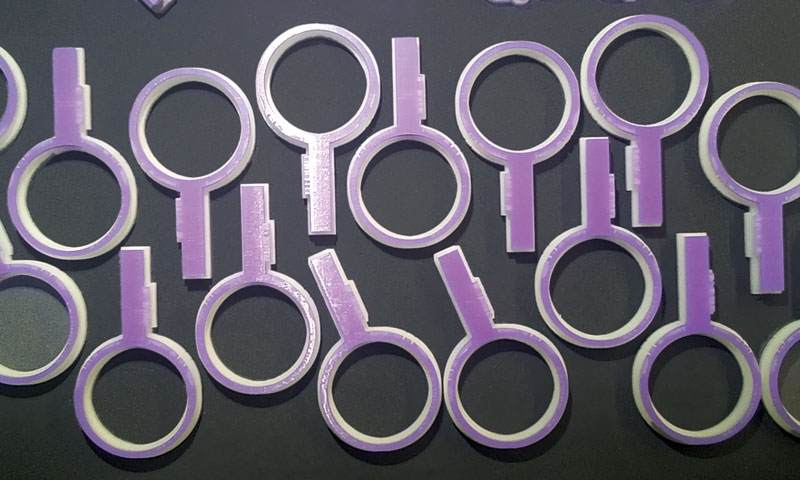
How one jewelry caster turned to 3-D printing to better compete
By Shawna Kulpa
For much of the history of volume jewelry casting, practitioners followed a pretty standard formula: create a master model, use it to develop a mold (often made of rubber), shoot wax into the mold to create a new model, repeat as needed to fill a casting tree. While you could certainly cast a wax model directly, it wasn’t a practical solution for pieces needed in quantity.
The process worked well enough, but it also meant that if a company wanted to make changes to a design or even offer a design in different sizes (such as you would with rings), a new model and rubber mold had to be created for each iteration. The integration of computer-aided design (CAD) and computer-aided manufacturing (CAM) into the jewelry industry changed that formula: Casters no longer needed to make a half-dozen molds of the same ring in different sizes. Instead, a CAD file could be created that would allow the operator to easily adjust the design in CAD and print a new model in the needed size.
But the system worked great only for one-offs and limited production runs. In cases where a company needed hundreds, if not thousands, of a design produced, the earliest printers being used in the industry simply couldn’t build the models fast enough or in large enough quantities to make it a practical solution.
As with everything in life, technology continued to change and develop. Soon enough, it caught up to the needs of jewelry casters engaged in mass production, and those casters began to switch. Carrera Casting in New York City is one such company. A subcontractor serving the jewelry industry since 1975, it began to move from rubber molds to printing models en masse two years ago—and hasn’t looked back since. Here is their story.
Breaking with Tradition
For much of its history, Carrera followed the same casting formula described earlier. It worked well, but as any caster will agree, the system wasn’t perfect. Anytime you make a copy of a copy (which is essentially what you’re doing when using a rubber mold), the quality is reduced and the resulting copies will never be as sharp as the original. There’s also the possibility of distortion, simply based on how the rubber mold is filled.
“When you make a rubber mold and inject a wax, you’ll always have distortions,” says Joel Weiss, one of the owners of Carrera Casting. “There’s the element of the weight differential—one operator uses more pressure [when injecting] than another.”
In 2003, the company became an early adopter of CAD/CAM and invested in a number of 3-D printers. They primarily used the new technology to create models that would then be used to create the rubber molds. The printers could also be used to create models for direct casting, but that wasn’t a practical solution for most of the company’s orders: the printers’ build platforms were simply too small, and the printing process took too long. In addition, due to the printing process and the way the models were built, they often had seams requiring cleanup (along with the distortion issues common to traditional casting), which added time and money to the process.
“It’s an expensive process,” explains Weiss. “You could design one piece and cast it directly.” It would cost a little more to print it, he says, but it was negligible. But, Weiss adds, “if you’re manufacturing multiples of a piece, you can’t afford to spend a little more every time you cast something.”
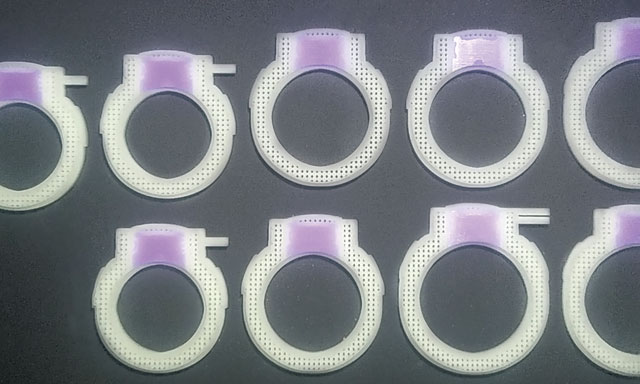
“We can print 300 [models] in 10 hours on one build platform. The more pieces you’re producing, the more this [new] technology is an advantage.” —Joel Weiss
The company continued on for several years, printing models for molding or for the occasional small-run job. Then, a couple of years ago, they had a problem with a job involving a set of very large bracelets. The bracelets couldn’t be molded in one piece, so the company decided to try to print them. However, their printers had a height limit that restricted items measuring more than 50 mm tall. The Carrera team eventually figured out a way to print them but it took 100 hours to print one bracelet—far too long to be profitable.
By then, printers with larger platforms had become available, and they decided to take a chance. They invested in a new ProJet MJP 2500W printer, with the bracelets as the first test.
“They came out great,” Weiss says, who notes that they were able to print eight of the bracelets at one time, and it took about 20 hours. Then, he adds, “we started playing with [the printer].” Weiss and his team wanted to see exactly how far the new technology had come.
They started small, slowly learning the extent of the machine’s capabilities. (“We’re still learning, to be honest,” admits Weiss.) They spent about a year experimenting with the printer, developing processes and techniques to maximize its benefits. They looked at everything—from the supports on the models to moving the models from the printer to a casting tree in the most efficient way possible.
“We’ve come up with proprietary procedures so the [model] is never touched until after casting,” says Weiss. It took the company many months to develop this system, but Weiss says it was worth it because the models wind up with “no fingerprints, no nail marks, no distortion.
“It was hit or miss at the beginning,” he recalls. But as they continued working with the printer, several advantages became clear.
Large Volumes
The biggest advantage was the sheer number of models they could print at one time, as well as how quickly they could print them.
“We can print 300 [models] in 10 hours on one build platform,” says Weiss, noting that previously they could print only four to six pieces in 18 hours. “If there are times when we need something in a rush, I can [print] two or three pieces and have them in one hour. And these machines can run all day and night.
“The more pieces you’re producing, the more this [new] technology is an advantage,” he continues. “If you use the old technology to make a ring, it doesn’t matter if you have to spend an extra hour working on the casting because it’s one piece. The casting will cost a little more, but it’s just one piece. But multiply that by a thousand, and it makes no sense.”
Distortion-Free Castings
The new printer removes the inevitable distortion that occurred with the company’s old way of casting waxes produced from a rubber mold. Thanks to advancements, the printer creates the models the same way every time, and there’s no differential in weight, which could cause distortions.
Stamping
The company can incorporate trademarks and stamps into the CAD file and have them built directly in the model. “Trade stamps don’t hold up in rubber,” says Weiss. “It eliminates laser engraving and stamping…[and the results are] much deeper, much nicer than using an old-fashioned stamp.”
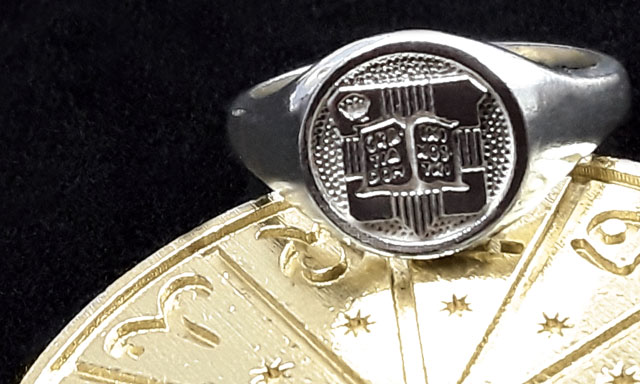
“Once I show a customer, they never go back. It’s different, but once they see it and hold it in their hands, they say, ’Wow, I can’t believe that.’”
Printing and casting models with stamps already embedded in them also helps to speed up the finishing process, resulting in additional time and money savings. “Products are getting through finishing better and faster,” says Weiss.
Near Endless Possibilities
The technology allows them to make things that simply weren’t possible before. Weiss recalls a coin that he created for a customer, which required crisp detailing. “It was the type of item that could not be done with molds; it really had to be die struck,” he says. “But we cast it with this technology, and you’d never know that it wasn’t die struck. It comes out perfectly knife-edge sharp, and the detail and accuracy is incredible.”
Easy Cleanup
Without the distortion issues the company faced with traditional casting, the new printer saves time on casting cleanup. For example, previously, if the company molded and cast a piece that had azures in the back, the right angles of those azures would come out of the rubber mold rounded.
“A jeweler would have to go in and clean out every corner of that square azure, adding a lot of labor,” he says. “Now they come out perfectly square and don’t need to be worked on.”
Cost Savings
Between the speed with which the printer can create models and the print quality that eliminates a good portion of labor, Weiss says the new system reduces the printing cost drastically. “We can print 300 waxes in the same time we could print only five to eight [models before]. We charged $40 to $60 with the [old printer], and we charge anywhere from $2 to $5 with the ProJet, or even less for very large orders.”
Convincing the Masses
Impressed with the abilities of the new printer, the company started introducing the process to its customers. Weiss notes that they started their customers out slowly, initially trying just a couple pieces.
“It’s like any other technology—some people have been doing things a certain way their whole life and they can’t wrap their heads around it,” he explains. “And it’s not the type of thing you can change overnight.”
But for many of his customers, those first couple pieces led to a few more pieces. Weiss and his team emphasized the differences between the two types of castings: The direct cast pieces were exact to the CAD file—there were no distortions, mold seams, or shrinkage. Once clients saw the possibilities and the quality that directly casting the printed models offered (as well as the savings they received), many wanted to switch everything to the new technology.
“Once I show a customer, they never go back,” he says. “More and more people are saying they want to go direct. It’s different, but once they see it and hold it in their hands, they say ‘Wow, I can’t believe that.’”
The customer demand has led Carrera to invest in six additional printers. When customers began telling Weiss that they wanted everything produced this way, the company encountered a hurdle in their quest to go completely digital: For many of their customers’ older styles, they had only the original rubber molds, no CAD files. But the company found a solution to the problem in another new technology: It invested in a 3-D scanner to scan old models and create CAD files.
“Once we scanned some designs in, we saw how poorly made some of the models were originally (such as spacing and thickness issues), so we fixed the file,” says Weiss. “We created a better file as a model. That’s when we started doing a tremendous amount of scanning.”
So far the company has gotten by with just the one scanner, but Weiss admits that they’ll probably need to invest in another one soon to handle the workload. It usually takes about 10 minutes to scan in a piece, but additional time is needed if the file needs to be fixed. The costs of the process vary, depending on how many fixes are needed, but Weiss notes that “it’s far less than starting from scratch.” However, for companies looking to changeover years’ (or even decades’) worth of models, the costs can add up.
“It can become expensive if you have 400 styles on hand,” says Weiss, who notes that many of his customers are slowly having their old styles scanned on an as-needed basis.
Weiss notes that the company probably uses the new technology for 40 to 50 percent of its current workload, but he expects to eventually turn 90 percent of the work over to the technology.
“It makes no sense to deal with molds if you don’t have to,” he says. “There may be some styles or instances where it does make sense, but for 99 percent of the casting we do, this technology works great and is much better than rubber molds.”
And he doesn’t expect to be alone in this endeavor: “I believe in the next three to five years, people will not use rubber molds anymore,” he predicts. “This is taking casting to a different level.”