

Fresh Heir
Transparency and communication are key when transforming heirloom jewelry
By Irina Missiuro
A custom jeweler’s goal and the means of achieving it are similar to those of a psychologist’s: Both aim to get to the bottom of a client’s desires via subtle questioning. And that’s especially true when repurposing an heirloom. The memories in such pieces can be joyous, but they can also be poignant—and you never know when a question might touch a tender spot. “I’m like a therapist where inherited jewelry is concerned,” says Calla Gold of Calla Gold Jewelry in Santa Barbara, California.
Christopher Duquet compares it to a similar occupation: grief counselor. The owner of Christopher Duquet Fine Jewelry in Evanston, Illinois, he has seen clients bring in heirlooms about which they’re “emotionally involved and fragile,” and that excessive attachment can make it difficult to navigate the collaboration. In some cases, he has to suggest that the clients take some time to think about what they really want to do with the piece.
“Maybe they come back, maybe they don’t,” he says, but a lost sale is better than a client with regrets: “You don’t want them to change their mind after you take the piece apart.”
Because of the sensitive nature of heirloom redesign, proper communication and transparency are essential—but they’re not the only skills needed. On the following pages, several custom jewelers offer their insights into how customers can walk away happy with a repurposed heirloom.
Ask Many Questions… and Listen
The consensus among all the jewelers was that the first step should always be a comprehensive consultation. “The process of discovery is very important,” says Lisa Krikawa, founder of Krikawa Jewelry Designs in Tucson. Don’t be hesitant to ask too many questions, she advises, because clients often aren’t sure how they want to transform an heirloom. They might need to be pressed to reveal what’s significant to them, what they have in mind for the piece, and what they want to preserve.
“The discovery process is vast and depends on the starting point,” Krikawa points out. If customers are uncertain about how to proceed, she’ll offer various options, from subtle adaptations to a total redesign, with the heirloom melted down and the metal reused. Throughout the process, though, she constantly gauges the emotional attachment the client has to the piece: Those emotions can run deep and sometimes create conflicting desires.
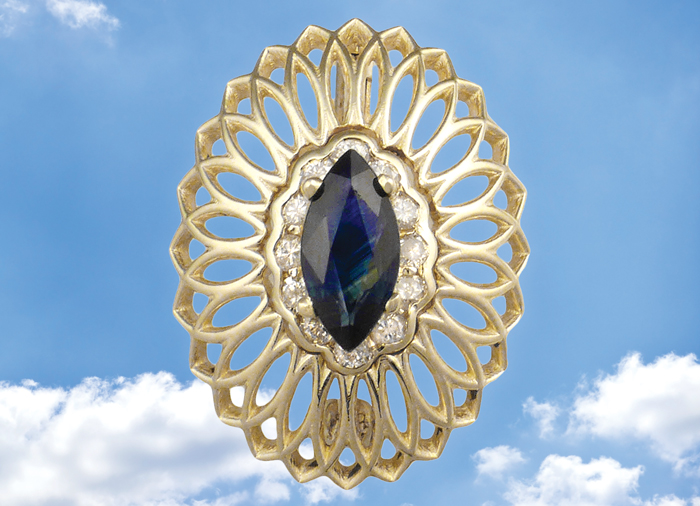
Such was the case with a woman who brought in a gold ring that she’d inherited from her mother. The ring (Figure 1) featured a prong-set sapphire center stone surrounded by a halo of diamonds, with additional diamonds set into the shoulders of the shank. Her mother had worn it all the time, and the ring held high sentimental value. But the client viewed it as outdated and unattractive, which created the conflict: She was attached to more than just the stones and didn’t want to melt down and redesign the entire ring, but she also knew she wouldn’t wear it.
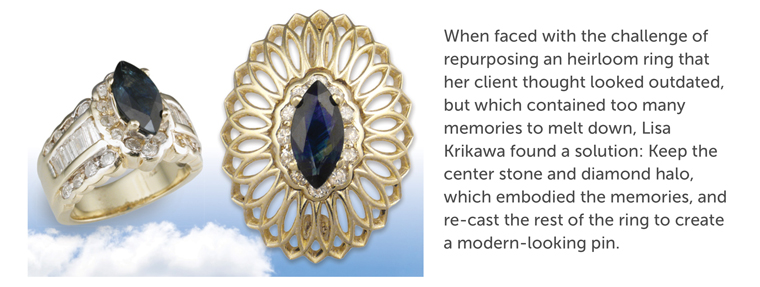
Krikawa suggested a compromise: re-moving and keeping the original mounting for the center stone and the diamond halo—the parts that embodied the memories—but melting down and transforming the rest of the ring. It was a bit of a gamble, but it paid off. After seeing sketches of a ring, a pendant, and a brooch, the client settled on the last option: Since she liked to wear blazers and jackets, she felt that a pin would be appropriate. And when presented with the finished piece (Figure 2), the client was “tearful, grateful, and excited,” Krikawa recalls. The brooch echoed the original ring, but with a clean, updated design that was closer to the client’s style.
Lee Krombholz, owner of Krombholz Jewelers in Cincinnati, had a similar experience with a widow who brought in her late husband’s wedding band (Figure 3). Bands are among the most common heirlooms taken in for repurposing, and Krombholz says that many times the solution is to simply resize the ring so it can be worn by the surviving spouse. But in this case the client already had rings she enjoyed wearing, and she instead wanted to turn the band into a pendant.
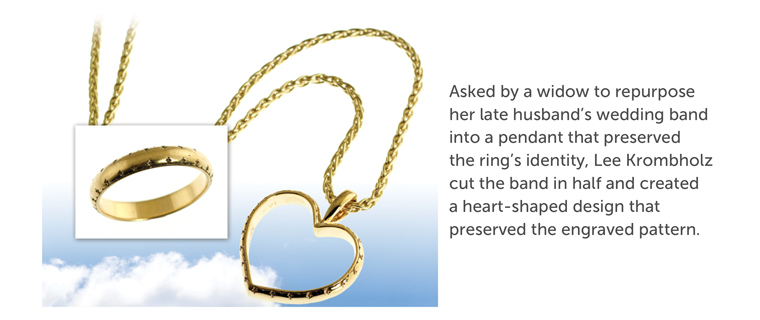
As Krikawa did, Krombholz offered options—altering the band in some way so as to preserve its identity (it featured unique engraving around the rims), or melting down the entire piece and creating something totally new. In this case, the client did not want to have the ring melted down at all, but she still wanted a more elaborate design than a band attached to a chain. So Krombholz came up with an alternative: He sawed the ring in half and re-shaped the band into a heart (Figure 4). “The original hallmarks and the engraving are still there,” he says.
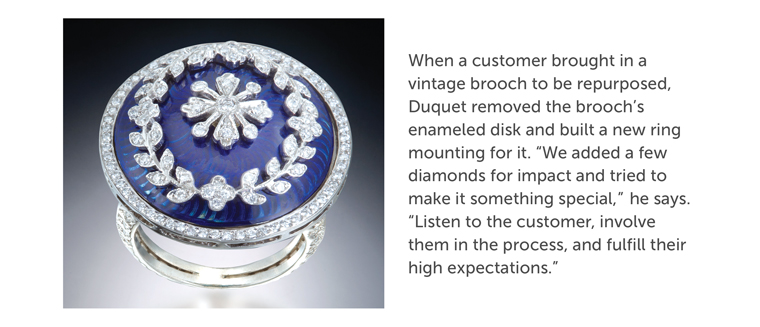
While you can offer the benefit of your expertise during the consultation, always remember: The decision depends entirely on the client. “Listen to the customer, involve them in the process, and fulfill their high expectations,” Duquet says. “We start by recording the project’s goals, learning who the person is. Then we see how we can apply the materials to that end.”
Kalee Sholdt of Sholdt Design Jewelry in Seattle puts it another way: “Listen to your customers. Hear their heart and let that guide the design.”
Be Transparent at Take-In
Sometimes people bring in heirlooms that they believe to be valuable, but prove otherwise. Krikawa tells of a client who brought in what she thought were 1 carat diamond studs, with which she wanted to make an engagement ring. Unfortunately, the stones turned out to be cubic zirconia. While such news about a prized heirloom may upset some customers, it’s best they learn the truth before spending money on a redesign. Being straightforward prevents hurt feelings and misunderstandings.
Krikawa advises cleaning and examining the jewelry in front of the customer, and noting any damage on the take-in form. Gold concurs with this, but also suggests that, to spare feelings, you shouldn’t take an heirloom piece apart in front of a customer: “They can get emotional and sad to see the empty setting.”
To check the metal quality and stones, you can perform some non-destructive tests at the counter, using handheld metal analyzers and electronic diamond testers. If, after inspection, you’re still not sure about the accuracy of the metal quality (even if it’s stamped) or the authenticity of the stones, explain that to the customer. You can then, with their permission, perform additional testing, such as a destructive acid test of the metal.
Explain What Can—and Can’t—Be Done
Krombholz sees the relationship with the client as a major component of a successful repurposing, and the managing of expectations as the key element of this collaboration. He compares himself to a contractor working on the renovation of an old house: “You never know what you’ll get into.”
That’s why a jeweler should be able to tell the customer what can and can’t be done. If the client wants something that ultimately won’t stand up to the jeweler’s standards, that must be communicated, Krombholz says. If the project is really challenging, he’ll even budget for “extra hand-holding time.”
Krikawa says that, as part of that communication, jewelers should educate the customers about all available design options, which she prefers to de-sign recommendations: “Offering choices instead of making suggestions empowers the customer.” That’s especially true when it comes to flaws that the owner might want to hide. For example, if an heirloom contains any soft stones on which the girdle is chipped, you should explain that the stone can be bezel-set to hide the defect, or it can be re-cut or re-polished. Also, explain all sides of any option—for instance, that re-cutting chipped stones would result in a loss of gem material.
And there’s always the choice to leave the imperfections alone, as suggested by Joel McFadden, owner of The Art of Jewelry by Joel McFadden in Red Bank, New Jersey. “Often, the beauty of the piece is the slight wear of the antique stones,” he says. Sholdt feels the same way about wear marks: “Oftentimes, people love the history of a piece, so they want to see the flaws.” Recently, she says, one of her clients brought to her an heirloom ring with a European-cut diamond that had chips all over the girdle. Sholdt suggested having it polished, but the client said no: The ring had belonged to her great-grandmother, who wore it the night she survived the sinking of the Titanic. The chips remained.
Once all the decisions have been made, ask the client to sign off on them. For instance, only after the customer gives the final approval does Duquet make the wax model. McFadden operates similarly: “We don’t do anything until the customer OKs the process and budget.”
Take Exceptional Care of the Heirloom
Krikawa recommends handling the jewelry a client brings in as if it’s worth a million dollars, because it is to the customer. She says that it’s important for jewelers to show respect for the item regardless of its monetary value. Similarly, McFadden states, “I treat any stone I can’t positively identify as the most fragile option.” He’ll even use tools made from chopsticks to avoid scratching the stones.
Using highly qualified goldsmiths will earn your customers’ trust—people will return once they know that the bench experts will do the best possible job with their heirlooms. Sometimes, though, even the best jewelers can’t do much for severely damaged or heavily included stones. In those instances, Krikawa proposes asking the client to sign a release form, acknowledging that they want to proceed with the job despite the high risk of breaking during setting.
Once the client leaves the heirloom components in your shop, take care to ensure that you are storing them in a way that prevents scratches, such as in individually labeled Ziploc bags. Careful cleaning also plays a role in avoiding damage: Make sure that fragile items, such as enameled pieces, are cleaned by toothbrush with soap and water. But don’t be afraid to use an ultrasonic. Krikawa says that, unless an item has an inlay, mother of pearl, or any glued segments, it’s fine to clean an heirloom ultrasonically. In fact, she recommends testing vintage heirloom rings this way—if their stones fall out, then they will also fall out during wear.
“Of all the antique jewelry we deal with, 90 percent is cleanable [in an ultrasonic],” concurs Krombholz, adding that he and his staff first “inspect all of the jewelry to see if there are loose stones that could fall out during cleaning.” As for the remaining 10 percent, he cites foil-back rhinestones, fragile stones (such as emeralds and opals), seed pearls, and lockets containing pictures as being among the items that may raise a red flag. And if in doubt, err on the side of caution.
Deliver on Your Promises
Gold believes that, if the heirloom has good bones, a restoration may make you fall in love with it all over again. She tells of successful redesigns that honored their past wearers’ memories—a pendant made out of a mother’s ring, commemorating a woman gone too soon, and a restored antique ring that survived a demolition and was found in a pile of rubble.
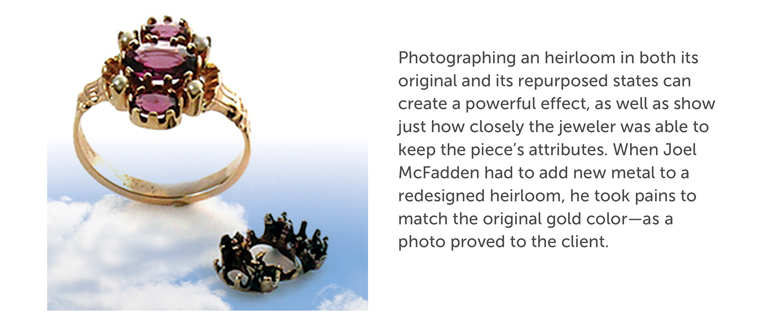
For a dramatic reveal, Krikawa suggests photographing the heirloom in its original and final states to present the customer with powerful “before” and “after” images. For McFadden, that technique proved useful with a customer who insisted on saving as much of the original heirloom as possible. He had reused the shoulder details, but since the color of the new metal differed from that of the old gold, his caster had taken pains to match the colors. It was a tedious process, McFadden remembers. But it was worth it, he adds, when the client saw how the colors matched in the two photos, just as she had expected—and she walked away happy.