

Awakening Creativity
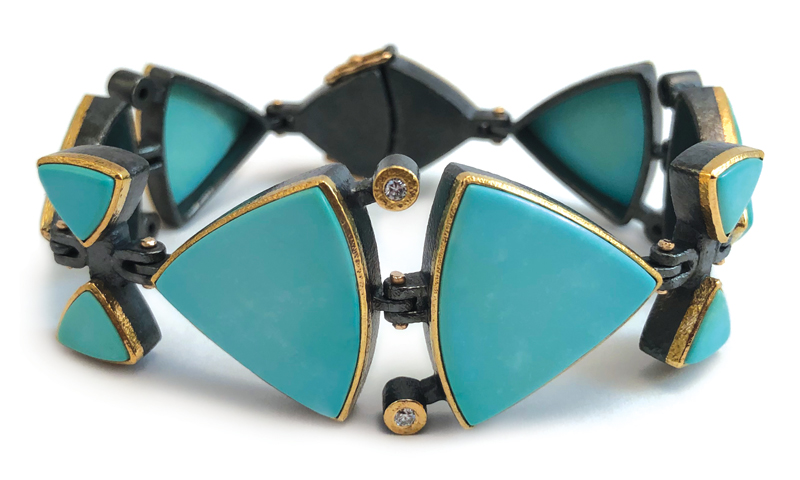
Alex Boyd’s Sleeping Beauty turquoise bracelet
By Tina Snyder
When Alex Boyd first laid eyes on a small chunk of flawless Sleeping Beauty turquoise at the Denver Gem & Mineral Show last year, he knew he had to have it. Unsure of its fate, he began cutting into the material, slicing carefully to get as many flat slabs as he could from it.
“It’s super hard and strong material, so I knew I could get away with slicing it pretty thin,” he says. “I then looked at what shape would fit best inside these cross-sectional slabs, and that’s how I landed on a soft-sided triangle shape like a trillion.”
Trying to use as much of the material as possible and leave minimal waste, Boyd ended up with seven larger triangles and four small ones, the latter of which he was able to harvest from the scraps.
Boyd knew he wanted to make a bracelet with the pieces, and he began to lay out the design with the stones. In an effort to avoid heft, he decided to create open-back bezels for each of the turquoise triangles in 22k gold. But to keep costs down, he soldered the gold bezels onto 3 mm thick silver sheet, then pierced out the openings for the back, filing them to a contour that would match the wearers wrist. The sterling not only adds sturdiness to the piece, but when blackened contrasts nicely with the high karat gold. It also keeps costs down.
“I teach a workshop on using gold on a budget,” says Boyd. “I like taking a small amount of gold and stretching it as far as possible, so you get a rich gold look without spending crazy amounts of money.”
To further add value to the piece as well as a pop of brilliance, Boyd set 2 mm diamonds in a pattern on the bracelet. “Again, the diamonds appear to be set in big gold bezels, but they are literally flush set into a silver rod that I have soldered a thin sliver of 22k gold onto,” he explains.
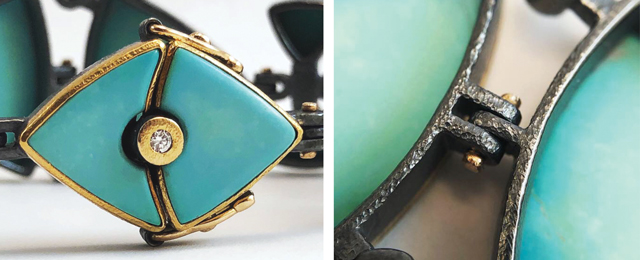
The bracelet features a simple box clasp hidden beneath two turquoise pieces. Two 18k gold fasteners hinged to each side complete the closure. To connect the bracelet segments, Boyd used silver strips to fashion U-shaped silver hinges that he connected with 18k gold wire.
The carefully crafted turquoise bezels are connected with handmade hinges. Boyd says he opted for hinges over jump rings because it enables the bracelet to lay on the wrist as the jeweler intended it to. “Jump rings can twist around and get kinked, whereas hinges guarantee the piece will lay how you want it to, and they also make the piece more elegant.”
To fashion the hinges, Boyd made U-shapes from 1 mm and 1.5 mm strips of silver that fit tightly together, soldering them to the bezels and filing away the excess. He then crafted pins from 18k goldwire, which thread through the knuckles of the hinges. He used a torch to fuse balls on each side, then filed and cleaned them up so they look like clean rivets.
With all the time and materials going into the bracelet, Boyd knew he needed a clasp that would be just as carefully considered as the rest of the piece. “I couldn’t just put a simple hook—I needed the clasp to stand out,” he says. When he was first laying out the design of the piece, he made a metal box clasp that matched the shapes in the bracelet, but says it felt like a “dead spot.”
“Everything else was really vibrant, andthen there was this boring area there,” he recalls. “And that’s when I got the idea to use that last piece of turquoise as the clasp for the bracelet.”
Boyd constructed a simple box clasp in sterling silver, hiding the elements that clasp together beneath the turquoise, which he split in half. Two 18k gold fasteners hinged to each side complete the closure.
“I thought this was going to be one of those pieces people see and handle and love, but ultimately can’t afford,” he says. “But it turned out that soon after I completed the bracelet, a customer who is a regular at the gallery showing the bracelet fell in love with it and bought it for his wife.”
Just as it was love at first sight for Boyd with that hunk of turquoise, so too did the customer fall in love with the beautiful piece of jewelry that mineral had become.