

Infrastructure for the Body
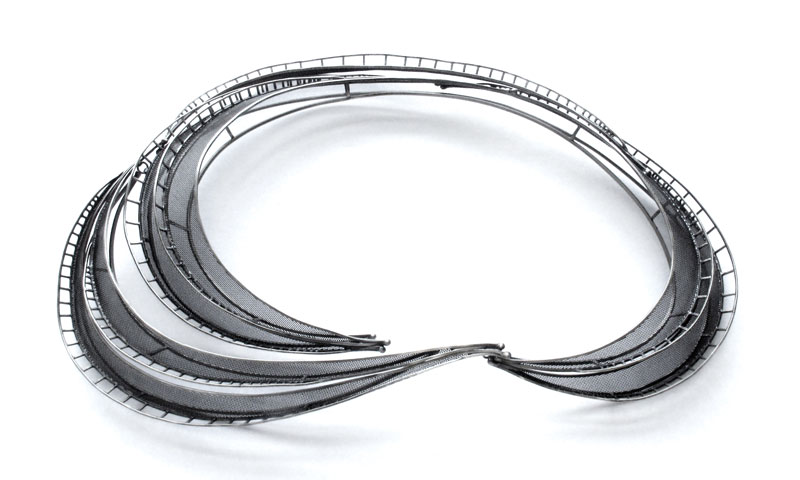
Exploring the creation of Caitie Sellers’ Highway Necklace
By Tina Snyder
Caitie Sellers’ fascination with urban landscapes began during her artist residency at the Houston Center for Contemporary Craft—a culture shock compared to her home in the mountains of western Virginia. Finding inspiration in Houston’s intense interstate highway system that starkly contrasted her rural up-bringing, Sellers discovered what would become the foundation of her art jewelry aesthetic. As she relocated frequently in the years to come, the familiarity of infrastructures such as highways, power lines, and train tracks would serve as a consistent source of inspiration.
The Highway Necklace pays tribute to the original Houston highways that sparked the theme of Sellers’ work. “My intention when designing this necklace was to depict a complicated highway system that rests on the outer edges of the shoulder, making the wearer appear to be the heart of the city around which traffic orbits,” says Sellers. “I wanted it to be gracefully feminine, highlighting the beauty of implied motion, urban sprawl, and the body on which it rests.”
Hand-forged from Argentium silver wire and copper mesh, the necklace started as a paper model in two parts, which Sellers used to practice the curves on a mannequin to ensure it evoked a perspective of highways disappearing in the distance. “I’m sure it would be easier to make such a piece in CAD and not experiment with all the paper models, but that’s not part of my practice,” says Sellers.
Once satisfied with her paper model prototype, Sellers began fabrication by cutting the copper mesh and 14-16 gauge Argentium wire to shape the necklace in two parts: the inner curve and the outer curve, which clasp together at the base of the neck where the wire points meet.
“The mesh is pliable, lending itself to having dimensional movement with convex and concave twists and turns,” Sellers explains. “The wire adds a lot of support to the structure.”
To form the necklace, Sellers bent the Argentium wire into the shapes of the curves in the road. Next, she fused the copper mesh to the wire, leaving the edges of the mesh exposed. She then sanded them to add a final finish.
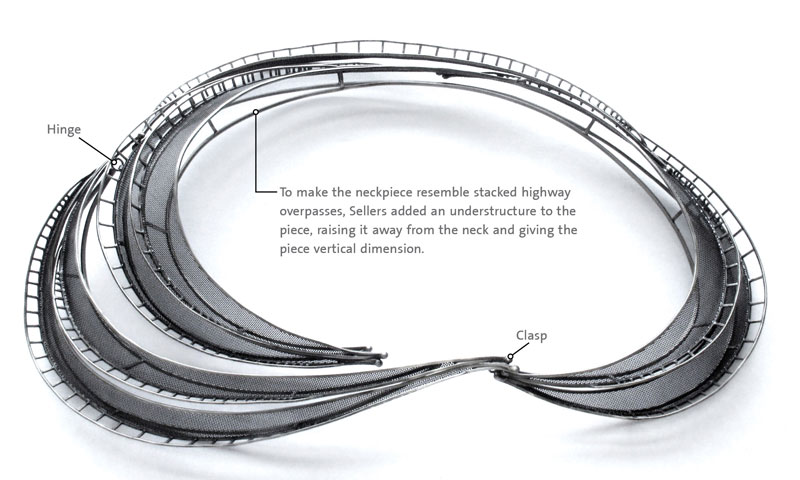
“The shape itself begins by fusing the mesh with the silver and cutting off the excess,” she explains. “Then I add the understructure, which is the thick wires that you see holding the piece up on the body, so it holds it away from the neck and gives it vertical dimension, making it resemble stacked highway overpasses.”
Last, she added the 18 gauge wire railings, individually fusing the perpendicular Argentium fence wires to the outer Argentium wire. “The germanium in the Argentium allows it to fuse to itself, essentially becoming one piece of metal,” she explains.
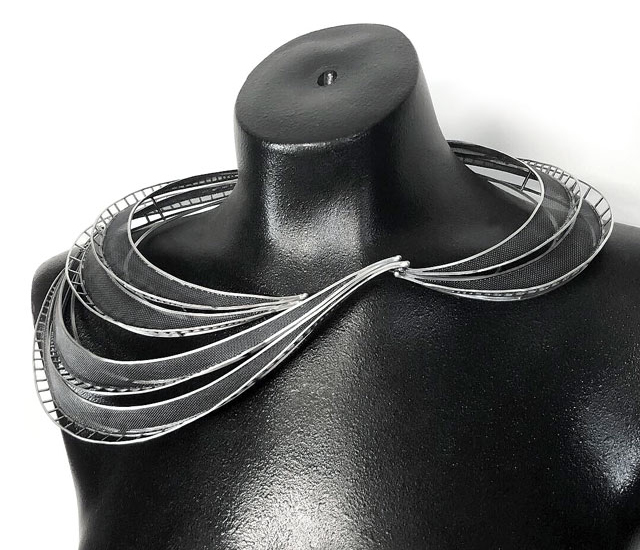
She then curved the component by hand to match the highway components of wire and mesh, and soldered each fence rail to them individually. “Because copper has a high melting point, it reacts well with the Argentium when soldering and there is less of a chance of burning a hole through it with the torch,” she says. “It also takes a beautiful dark black patina, making the highways look industrial.”
Designing the piece to sit comfortably on the shoulders while incorporating a closure that did not disrupt the long lines was a particular challenge. Sellers found a solution by making one of the large, fitted curves on a swinging jump ring hinge with tube attachments that allows the necklace to be flexed open. It closes with a hidden clasp where the two highways meet.
Sellers blackened the necklace in a liver of sulfur solution to achieve a rich black patina, then used fine grit sandpaper on the silver to provide a bit of contrast.
“People always ask if the necklace is pewter or steel,” she says. “These are metals we associate with building and infrastructure, not jewelry, which I enjoy.”