

Stick to It
A bench jeweler’s guide to glues and epoxies
By Shawna Kulpa
It’s that time of year when jewelers start updating their tool “wish lists” so they’re ready when their loved ones ask what they’d like for the holidays. Those lists are likely filled with laser welders, 3-D printers, diamond scanners, and maybe even a fancy new hammer. Two things likely not on that list? Glues and epoxies.
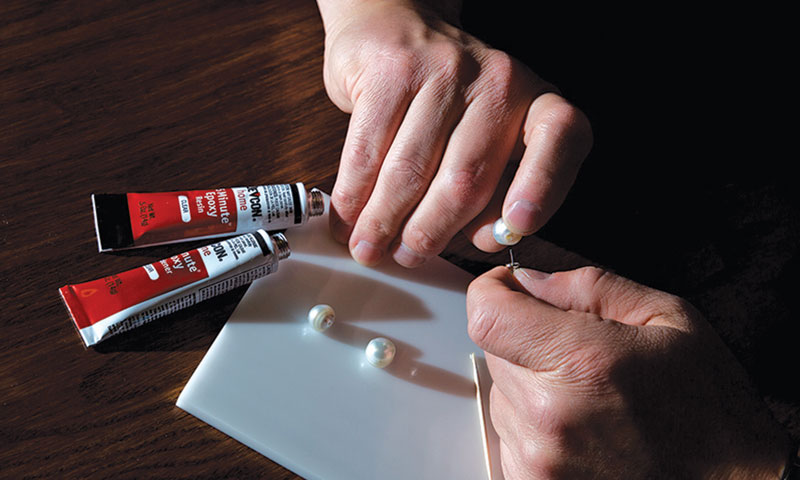
It’s easy to see why these simple adhesive solutions would be overshadowed by their sexier tool cousins. Their purpose seems fairly basic and limited, and some jewelers may view them as something used only for making fashion jewelry. But sometimes a dab of glue or epoxy is just what a fine jewelry project needs, whether it’s to adhere a pattern onto a sheet of gold for easier sawing or to secure inlaid gemstones.
To help you determine the right adhesive for your needs and how to best use them, we spoke with industry experts. They told us about not only the differences between glues and epoxies, but also how these products should (and should not) be used at the bench, and even the opportunities they offer. We hope the advice and tips they provide will stick with you over the long term.
Glues vs. Epoxies
When shopping for a bonding agent, jewelers are likely to first wonder what the difference is between a glue and an epoxy, and which is the best product for the job at hand.
There are two main differences between glues and epoxies. First, glues are single-solution substances that come ready to use as is. Epoxies, on the other hand, usually contain two parts—a resin and a hardener—that have to be mixed before use. Mixing them is a pretty straightforward process—it could be as simple as placing a drop of the resin and a drop of the hardener on a small piece of paper and then using a toothpick to mix the drops together. (If a jeweler is unsure about the amount of epoxy needed, it’s best to err on the side of too little than too much since once the solution is mixed, there’s nothing that can be done to separate it or stop the solution from hardening.)
The other main difference is that glues should be considered for short-term, temporary holds only. “Glues can become brittle [and discolor] over time, especially when exposed to chemical extremes,” says Scott Bradford, a member of the Tech Team at Rio Grande in Albuquerque, New Mexico. “Epoxies aren’t subject to that.”
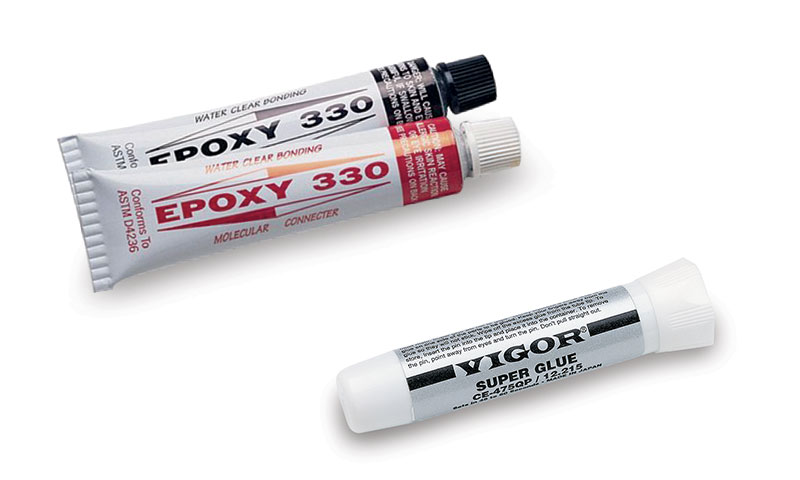
“Epoxies offer a stronger, more durable bond that will hold up to heat, cold, moisture, and vibration,” says Mark Esslinger, CEO of Esslinger & Co. in St. Paul, Minnesota.
But while glue should never be used to secure settings in fine jewelry or other pieces that require long-term holds, it does have a place at the jeweler’s bench.
“I’ve seen tips for using Super Glue to temporarily hold things together in a certain orientation for laser welding or other applications,” says Gary Dawson, custom designer and owner of Gary Dawson Designs in Eugene, Oregon. He notes that it’s also good for adhering printed patterns onto metal for piercing and sawing.
“There is a place for a glue,” says Esslinger. He notes that jewelers may sometimes get a sentimental piece of fashion jewelry that’s been glued together in for repair. “You wouldn’t change the design and make it a soldered piece—it would cost more than the piece to do that. It depends on the jewelry and the customer.”
“I’ve also used it for fixturing a gemstone to a dop for lapidary work,” adds Bradford, who notes that glue is faster and easier to use than wax.
Although there is a large array of glues on the market, cyanoacrylates, such as Super Glue, are the most likely to be used in a jeweler’s workshop. These glues air-dry quickly, can be used to adhere a variety of materials (including metal), and are very resistant to liquids and mild heat. They also have a fairly short shelf life once opened, but storing containers in the freezer may help prolong the product’s life.
UV glues are another option. “The advantage of these UV glues is the cleanup,” says Esslinger. “Super Glue is dry in an instant, but UV glues take a short time to dry. You have a little time to clean it up before it sets.” He notes that with these glues, all of the material needs to be ex-posed to light in order to set, and some require either direct sunlight or a UV lamp.
Regardless of which type you use, re-member the warning issued by Bradford. “With metals, the vast majority of glues may off-gas some compounds that could cause tarnish,” he says. Although he adds that with a gemstone you probably wouldn’t notice, it could be particularly troublesome if glue was used inside of a watchcase: “If used in watches, you could get some oxidation of materials inside the case.”
And though most doctors aren’t likely to recommend it, Super Glue is also used as a first aid tool by many a jeweler who’s sliced open a finger or two. “The way I was first introduced to it was as a quick suture if you nicked your finger with a saw blade,” says Bradford. While it’s no substitute for receiving proper medical care in the case of a cut, Super Glue will do in a pinch if bandages aren’t kept in the shop.
Working with Epoxies
Epoxies have a range of uses at the jeweler’s bench, from adhering pearls to their posts and securing inlaid pieces to assembling doublets and fastening alternative materials such as leather. At some point, jewelers will likely cross paths with an epoxy, if not in the construction of a piece than in the repair of one.
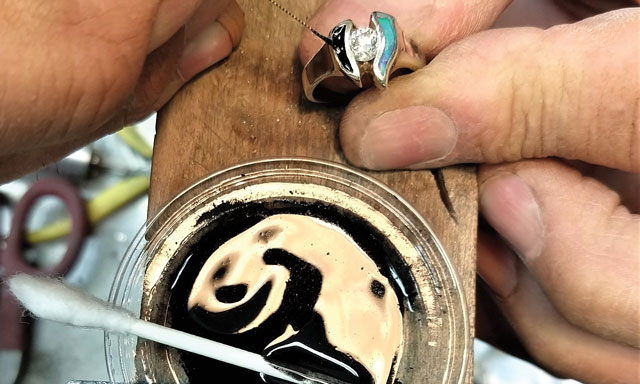
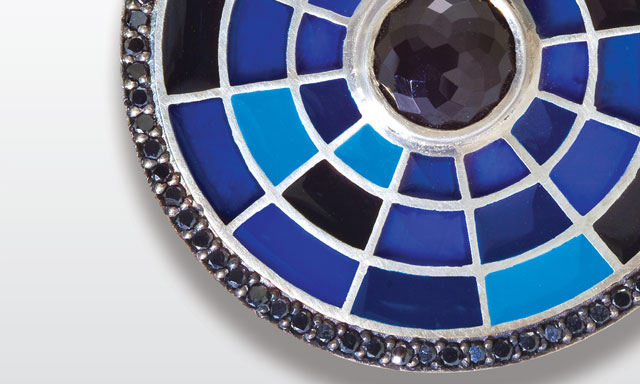
They may also decide to use them as a focal point. Some epoxies are available in a range of colors, which may make them ideal for certain jewelry projects. Devcon, for example, “is a black epoxy that is used as a backing for a lot of stones,” Bradford says. “It’s particularly prominent here in New Mexico for [setting] turquoise.” He also points to a collection of colored resins, Colores, sold by Rio Grande specifically for use in jewelry. “You match the colored resin with the hardener you want and use it as a centerpiece for the jewelry,” he says. “When cured, they feel like plastic.”
And jewelers aren’t limited to the colors commercially available: They can mix their own to match a particular project. Dawson has tried this: When he works on a gemstone inlay piece, he may grind off particles from the stone and mix the resulting dust into the epoxy before applying it, so any epoxy that would be visible would match the stone. Alternatively, if he desires a black outline in the inlay, he might shave off a portion of his charcoal soldering block and grind that into a fine powder, allowing the particles to blacken the epoxy.
(Dawson also adds one more non-traditional use for epoxy: While it’s generally frowned upon to use epoxies to secure gemstones in lieu of traditional stone setting in fine jewelry outside of inlay work, he notes that there are some circumstances where it may be acceptable, such as to secure a gemstone in a setting that is too worn out to repair and the client does not want to replace for sentimental reasons. “In cases like that, when it’s not repairable as it is, you might use an epoxy, but with full disclosure and the understanding that it’s a temporary solution. It’s not a permanent fix,” he cautions.)
Regardless of the task, it’s important to remember a few things when working with epoxies.
Play It Safe. When working with any epoxy, always reference its Safety Data Sheet (SDS). It will outline any required safety equipment, such as gloves or ventilation, that should be used when working with the product. If the SDS is not available, play it on the safe side.
When Bradford works with an epoxy, he says he thinks backward about it. “Whatever [precautions] you would use when removing the epoxy, use to apply it,” he recommends.
“Any kind of precaution that you can take, you should take,” says Andy “The Tool Guy” Kroungold, director of tools sales at Stuller Inc. in Lafayette, Louisiana. “I always wear safety glasses and gloves. And ventilation is key: Don’t breathe it in.”
Allow for Curing. In addition to needing to be mixed, any epoxy also must be cured, which can add time to a job. Cure times can range from minutes to days, depending on the specific epoxy. Most of the epoxies suitable for use at the jeweler’s bench will take 24 to 72 hours to cure all the way through, though there are epoxies offering faster curing periods.
“There’s one that cures in five minutes,” says Bradford. “It’s used by a lot of people doing repairs, where time is money.”
It’s worth noting that the quick-curing epoxies tend to have a shorter working time, making speed of the essence when mixing and applying them. These epoxies also don’t tend to be as durable as some of the longer-curing epoxies.
“Typically, the ones that take longer to cure provide a stronger bond,” says Bradford.
Don’t Touch. It’s also important not to jar items during the curing time. Don’t plan to adhere something with epoxy and then continue working on the piece.
“The biggest thing that I see people have issues with is that they want to inspect it,” says Bradford. “You have to get it straight the first time, and then don’t touch it until it’s completely cured for the strongest hold possible.”
If time is of the essence, it is possible to speed up the curing time of most epoxies. Items can be placed in an oven set between 120°F and 150°F. Dawson notes that you can also accelerate the process by placing the item under a heat lamp or a warm incandescent light bulb, but he cautions that it’s probably a good idea to wait at least 24 hours before presenting it to the client.
Don’t Overdo It. When it comes to applying epoxies, a little tends to go a long way, partly because the material is so durable and partly because the part being epoxied may need to be removed at some point in the future.
“I always use a Q-tip to apply epoxies,” says Kroungold. “With epoxies, you want to be sure to use only a small amount.”
Think Long Term. Bradford recommends that jewelers give careful consideration to where they place the epoxy. Consider not just the location that might hold the item best, but also a location where it would be easy to remove should the occasion ever arise. This is especially true if you’re using it around materials that may not react well to the products that remove epoxy.
“If using chemicals [to remove the epoxy] is out of the question, I may wind up putting the epoxy in an area where it could be reached with a scalpel,” says Bradford. “I try to keep epoxies hidden as best I can, but I also know what it’s like to be in that situation of having to cut a stone out in order to work on it. Sadly, sometimes there’s no way around it.”
While many epoxies will dry clear, Esslinger notes that some of the longer-cure varieties may be colored, so jewelers would want to take that into consideration when deciding on where to apply it and how visible the dried material would be in the finished piece.
Keep It Clean. Regardless of the type or color of epoxy used, a clean application is needed. Unlike glues, which can usually be easily cleaned up with alcohol, epoxies are designed to endure. If you do apply too much, wipe it up before it cures.
Removing excess material is important not only for aesthetics, but also as a safety precaution. “People can be allergic to something in the epoxy,” cautions Kroungold. “You don’t want to put it on in a large amount that could get on the customer.”
Removing Epoxy
As noted above, epoxies are designed to endure—which means that, if you have to repair a piece that contains epoxy, you’ll need to find a way to break its bond. Bradford recommends first starting with heat.
“You can gently heat the piece until the epoxy softens enough to remove the items,” he says, adding that most epoxies won’t require temperatures that could damage fragile stones, including pearls.
If heat doesn’t work, the next step would be soaking pieces in acetone, which will slowly dissolve most epoxies. Dawson also says that soaking the piece in a shampoo containing sodium lauryl sulfate, which is a detergent and surfactant, may dissolve the epoxy. (Note: For these reasons, consumers should be warned about wearing any epoxy-bearing jewelry in the shower or exposing it to high heat. Chlorine also should be avoided. Chlorine is “the number one killer [of epoxies],” says Kroungold.)
Depending on the location of the epoxy, it may also be possible to cut or chip away at it with a sharp blade, though caution should be taken if used near pearls or other fragile stones.
If none of those methods work, try a commercial adhesive remover such as Attack. However, experts note that this is a particularly caustic chemical and should only be used as a means of last resort.
“Attack is the most aggressive thing I’ve ever seen in my life,” warns Kroungold. “It will eat a pearl—it’s that aggressive.”
If you have to use a product such as Attack, Kroungold says that it doesn’t take much. “If you’re trying to remove a stone, a little dab will do.” Be sure to reference the SDS, he adds, as this type of solvent can cause skin burns and eye irritations and be harmful if inhaled: “Be smart. Be careful. Think before you act.”
Words to live by.