

Bench Envy: Jo Haemer
Jo Haemer’s bench combines the best of two worlds
By Jo Haemer
Editor’s Note: When jewelry maker Jo Haemer is asked about the most important tool she owns, she often says it’s her workbench, and it’s not hard to see why. She and her husband Timothy Green have three custom made workbenches in the home studio they share in Portland, Oregon. Haemer offers a peek at her bench, explaining its construction and how she puts its thoughtful layout to good use.
My bench was custom crafted out of cabinet grade oak plywood. It measures 47 inches high by 46 inches wide by 22 inches deep. It weighs about 220 lbs. and is a combination of a watchmaker’s bench and a jeweler’s bench: It’s heavy and sturdy enough for jewelry making and has lots of drawers like a watchmaker’s bench. It was originally designed about 50 years ago by Ronald Reimer, a highly skilled watchmaker and cabinetmaker at the venerable old Portland jewelry store Zell Bros. Jewelry. When he retired about 25 years ago, he gave the bench plans to my husband, who passed them along to John Vesowaite of West Coast Findings in Portland, Oregon, with the stipulation that we would buy the first two that he made.
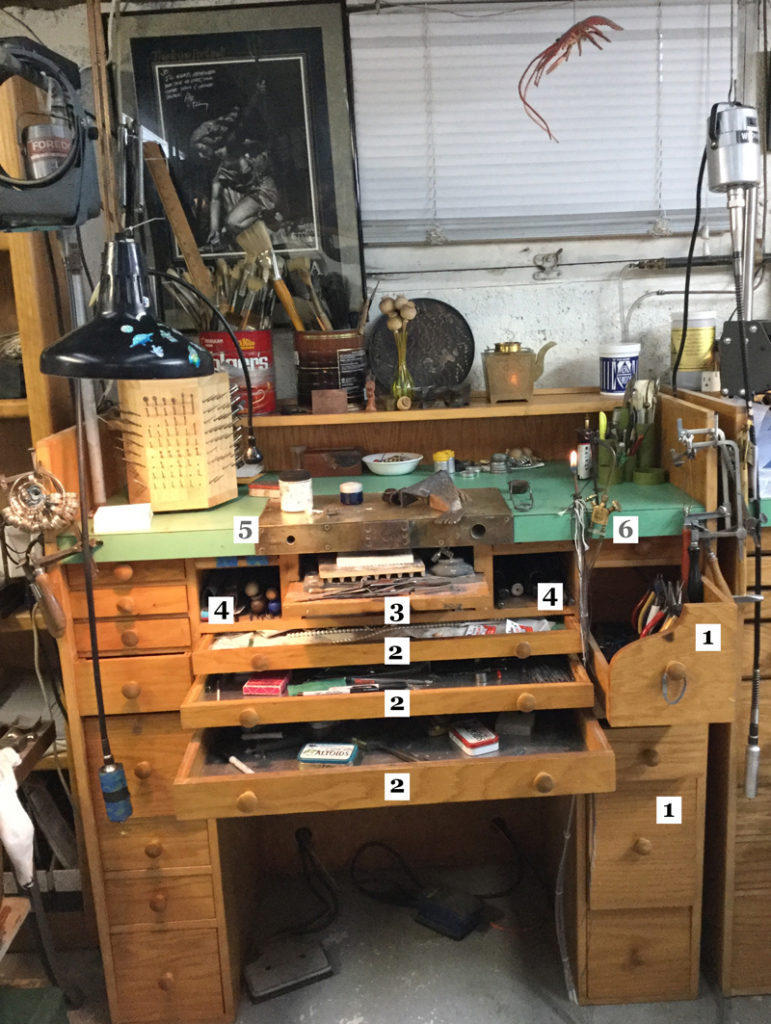
1. My bench has 14 drawers of various sizes. Two of the drawers are specialized: One drawer on the top right was made just for holding pliers with a bar built into it, and another lower drawer was made to hold hanging files for paperwork and sketches.
2. There are three slide-out bench pans. The lowest one is for general sweeps. The middle one is lined with stainless steel and is used to hold platinum sweeps and designated platinum-working tools. The top drawer has a Formica-lined bottom for wax carving. Because the Formica is soft enough to not scratch things but tough enough to hold up to being worked on, I also use the top drawer for delicate tasks such as pearl stringing or laying out gems I don’t want to have scratched by metals or abrasives.
3. In the center of the bench is a slide-out tray used for soldering.
4. Next to the tray are built-in cubbyholes. I use one to hold my ring and bezel mandrels, and the other for emery sticks and files.
5. The top of my bench is Formica. It has held up beautifully. But while it’s strong, it’s not fireproof. That’s why one of my favorite features of my bench is a 1/8 inch slab of brass that runs across the center front and top of it. On the top, it measures 18 inches wide by 10 inches deep. It’s meant to protect the surface from the torch. The brass also serves nicely as a built-in bench block. It’s hard enough to hammer on but soft enough that it won’t mark up any stone or metals that I’m working on.
6. The bench has plumbed into it a permanent copper-tube pilot light for our torches on the right side of the bench. It also has a cut-off valve for the gas. It saves time looking for a striker that is lost somewhere in the bench pan. It’s fixed next to a torch holder made from a heavy brass rod that was shaped to hold my very old brass NGC torch.
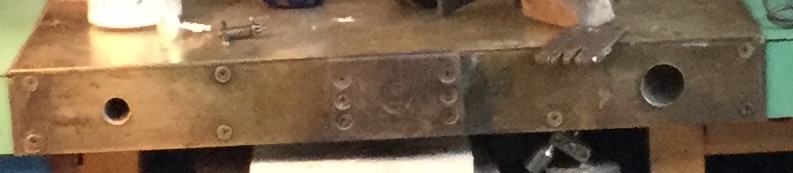
Attached to the front of the brass plate is the GRS base plate for my bench pin and all of the nifty devices that GRS makes. The front of the brass plate also has two holes drilled into it to hold ring and bezel mandrels steady while doing things that require three hands.
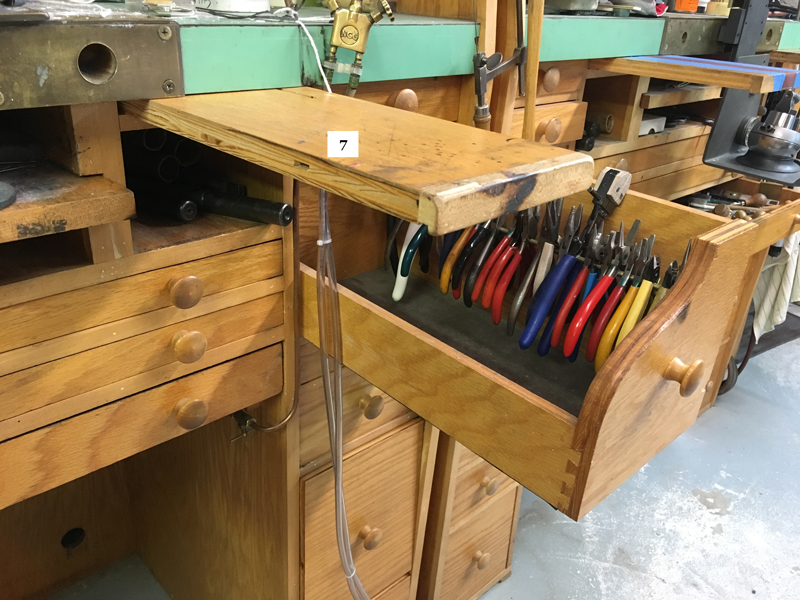
7. On either side of the soldering tray are retractable arms. While Tim loves and uses his daily, I mostly use mine as a place to put my coffee or do a quick sketch.