

Under Hypnosis

Thomas Dailing’s Abberation
By Tina Snyder
Award-winning jewelry designer Thomas Dailing of Stevens Point, Wisconsin, has built a reputation for his inventive jewelry designs showcasing one-of-a-kind gemstones cut by Richard Homer. His most recent show stopping pendant, a finalist in the 2020 Saul Bell Design Award Competition, features Homer’s 16.84 carat Phantom Spinner Citrine set in a reflective 14k white gold disc with an 18k yellow gold dome.

Thomas Dailing
Thomas Dailing Designs, Steven’s Point, Wisconsin
“This piece involves a number of innovative techniques that I’ve been conceiving over the years,” says Dailing. “And when worn, it’s hypnotic.”
Having designed and handcrafted more than 9,000 jewelry pieces, Dailing pushed the limits with Aberration. Starting with Homer’s citrine, which has a polished drill hole running down its axis, Dailing wanted to maximize the play of color that would reflect in the dish using accent stones.
“Once light hits the drill hole, it refracts back, camouflaging whatever runs through it,” says Dailing. “I knew I could use the drill hole to make a setting that people would wonder, ‘How did he do that?’”
Since Homer’s citrine had deep concave facets crossing the table and intersecting the drill hole, Dailing was able to lock down semi-bezel-set diamonds into those facets. “I selected a diameter of tubing that fit into the facets perfectly, so the entire top setting is a tight little unit,” he explains. A four-prong head that fits snugly between the diamonds holds the 0.15 carat central pink sapphire above the drill hole.
That top embellishment is connected to a piece of white gold tubing that extends through the drill hole to the back of the citrine, where Dailing built an elaborate harness to house 25 bezel-set pink sapphires (1.9 ctw). “The pavilion has 16- fold symmetry, so there are 16 white gold wires that run up the center of each concave facet on the back of the stone,” he says. “The wires neatly tuck into the concave facets. I bezel-set the pink sapphires and attached them to that harness, facing them perpendicular to the face of the pavilion so that each one aims at the dish for maximum reflectivity.”
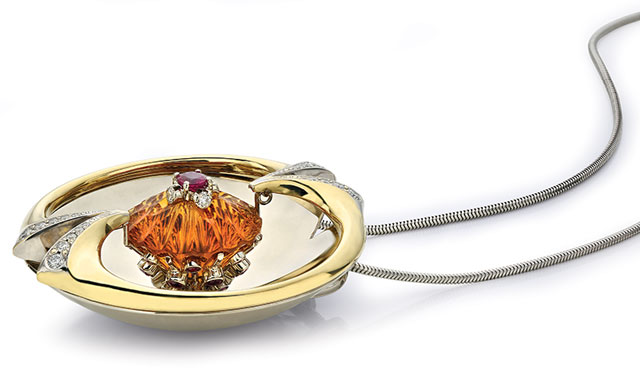
An elaborate harness containing 25 sapphires is tucked into the bottom facets of the citrine, allowing the stones to stay hidden while also being reflected by the while gold disc below.
The top assembly is threaded through the gem and laser welded to the harness, with the prong-set sapphire hiding the opening. When you view the piece from the top down, you cannot see any of the hardware on the back of the citrine. Dailing did this deliberately to enhance the mystique of the piece. “Nothing sticks out past the girdle of the citrine,” he says.
The next challenge was achieving the motion Dailing desired for the citrine. He didn’t want the gem to “twitch,” but rather to “swing” slowly when worn, creating movement to enhance the play of color. Exactly how he achieved this feat is proprietary, but Dailing says it involved quite a bit of math and trial-and-error to get the desired effect.
“I literally fashioned the hardware that holds the citrine like a swing set, so it swings side to side,” he describes. “I knew if I could find a way to suspend the gem far enough down into the white gold disc, the smoother it would swing from side to side.”
To reduce the friction where metal meets metal, Dailing gave the swing hardware an extremely high polish.
The play of color combined with the movement of the citrine is the hallmark of the piece. “The most wowing visual intensity is the colors flashing around in the dish,” says Dailing. “And that was the result of straight-up experimentation!”