

Fair Play
Ethical Gem Suppliers Group launches new show in Tucson
(Originally appeared in the April 2020 issue of MJSA Journal.)
By Rich Youmans
A new show debuted in Tucson this February, which in and of itself is not unusual. During the city’s annual winter “phenomenon,” when gem and mineral shows abound, you’re never more than a few minutes away from another opportunity to pore through stones of every type, size, cut, and carat. It’s also not unusual, if you look among the shows, to find some vendors promoting responsibly sourced gems—a growing trend as consumers (especially younger ones) pay more attention to their stones’ origins.
What is unusual is to find a show dedicated solely to ethically mined, fully traceable gems. But that’s exactly what buyers found at the first Tucson Ethical Gem Fair, Feb. 4-6 in the hall of the Scottish Rite Cathedral on South Scott Street. Granted, there were only seven exhibitors total, but that is by design. All are members of the Ethical Gemstone Suppliers Group, the fair’s sponsor, and their goal is not to create another event to compete with the many others in Tucson.
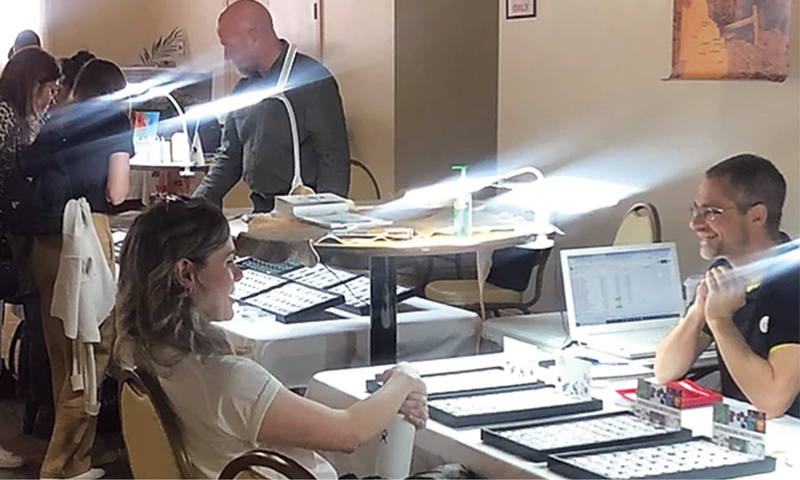
“We’re not promoting a trade show,” says Ian Bone of Capricorn Gems, an Australian supplier specializing in responsibly sourced Queensland gems. “We’re creating a market.”
That push has been going on for a few years now, and the Tucson show is the latest manifestation of not just the group’s efforts, but also the growing profile of sustainable colored stones.
Recent surveys have shown a rising consumer sentiment for responsibly sourced jewelry materials—just a few months ago, the World Gold Council released survey results showing that 70 percent of respondents wanted gold jewelry “produced ethically.” However, most of the attention has been focused on either gold or diamonds, as consumers became introduced to how the mining of these materials could involve forced child labor, environmental harm, dangerous working conditions, and even connections to guerrilla and terrorist groups. Standards and certifications were developed to trace the path of diamonds and gold from mine to market, and they were promoted to consumers.
Until recently, though, colored stones had no similar certifications to promote, nor did they have the elevated visibility of diamonds and gold among consumer buyers. Not that there weren’t people just as passionate about the mining (and cutting) of colored stones, and about improving the conditions of the artisanal mines that produced them. One longtime proponent, Eric Braunwart of Columbia Gem House in Vancouver, Washington, developed his own documentation for what he termed Fair Trade Gems. Brian Cook, owner of Tucson-based Nature’s Geometry, created the Bahia Initiative to support sustainable and environmentally friendly mining in Brazil. Others, such as Stuart Pool of Nineteen48 in Hertfordshire, England, and Monica Stephenson of Seattle-based Anza Gems, collaborated with the Tanzania Women Miners Association to help build a market for their Moyo Gems.
As these efforts played out and more designers learned about responsible colored stones, interest grew. In 2017, Bone had an idea for how to raise this interest even further.
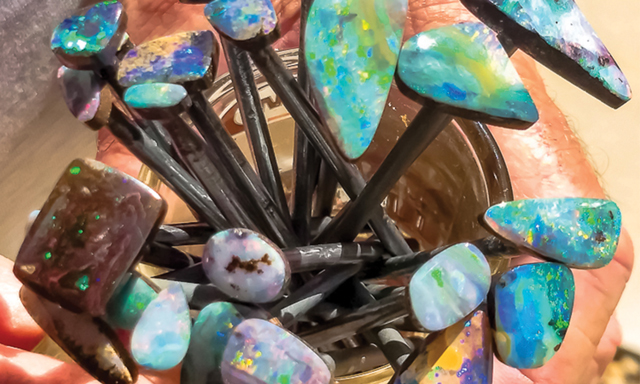
He envisioned a fair focused entirely on responsible colored stones, “a way of meeting an emerging market need in the U.K.” He approached Pool, one of his longtime colleagues, who in turn brought in Kathy Chappell of London-based Fairtrade Gems (the U.K. representative of Columbia Gem House). In March 2018, the three companies came together for a one-day fair in London—the first Ethical Gem Fair.
Since then, several fairs have been held in London and Edinburgh, Scotland (home of another responsible supplier, Gemstones Brazil). But it wasn’t until Bone and his colleagues met several more suppliers at the 2018 Chicago Responsible Jewelry Conference that the idea of having a U.S. fair (and organizing as a group) took hold, with Tucson as the most natural spot.
The 2020 Tucson Ethical Gem Fair featured, in addition to Capricorn and Nineteen48, five other members of the Ethical Gemstone Suppliers Group: Nature’s Geometry, Columbia Gem House, Anza Gems, Perpetuum Jewels in New York City and San Francisco, and Gems of Ethiopia in Lynnwood, Washington. Only Fairtrade Gemstones and Gemstones Brazil couldn’t participate.
The exhibitors noted how pleased they were with the attendance, which totaled close to 250 over the fair’s four-day run. “From my point of view, the first U.S. Ethical Gem Fair exceeded my expectations,” Pool said. “I don’t think any of us were under any illusions as to how hard it is to attract people away from the big [Tucson gem] events, and it was incredibly affirming that we are doing something right.”
Promotion for the event was done mainly through social media, and many buyers said they had come to Tucson specifically for the fair. “This says two things to me,” says Braunwart. “First, this group is very social media savvy (most were younger), and [it] is very committed and larger than many in the jewelry industry thought. I started in this area 19 years ago, and it is just in the last three years that we have seen this level of interest.”
Those buyers primarily fit the group’s targeted demographic, Bone says: “An independent jewelry designer, typically a young woman in her late 20s or early 30s who is just starting her own business, usually a custom studio. They’re looking for something special and different.”
So are their customers, he adds: “They’re checking the boxes, making sure that everything is responsible. A gemstone’s beauty now often comes second to responsibility.”
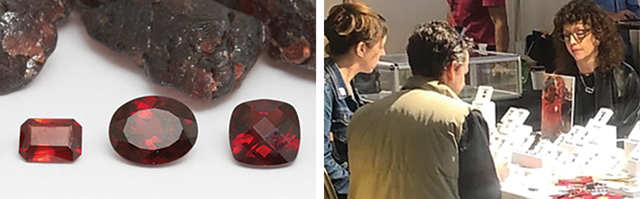
Garnets from Columbia Gem House (L), Monica Stephenson of Anza Gems (far R)
Obviously, there’s a market for these stones, and an opportunity. But for Bone and his colleagues, there’s also a question: How much demand can the artisanal mines really fulfill?
“It’s a constant puzzle,” Bone says. “Right now, we couldn’t match the supply needed if a company like Tiffany reached out. It would be no problem to supply 10 to 15 7×5 mm or 8×6 mm calibrated stones, but larger numbers are problematic.”
At least for now. As he notes, if larger companies express an interest in responsible colored stones, he can then go back to his suppliers and ask them to begin ramping up. It would take a while, but it could be done—as long as things proceeded slowly.
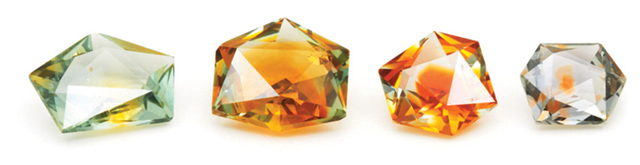
Sapphires – Columbia Gem House
The same holds true for the size of the Ethical Gem Suppliers Group. “We could possibly go up to a dozen [suppliers], but we have to vet the new people,” Bone says. Given how much responsible gems depend on consumer trust, even one bad supplier misrepresenting stones could taint the entire group.
“We have to grow organically,” he says. “We have to be careful.”
Several Ethical Gem Fairs are scheduled for the rest of this year and into 2021: April 2-3 (London), Sept. 9-10 (London), Sept. 23-24 (Edinburgh), and Jan. 31-Feb. 4 (Tucson). For more information, go to ethicalgemsuppliers.com.