

Break It In
Simple modifications for a new bench pin
By Helen I. Driggs
It’s nice to splurge on a new bench pin every couple of years, and after making some basic modifications to an off-the-shelf pin, it’s easy to quickly get busy working again on the pristine surface of a new one. Over the years, I have found that there are three modifications that I consistently add to every pin I’ve owned, right after I’ve created the V-slot. To make these modifications, you’ll need a stock bench pin, a flat wood rasp or coarse file, a round wood rasp, and a1/8 inch drill bit (about #30).
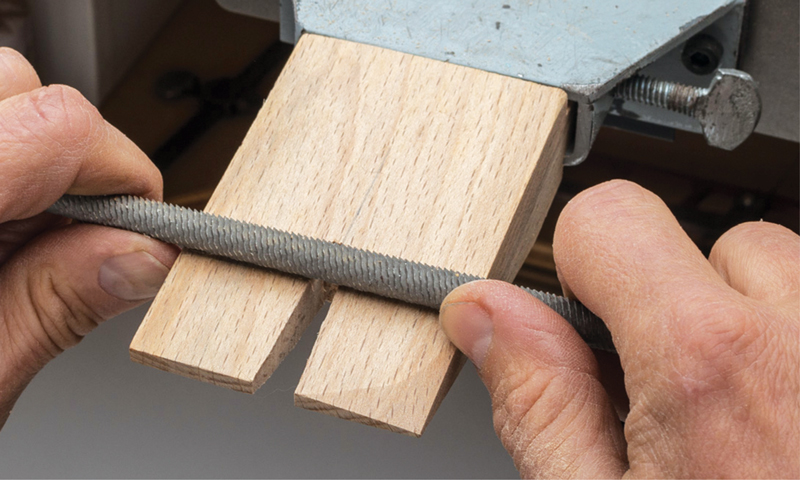
The Filing Ramp
Use a flat wood rasp or coarse file from the hardware store to create an angled ramp on the right “fork” of the pin, which I do because I am right-handed; if you are left-handed, make this modification on the left fork of the pin. The ramp has about a 30-degree angle, and is a great place to position work for filing.
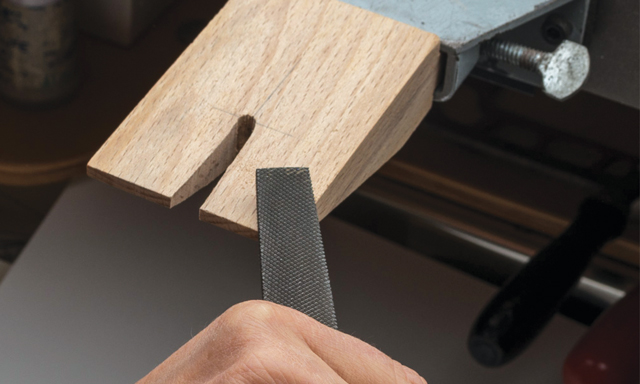
That angled surface takes advantage of the arm’s natural tendency to sweep upward at the end of a file stroke, and allows you to maintain consistent contact with the metal during the entire stroke of the file.
The Half-pipe, Dude
I always create a semi-circular groove about 1/4 inch from the back of the pin’s V-slot using a round, non-tapered wood rasp.
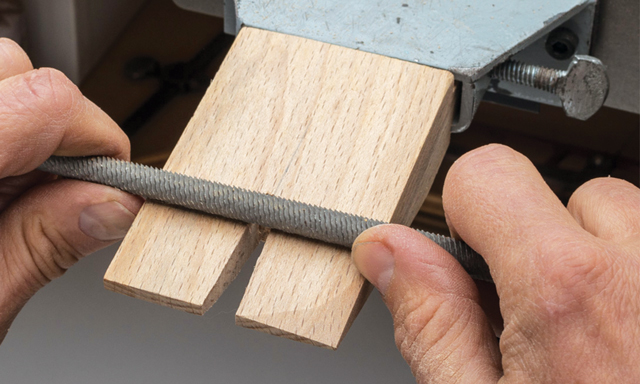
This miniature half-pipe is not for snowboarding, though it does make it simple to cradle and hold tubing, round wire, or bar stock as you saw.
Ready, Steady, Set
Near the back of the bench pin, drill a1/8″ diameter hole all the way through for vertical insertion of earring posts, pin stems, wire, and/or tubing. The drilled hole makes it easy to file, sand, and inspect edges and ends because you can expose just the material you need to remove by sliding the tubing up or down in the hole.
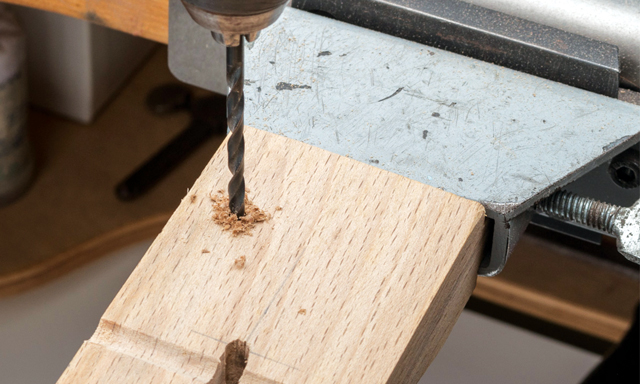
I always leave a long section of soldered-on 2 mm tubing attached to my work to use as a handle while I tube or bezel set tiny stone-on-stone pieces. Once I’ve set and final-polished the stone, I saw off the excess and tube rivet it to the underlying layer of the work.
There are dozens of other modifications I have added to my various bench pins over the years, but these are my must-do modifications for any and every pin I own, including the inexpensive, little travel pin I keep in my toolbox.
Helen I. Driggs is an experienced metalsmith, lapidary, and studio jewelry instructor. She has appeared in six instructional jewelry technique videos. Her latest book, Metal Jewelry Workshop, was published in 2017.