

World of Whimsy
Fairy Queen of Keys Castle by Christi Anderson
First Place, PMC Category
2012 Saul Bell Design Award Competition
By Sharon Elaine Thompson
A fantastical confection of turrets, keys, and doors that open and latch, the Fairy Queen of Keys Castle pendant by Christi Anderson of Marana, Arizona, took first place in the Precious Metal Clay category of the 2012 Saul Bell Design Award Competition. Although the pendant measures 2.5 inches deep by 3 inches high, the walls are so thin that it remains light and wearable despite its large size.
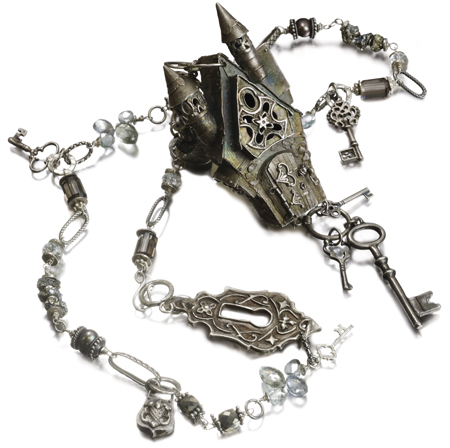
The piece evolved naturally from Anderson’s line, specifically her hollow birdhouse pendants. She says the castle actually started out as “an extreme birdhouse.” But when the initial footprint turned out larger than she had planned, she realized it would work better as a fairy castle, instead.
Anderson made her first fairy castle at the request of a customer who had seen the birdhouses. But then a retail show came up while she was working on the castle. Anderson oftern displays works in progress at shows to get feedback. When she exhibited the not-quite-finished fairy castle, she says, “Everyone wanted it.” Now, despite the time and labor that go into these large creations—the fairy castle took about 60 hours to complete, including the chain—Anderson knows there is a market for them.
PMC seems to tempt artists to work with hollow forms; however, hollow pieces can warp, shrink, sag, lean, blow out, and change sizes in the kiln. Anderson’s secret to maintaining structural integrity: “It has to be 250 percent dry [before firing in the kiln],” she says, otherwise disaster is sure to strike. The Fairy Queen of Keys Castle say drying on a heating pad for three days before she trusted it in the kiln. “And I live in Arizona,” she adds.
A viewer’s impulse on seeing a hollow piece like this is to want to look inside. Anderson does not disappoint them. Almost all of her pieces have doors, gates, and windows the open and latch. Sometimes the entire piece opens like a locket. As a result, Anderson has become adept at hinges. To make them durable enough to hold the weight of the opening section, she ensures that the cynlindrical part of the hinge through which the pin runs bonds completely with the surface it adjoins. “The PMC has to literally melt with the water, so that it’s like lead solder,” she says. That still leaves the hinge cylinder and the surface with a very small common contact area. To resolve this issue, Anderson builds up the PMC on either size of that contact point, increasing the footprint where the hinge touches the flat surface of the piece until the hinge is secure.
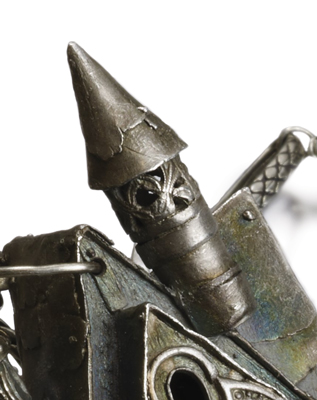
The most noticeable features on the castle are turrets, which were originally meant to go onto another piece. Seeing them sitting on her bench, however, Anderson wondered how many turrets she could add to the fairy castle. Because the castle was designed to stand on its own, she had to balance the turrets visually and physically so the castle would not tip over.
Being inspired by components meant for another piece is typical for Anderson, who says her pieces evolve from each other. Inspiration often comes from the leftover bits on her desk—shapes, ornaments, or turrets that weren’t used on a previous piece. Birdhouses become “extreme birdhouses,” which evolve into fairy houses, which evolve into turreted fairy houses.
Although Anderson’s pieces are very complex, she uses minimal tools—well, one, to be exact. “For 99 percent of what I do, I use an X-Acto knife,” she says, whether it’s carving, slicing, shaping, or texturing. Even her wood grains come alive under the knife. “Wood grains are something I’m very familiar with,” she says, having grown up with a carpenter for a grandfather. “I had splinters from the time I can remember.”
Anderson learned from a young age that whimsy is hard work—and she loves it. She’s already building another piece to enter in next year’s Saul Bell Design Award Competition. As history has shown, pushing her limits and evolving her designs can bring rewarding results.