

World Class
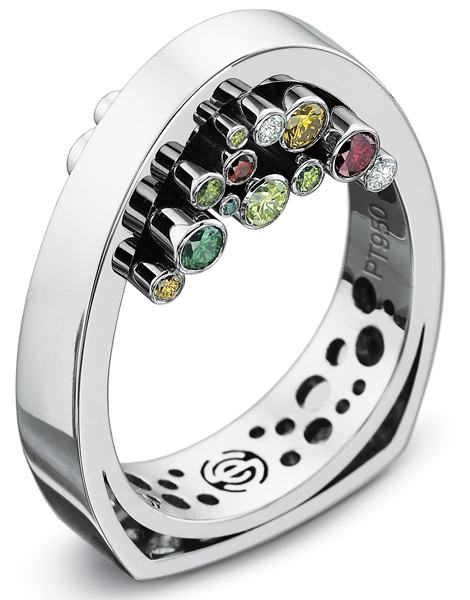
E. Stewart’s Hollein Ring
Winner, 2011 Johnson Matthey NY Sustainable Design Awards
By Shannon L. Brown
When Erik Stewart of Tucson was a teenager, a friend who’d traveled to Europe told him about the exterior of the Juwelier Schullin jewelry store designed by Hans Hollein in Vienna, Austria. Intrigued by the design, Stewart sketched a ring based on the inset above the doorway, which features tubes of varying lengths and widths. Years later, he pulled out the sketch, and, with very few changes, created Hollein—a woman’s platinum ring with colored and colorless diamonds bezel-set in tubes. The design earned one of three winning spots in the 2011 Johnson Matthey NY Sustainable Design Awards.
Using CAD/CAM, he designed the shank in two sections: a half-round inner shank and a full-round outer shank. “The interior of the shank goes from thick to thin so quickly that if I left it in one piece, the corners would break off in the casting process and would make a terrible mess,” says Stewart.
The inner shank has holes of varying sizes as both a design element and to lighten up the ring. Stewart also hollowed out the underside of the top of the shank to remove some weight, knowing the area would be hidden by the tubes. Following his standard requirement for making jewelry that is light and comfortable, Stewart began this design with about 27 grams of metal, but ended up getting it down to 19.3 grams, always keeping the ring’s wearability in mind. “It has a really nice balance,” he says. “It stands up on its own and doesn’t feel like it wants to roll.”
The ring was modeled and cast in two sections, via services offered by a contest sponsor. Stewart then gave what would become the narrow inside area of the ring a fine polish—a job made much easier by the fact that the components were separate. He tacked the two pieces together with a minimal amount of solder and then laser welded them so the seam would be invisible.
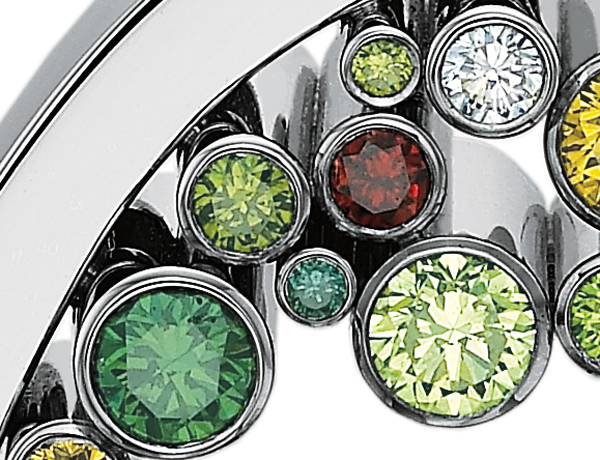
Coordinating the tube and diamond sizes caused some consternation. “I had to go backward a couple of times,” he says. Due to time constraints, he opted to use stock tubing as opposed to fabricating the 12 tubes by hand. So he had to coordinate available diamonds in sizes that fit that tubing; as a result, the stones were more or less chosen for him. “Those are the colors that were available for those small sizes,” he says. Ranging in size from 0.9 mm to 2.1 mm, the 24 diamonds in the ring include colorless and irradiated colored diamonds with a total weight of 1 carat.
Twenty-four diamonds ranging in size from 0.9 to 2.1 mm are bezel-set into tubes of various lengths at the top of the ring. This design element was inspired by the inset above the doorway at the Juwelier Schullin jewelry store designed by Hans Hollein, for whom the ring is named.
The tubes were cut to varying lengths from 6 to 9 mm. “I didn’t want the tubes to stick out beyond the shank more than 2 mm on each side,” Stewart says. He pre-polished the tubes by inserting one each into a #30 Foredom handpiece and holding it against a polishing wheel moving at a high speed. With half polished, he removed the tube, turned it around, and polished the other half.
Stewart then drilled out the bezel settings at both ends of the tube and dry-fit each diamond before setting. He had to use extra care when setting the second stone in each tube; if it wasn’t seated properly, the luxury of pushing it out from the other end no longer existed. After all the stones were set, he polished the tubes again.
To attach the tubes, Stewart turned the shank upside down and soldered them in one at a time, following the layout he had carefully planned to achieve the desired aesthetic. (For retail clients, he can vary the number of and placement of tubes, making the same shank produce a ring ranging in size from 6 to 9.)
He used a low temperature solder for the project, something he says, “really made this design happen and maintained the high polish.” A “modest final polish” completed the ring.
“Working in platinum allowed me to move forward on each step without the need for re-polishing or dealing with oxidation,” he says, “Plus, it’s always an honor to work in one of the most presitigious metals known.”
Photo by Rare-Creative.com