

Wood Craft
Modifying your bench pin for maximum performance
By Charlie Herner
She’s always there for you, welcoming you each day as you approach your bench, ready to take on any task. She’s your loyal and devoted bench pin—and chances are you’ve customized her to suit your needs. The following are snapshots of my and my fellow Green Lake Jewelry Works jewelers’ bench pin modifications, with descriptions of how those mods enable us to better perform our craft.
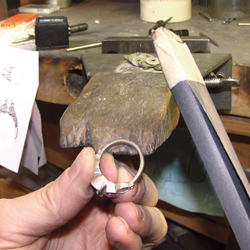
“I notched a half-circle in my bench pin to help me file and emery the side faces of rings. The mod came about because as I worked, rings kept slipping all around my bench pin and my fingers were slamming into the edge of it. This notch solved that problem. I also use the flat top instead of the slope because I do so much filigree and need a flat surface to keep things from falling off into my pan.”—Amber Worley
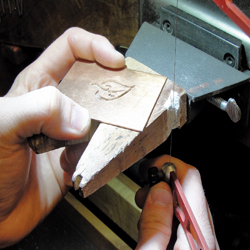
“I cut a notch into the right side of my piercing bench pin and then packed it with Bur-Life. This works out great for keeping my saw blade properly lubricated while remaining extremely close to my work.”—Charlie Herner
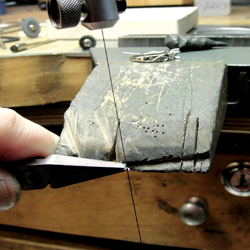
“I don’t think I do anything totally outside the box with my bench pin; however, I find that a few well-placed notches and grooves help to improve bracing. I like a horizontal notch for bracing everything from filing ring shanks to sawing small components such as filigree. A vertical notch is also useful in similar applications requiring a different angle of attack.”—Joe Worley
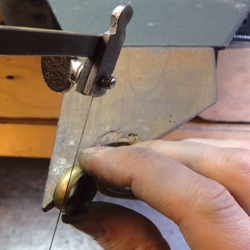
“I cut a V-shape in my bench pin to firmly hold work pieces while cutting. It’s great for applications such as cutting rails or cutting coiled wire into jump rings.”—Kyle Coffey

“Since bench pins wear away over time, they are constantly evolving. This one has seen better days, but the general shape has remained. I use the left groove for support while filing and shaping. The groove on the right is good for cutting, but it also protects my hands and other objects by stopping the cut of the blade. The remaining center section is perfect for supporting a ring while sizing a shank.”—Jeremy Dunn