

Under the Sea
The ebb and flow of Marie Cabirou’s Swinging Necklace
By Tina Snyder
An avid scuba diver, Marie Cabirou of Marie Mas in Paris finds much of the inspiration for her Swinging Stones collection in the underwater world. “The way the fauna and the flora move is very fascinating,” she says. “Everything is alive underwater, and the fauna and flora react to your movements as you pass by. It’s magical.”
Cabirou endeavored to imitate the organic flow she witnesses under the sea in her jewelry, creating a line of kinetic pieces that come to life with wear. Her jewelry changes color with the movement of the body, or with the way a person chooses to wear it. “It’s like a balletic domino effect when the gems switch color,” says Cabirou. “In this way, my designs highlight the beauty of the woman wearing them and the sensuality of her gestures.”
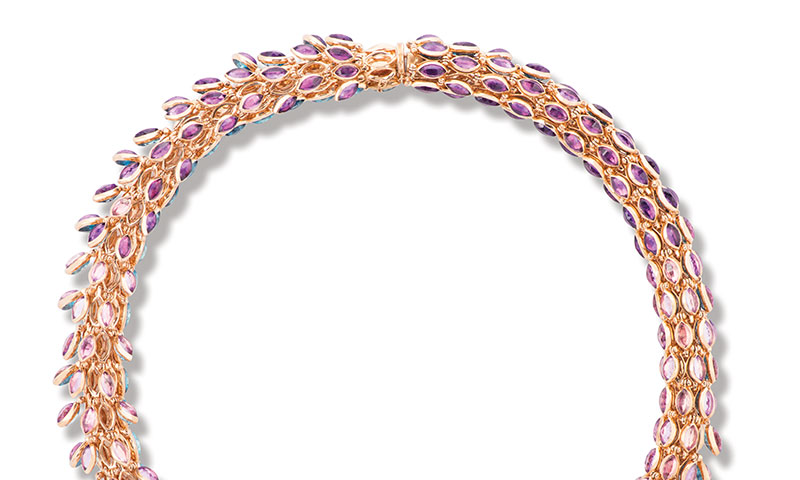
By far the most complicated piece in the collection is the Swinging Necklace. Crafted in 18k rose gold, the piece features a total of 486 stones (111 carats total weight). The stones, which measure 6 mm by 3 mm, are cut with a flat back that enables them to be set back-to-back in a bezel setting. Set between the stones within the bezel is a piece of high-polished white gold to maximize the shine of the stones. The bezel is then attached to a rose gold wire structure hidden by the stones using a patented hinge mechanism. “It was very important for me that the focal point was the colored stones and their movement—not the structure,” says Cabirou.
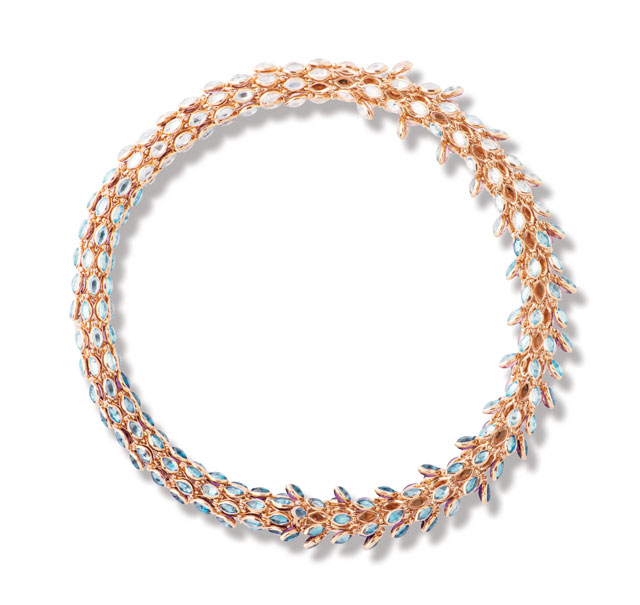
The hinge mechanism allows the gemstones to basically flip from one side to the other, revealing a purple- or pink-hued gemstone on one side, or a blue-hued gemstone on the other. The bezel-set stones are attached to the 18k rose gold base structure in stations of six around. The three stones on the inside of the necklace, which sit on the neck, are attached by a fixed mechanism that does not allow for movement to ensure comfort. The three stones on the outside of the necklace are attached with the patented hinged mechanism. If the necklace clasp is worn at the back of the neck, the necklace is shades of purple and pink; whereas if the clasp is worn at the front of the neck, the necklace is shades of blue. The clasp features stones that are set in the same way as the rest of the necklace to make it as invisible as possible. Since the outer gemstones on the necklace are hinged, they dangle and articulate as the wearer moves—a subtle dance evocative of the sway of ocean life beneath the sea.
Cabirou designed the necklace in a gradient of color on each side. “I wanted to have a soft, pastel, and feminine color palette for this collection in order to balance with the masculinity of the technique,” she says. “I also wanted to have two very different colors on both sides, but to be able to have the color gradient in those colors to pass smoothly from one color to the other.”
As she developed the necklace, she realized that the flat back cut of the stones limited her options. “We had to try to be sure that the needed thinness [of the stones] would not take away from the color of the stone,” she explains. “For a lot of stones, when they are cut very thin, they lose their color.”
It took a lot of trial and error with different gemstones to finally get to the final two color shades. The blue side fades from dark to light in a cascade of 72 Swiss blue topaz, 90 London blue topaz, 54 sky blue topaz, and 27 blue moon quartz. The purple side follows suit, fading from deep purple to pale pink in a cascade of 72 Brazilian amethyst, 90 African amethyst, 54 pink quartz, and 27 rose quartz.
“The special cut developed for these stones not only gives them a flat back so they can be set specifically for this effect, but also enables as much light as possible to travel through them, revealing their beautiful colors,” says Cabirou.