

Tool Testing: Supra Pliers
Supra Pliers
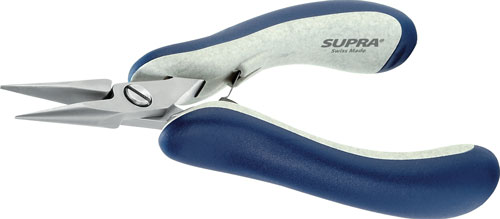
Made of ball bearing steel hardened to 45 Rockwell, these Supra flat-nose pliers feature a no-scratch/anti-glare satin finish, a lap joint with a fine-pitched screw for ideal joint adjustment and symmetry, and stainless steel dual leaf springs. The rounded ergonomic handles have a wide, soft, comfortable gripping surface. Overall length is 5 1/8 inch. Supplied by: Gesswein
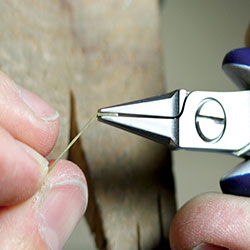
Tom Linenberger: I was really impressed with how these pliers were put together. There was no lateral movement and they were very comfortable in my hand. They tended to grab jump rings really well without the rings slipping out and popping away from me. Although I have only had them for a short time, the quality construction leads me to believe that they would last a long time.
Kirk Lang:Due to the tendonitis I recently developed in my hand, these pliers were a welcome tool. They are easy to grip and comfortable. The handles are a bit sticky and tend to pick up some dirt and debris, but they are super comfy to use.
Also, the anti-reflective finish comes in handy when you are using them under a microscope. When doing any delicate work under the microscope, direct light reflection back into the lens can be hard on your eyes. The finish on these pliers prevents that.
Patricia Tschetter: The fact that these pliers have a removable spring makes them ideal for me, as I like to remove the spring because it’s easier on my hands to use them that way. Often pliers have a heavy spring that can cause your hand to ache from all the repetitive motion. It’s nice to have the option to remove the spring.
Also, the pliers are rounded on the corners, so if you are making a bend in metal you don’t mar it with the sharp corner of the pliers. And the jaws truly close from snout to tail. A lot of flat nose pliers only meet at the tip, so if you try to bend something with them it’s hard to be precise because you aren’t gripping the metal with the entire jaw. These grip the whole way, so you get a more consistent form through the width of metal.