

This Bench Sucks
A homemade ventilation system
By John de Rosier
Air quality is a vital concern for any craft that generates dust. When working at the bench, the rotational direction of power tools such as flex-shafts tends to blow that dust straight into the jeweler’s face. Compounding that, jewelers often have their faces quite close to their work. That is the very definition of an air quality/workplace health problem.
I spent some time in my studio grappling with how to best address this. There are a number of commercially available solutions, any one of which might prove effective; however, with a limited budget and a desire to have my system synchronize well with my existing setup, I designed a dust management system from the ground up.
I don’t do any soldering at my bench—I have a separate station (with its own ventilation) for all things torch- or chemical-related, so the system shown here is just for dust, not fumes. The problems I addressed are of the particulate variety: small gritty bits of dust that are harmful to breathe into the lungs. The goal when dealing with this stuff is to pull it away from your face, not past it (you don’t want the air suction behind you or above you, for instance). At the same time, you want your setup to permit you to work smoothly and effectively, without creating any unnecessary inconveniences.
The images here show how I designed my own bench ventilation system using a Fein Turbo shop vacuum. It’s powerful, well made, and quiet. It actually has several suction/noise settings, so I can have a conversation-friendly environment while it’s on. I hooked up a foot pedal switch to the vac so I have remote control over it, and I have no excuse for not using it when it’s needed.
The vac hose can be routed to my work from below or above the benchtop. It works well with a standard bench pin or with the GRS BenchMate, and it’s versatile because it can be positioned precisely, moved out of the way, or even removed entirely if needed.
Most important, I don’t blow my nose to discover black snot anymore. Gross as that sounds, my lungs were surely getting some of that dust, so I’m happy to be taking better care of my respiratory system now, which is not replaceable equipment.
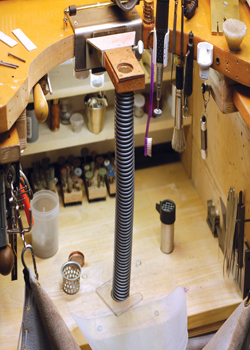
Here’s the dust collector mounted from below using a special bench pin that I made, which inserts into a GRS bench pin holder. It has been fitted with a screen to prevent whatever I’m working on from being sucked into the wormhole of dusty oblivion. A C-clip made from acrylic sheet holds the hose in place
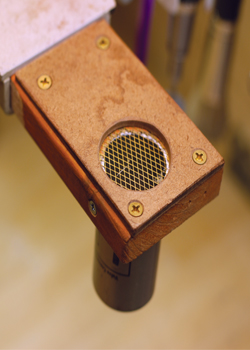
This is a close-up of the dust-sucking bench pin without the hose attached. The hose mates with an aluminum tube anchored beneath the platform. I used brass screws because they’re softer than steel and less likely to damage my work. The top plate is removable to replace the screen if needed.
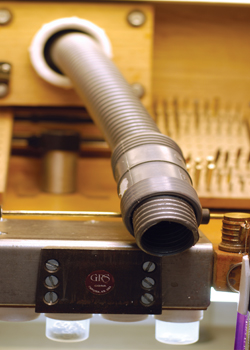
For use from the top of the bench, the vac hose comes out of an opening on the upper back wall. It can be pulled out or pushed in with little effort. The pipe/rail system allows the hose mouth to be positioned with precision. Once in place, it stays put. Here it is shown on the rightmost end of the positioning rail.
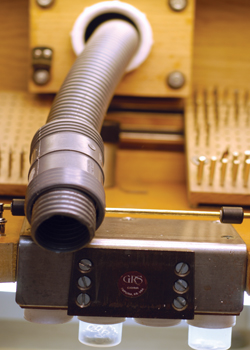
Here the hose is repositioned at the leftmost end. The rail and guide pipe unit is designed to be quickly removed if I need the space on the bench top. The end posts are actually quick-release keychains (without the rings), the shorter halves of which are recessed and anchored flush to the bench top. Just press the keychain buttons and the entire assembly lifts off the bench.
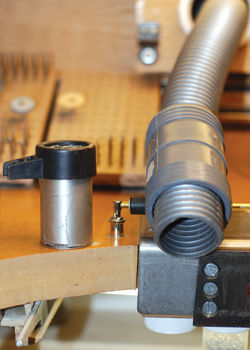
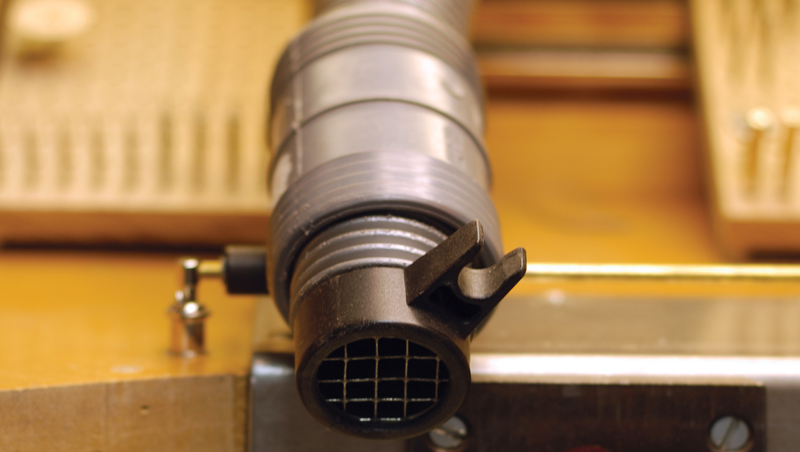
The hose is shown here with the screen attachment (upright, on left). The silver portion, which is an aluminum tube sectioned from an old bicycle pump, inserts securely into the hose.
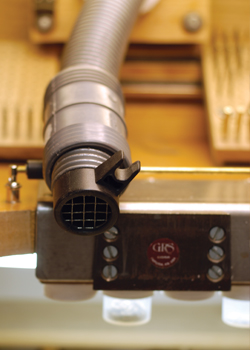
This photo shows the hose with the screen attachment installed.
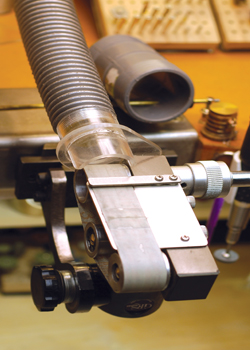
This setup is very versatile. Here, the hose is attached to a Wolf Belt Sander.