

The Student Becomes a Master
Jason Baide
Gem Gallery, Bozeman, Montana
As a recent graduate of a metalsmithing program, Jason Baide isn’t afraid to face a challenge. That’s one of the reasons he so readily agreed to participate in this year’s Mystery Box Challenge.
“I like pushing myself on designs and materials, and I thought it would be fun to get back into that and try something new,” he says.
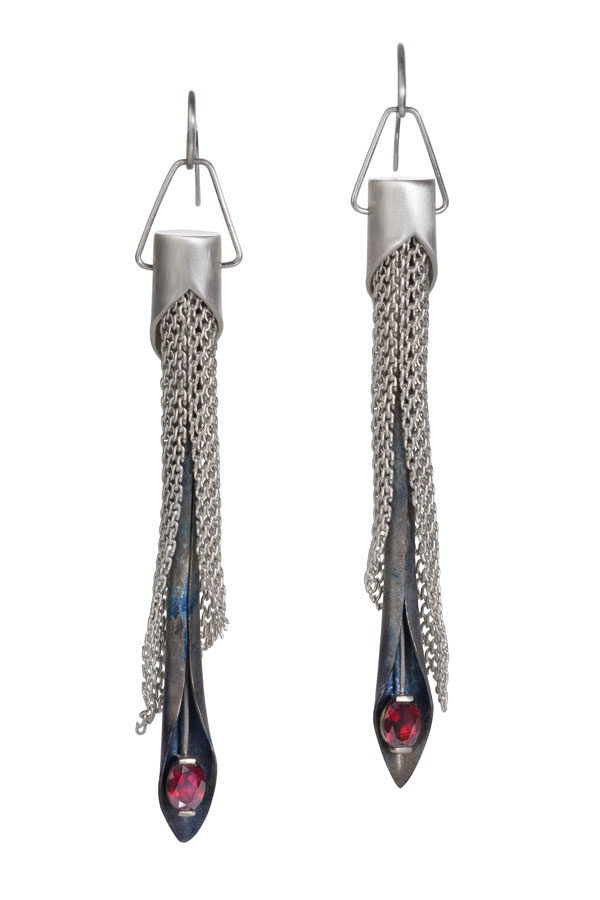
That sense of excitement didn’t dissipate even after he received the Mystery Box and discovered the materials with which he would have to work.
“The sterling silver was familiar ground, and I do a lot of flexible rings so I felt comfortable with the mesh,” he says. “But I had no idea how to work with the titanium. I didn’t know how well it would shape and move, especially with the pattern on it. I was at a loss, but also excited about it.”
After sitting on the materials for a week and thinking about what he could do with them, he finally felt ready to begin sketching out some ideas. Since one of the reasons why he wanted to participate in the challenge was to push himself, it was important to Baide that he really work to transform the materials.
“I knew I wanted to transform the mesh, and it would be too easy to create a bracelet or a bit of chain with it,” he says. “I wanted to push myself and use the materials in a different way.”
Although the idea of creating earrings didn’t initially jump out at him, as he studied the mesh and how it was constructed, he was struck with the idea of creating something like a calla lily bloom. He developed the idea further through sketching and eventually cut out paper versions of the shapes to test his idea.
Once he felt confident that his earring idea would work, Baide began shaping the mesh. He inserted round bezel mandrels through the center of the material and then hammered it with soft mallets, rounding it out and giving it a taper at the bottom. “I didn’t know how the mesh would respond to rounding and opening it up,” says Baide, who notes that he avoided any strong hammering that could have crushed the mesh structure. “I gently encouraged it to go where I needed it to go.”
Next he had to tackle the titanium. He cut out sample pieces of the metal and started playing with them to see if he could get it to curl the right way. He hammered the titanium against a series of sinusoidal stakes to transform the metal into a tight U-shape at the top that then flares out at the bottom.
“There was a little bit of a learning curve,” Baide admits. “Trying to saw the titanium with a jeweler’s saw was not a good move, but then I switched to sheers, which cut it like butter. The titanium was a little more stubborn than silver and gold and it took a little longer to hammer. Also, I didn’t want to anneal it because I was worried about losing the crystal pattern on it.”
After his experiments on the sample pieces, Baide felt that he had learned enough during the process to attempt the final piece. Ever the student, Baide had absorbed the lessons learned during his experimenting and was able to form and shape the titanium lily blooms without any problems.
Since he knew that it was possible to change the color of titanium, he had played around with heat-treating it using his torch. He liked the blue colors he achieved, so he duplicated the effect on the final pieces.
“I thought the blue would complement the red of the garnets,” he explains. To display the garnets, Baide drew some wire from the sterling silver to create a rod that would hang down in the center of the titanium lily.
To complete the earrings, he used more of the sterling silver to create circular end caps that feature a V design, which he thought made them more fun and interesting. “The shape accentuates the line of the mesh, and it continues to reinforce the verticalness of the earrings.”
Because he didn’t want to solder the titanium to the end caps, Baide drilled holes through the top of the titanium tubing and silver rods, then threaded silver wire through the mesh, rods, and tubing to secure the earrings within the end caps. “This allowed each of the components a little more movement,” he says.
He then bent the wire into a triangular shape and soldered it back to itself to form a catch for the ear wire, completing a pair of earrings of which Baide (and all of his former teachers) could be proud.