

The Struggle is Real
Ways to differentiate and engage customers
By Andrea Hill
(Originally Published by MJSA September 2019)
When my daughter was in nursing school, she experienced one tough break after another. Her first advisor wasn’t very good at her job, and she caused my daughter to miss several required classes, which led to her not being able to graduate on time. To add insult to injury, her financial aid was misreported by the school, which created a mess with the IRS that she spent weeks sorting out. One afternoon, finally giving in to tears, she said, “I just want to become a nurse. Why on earth is this so freaking hard?”
Nursing school aside, this sentiment may be familiar to you. These days, making and selling jewelry can be pretty freaking hard. And I’ll give you the same advice I gave my daughter: You certainly have other options, but if you still want to do this, you need to figure out what you can control, and revise your approach.
What Can You Control?
As a wholesale jeweler, you can’t control how independent retail functions, whether or not consumers are walking into retail jewelry stores, changing demographics and consumer expectations, or the economy. But there are things you can control. Let’s take a look at two of those things.
It’s About More Than Products
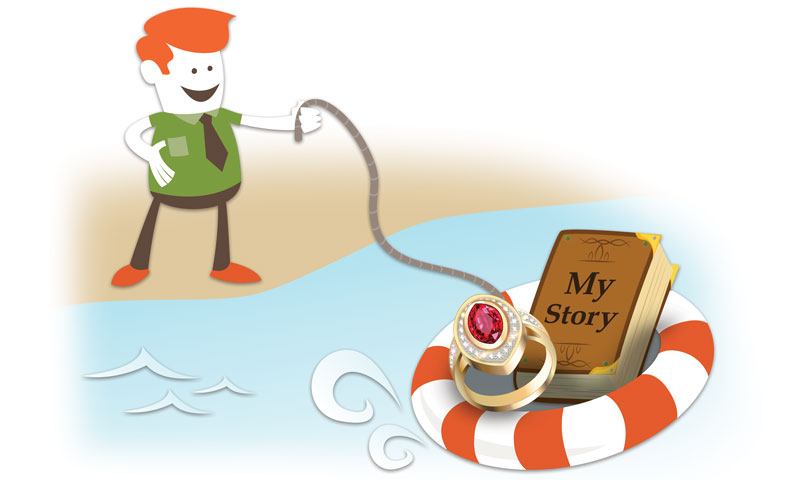
Today’s consumer is less acquisitive than previous consumer generations, which means that it’s more important than ever to have a story behind your brand and for each of your products. But what are these “stories” supposed to be, anyway?
Well, it’s more than just an artist statement or a brand vision. Your story should be the outward expression of your strategy. And what is your strategy? It’s the answer to these three questions:
- Who are we?
- What do we do that makes us different?
- Why do we matter?
Fashion jewelry—under $50 items that sell on impulse—doesn’t require differentiation at the brand level; it sells on color/style. But fine jewelry requires more differentiation. You must resonate with your consumers beyond the visual because there’s just so much jewelry available to buy, and when confronted with too many options, consumers get overwhelmed and detach. To cut through the noise, you must give them a reason to pay attention.
If you’re unable to come up with a completely new, never-heard-before story, don’t despair—there aren’t any! And you don’t need that. Just as flour, water, sugar, and oil can be combined in many ways to make many things, your story should be made up of a few ingredients that you combine in a way unique to you. The list of possible themes is almost limitless.
Not convinced? Try this exercise. Pick any four of the following elements and combine them in different ways. For each combination, imagine what kind of story you could tell and the jewelry line or brand you could create.
- Responsible sourcing
- The color red
- Specific consumers
- Gem history
- Cultural influence
- Artisanal craft
- 3-D
- A charitable cause
- Technology
- Stars and space
- Astrology
- Important milestones
- Emotions
Silly? Sure. But look how many fun ideas you came up with. If you get serious about telling your story, you will be able to reach through the oceans of pretty jewelry out there and make a meaningful claim to some consumers’ attention.
Make Your Story Come Alive Online
Consumers still prefer to buy fine jewelry in stores, so if you’ve heard that selling fine jewelry online is a long shot, that’s accurate. But just because something is true doesn’t mean it’s the only reality. When we examine this issue more closely, we see more nuance.
Consumers do prefer to buy fine jewelry in stores—roughly 85 percent of jewelry sales still happen offline. But nearly 95 percent of fine jewelry buyers say they did research online prior to making an in-store purchase. And if they find something they want online and they can’t buy it in a store, they’ll make the online purchase.
This tells us that all wholesale jewelry lines must have a strong online presence. You can’t rely on retailers to tell your story.
Your website must provide interaction, engagement, entertainment, and information. If all your site has are a few pretty pictures, an About page, and a Where to Buy page, it’s not enough. Your website must tell your story, in every possible way and on every single page. Here are five things your site must do:
1. Display all your products, along with colorful, interesting descriptions, clear specifications, and suggested retail prices. If you already have a comprehensive retail network, you don’t need a shopping cart. Just make sure consumers know where to find you. But if you don’t have a strong retail distribution network, it’s essential that you make it possible to buy.
What if you have a handful of retailers, and those retailers don’t want you to sell online? This isn’t as tricky as it seems. Offer your retailers a protected geographical area, and pay them commission for any products sold to customers within that area. When you combine that with clear direction regarding where to buy, and never list your current lines at lower retail prices, any reasonable retailer will work with that.
2. Make your inventory searchable and filterable. Make it easy for your customers to see only items within a certain price range, gemstone type or color, style, era, occasion, or whatever else makes sense relative to your story and your target customer. Customers visit more often and stay longer when a website makes it easy for them to play and interact.
3. Offer widgets or apps within your site. Most website technology makes it easy to offer interactive activities, such as polls, self-assessments, surveys, and list-builders. The more things there are to do on your site, the longer you’ll keep their attention.
4. Give them reasons to come back with wish lists and collection-builder functions.
5. Make your products easily shareable on social media and through e-mail, and let visitors vote on your products. Voting and sharing are forms of “social proof,” and social proof is the single best way to establish trust with new visitors.
During her darkest moments, my daughter was convinced that there was nothing she could do. But she kept reinventing herself and her journey, and she continues to succeed. You, too, must keep reinventing yourself and your journey. Business is changing rapidly, and the pace of change will continue. But someone will always succeed selling fine jewelry. It might as well be you.