

The Straight and Narrow
An easy method for straightening wire
By Helen I. Driggs
Coiled wire is easy to store and ship, but have you ever wasted time trying to sort out an interlocked and messy pile of unspooled 28-gauge wire only to inadvertently create bends or kinks in it? Once you unhook the end, most spooled wire has a really bad tendency to uncoil at light speed, and if you aren’t quick to control it, you will end up with tangles and kinks. Here is one of my favorite ways to get the kinks out of thin wire using a common kitchen utensil.
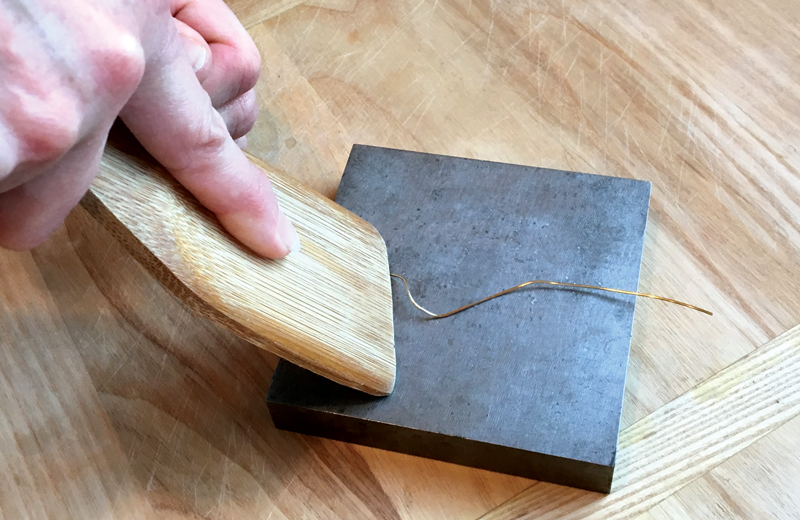
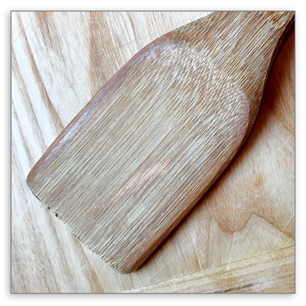
1. An inexpensive bamboo rice paddle or spatula with a straight edge makes a great wire-straightening tool. Bamboo is a hard, durable wood that will not change the profile or mar the surface of round wire as it is being straightened. Unlike softer woods, bamboo holds a firm edge no matter how hard a metal the wire to be straightened is made from.
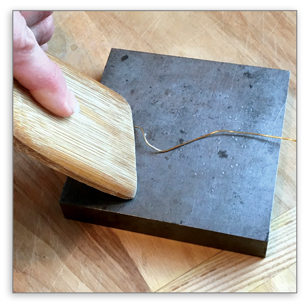
2. Position the kinked section on a steel block and firmly press down on the wire using the straight edge of the spatula held at about 45 degrees.
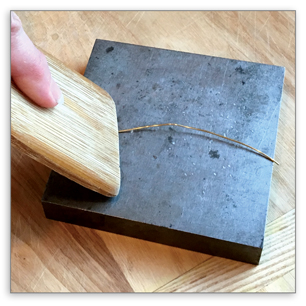
3. There are two ways to straighten the wire depending on the length: For short wires, push the spatula over the kink; for longer wire, pull it toward and under the spatula edge. Several passes under the spatula are sometimes required to completely smooth badly kinked wire.
This technique can also be used for straightening thick wire, which I like to use for fabricating rivets and hinge pins. Since rivet and pin wire must be rigid and very straight, two steel blocks should be used.
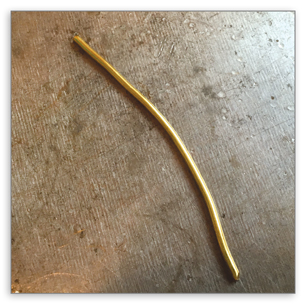
4. Use your hands or nylon jaw pliers first to gently get the wire as straight as possible without creating hard bends or kinks, and then lay the wire on a large steel block.
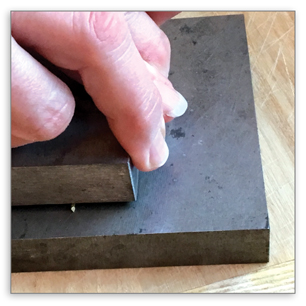
5. Hold another smaller steel block in both hands, and gently roll the block back and forth over the wire to straighten and harden it.
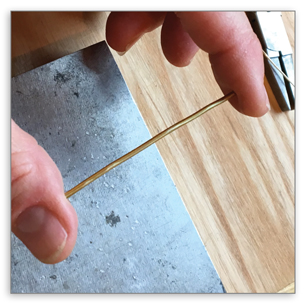
6. Voilà! The wavy wire is now straight, free of tool marks, and hardened into a rod that is perfectly suitable for creating rivets or hinge pins.