

The Shop of Tomorrow: Robotics
The Shop of Tomorrow: Robotics
With all the updated and new technology that will exist in the shop of tomorrow, it leaves one wondering who is going to operate it. If we already have robots that can clean the floor of our shops, could they help make jewelry too?
“For the types of applications where you make chains or plate in mass quantities, working on thousands or millions of pieces, it makes sense to employ robotics technologies,” says Dan Kara, practice director of ABI Research in Oyster Bay, Kentucky.
“There are new developments in robotics that will make them more suited to jewelry manufacturing,” he says. “A new class of human-sized ‘collaborative robots’ have re-cently emerged that have a large number of sensors on them to let them know what’s going on around them. If things are coming off a conveyor belt not in the same position, the robot can deal with it. Given a box of objects in a random orientation, the robot can pick them out using vision and manipulation. These collaborative robots are typically less expensive, $20,000 as opposed to $200,000, allowing them to be used by smaller companies.”
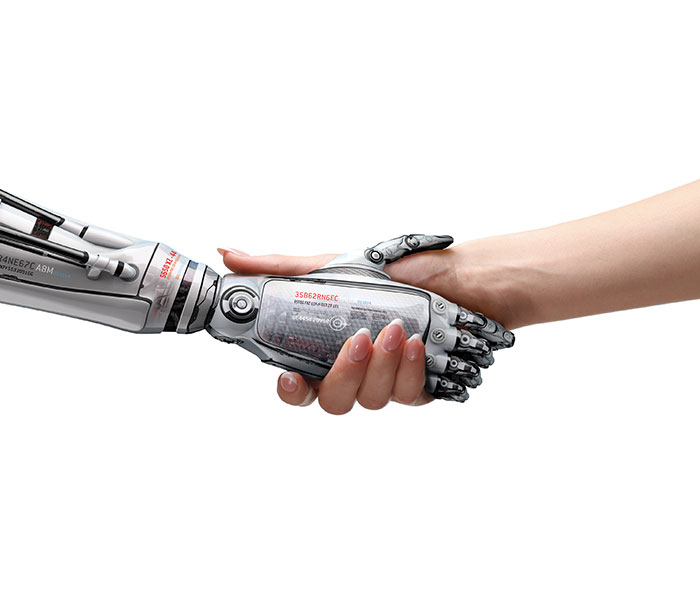
And the robots of tomorrow aren’t necessarily a replacement for their human counterparts, but can instead work in tandem. “Some applications have been working in conjunction with people as a second set of hands,” says Kara. “The robot might pick up a piece and hold it in place while the person works on the object. The robot then puts the object on the conveyor belt.
“In 10 years, we’ll see a greater proliferation of robots in the jewelry manufacturing industry working collaboratively with people to take advantage of the skill of the robot—they don’t get bored or tired like humans,” he predicts. “Let humans do the higher order things (inspections or setting stones). The robots can do the repetitive tasks or the potentially harmful ones involving working with chemicals or solutions.”
Jeff High, innovation officer at Stuller Inc. in Lafayette, Louisiana, agrees. Stuller currently has several robots at work in its facility. “We have two transportation robots whose jobs include picking up and dropping off products at specified stations within a department,” he says. “They have been very helpful in establishing and maintaining the flow of products from one operation to the next. We also have an automated head assembly robot that sorts die-struck head components and readies them for assembly.”
While High admits that the exact role of automated systems is hard to predict, “as vision equipment and other technologies improve and are available at lower cost, one can expect more sophisticated automation performing more of the fine detail work we now only associate with a human touch. The precision and repeatability of automated systems improves quality, provided the standards and expertise to set up and run those systems are present. To produce the best product, I think the real opportunity lies in working with both skilled professionals and automation.”