

The Pendulum Swings Both Ways
Kate Hubley’s pendulum earrings
By Irina Hawkins
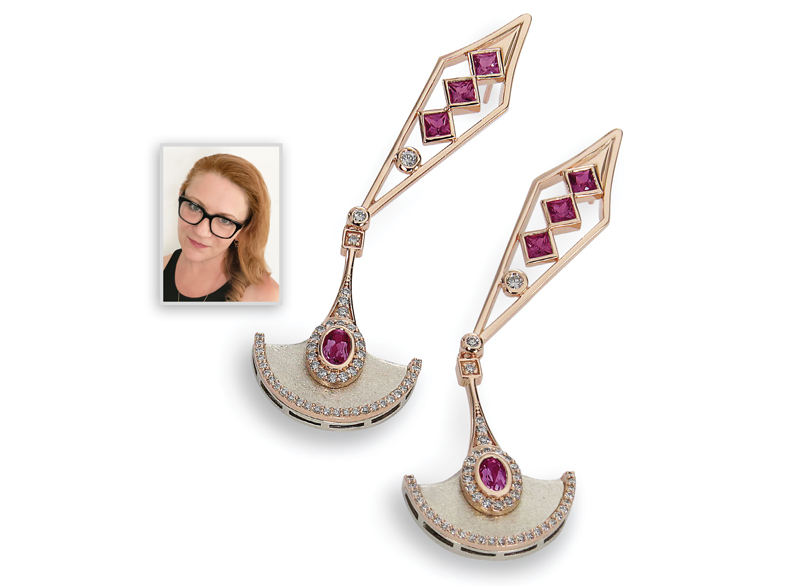
When a friend suggested to Kate Hubley, the owner of K8 Jewelry—a Montreal-based design house—that she should create some medieval pieces, she was amused. Looking at his sketches, she knew that they were not going to be her “holy grail.” Yet a drawing featuring a pendulum triggered a thought process.
Hubley realized that the pendulum would be the perfect ode to time’s healing power, which she’d experienced firsthand, having gone through a difficult divorce. With her swinging pendulum earrings, she intended to capture her epiphany to stop and enjoy whatever life throws at you. Hubley wanted to show that, even though the rose-gold minute hand (top of earring) keeps ticking, when the swinging 18k rose-and-white-gold pendulum (bottom of earring) rests in the center, all is calm.
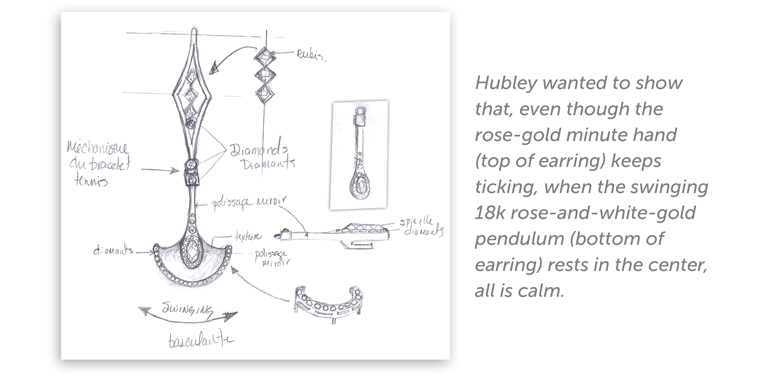
She hand-formed some prototypes, which allowed her to anticipate any construction and manufacturing challenges. “Also—even more important—it allows me to ‘own’ the design.”
Next, she had to decide which gems the piece would feature and where and how to position them. Hubley knew she wanted to incorporate color. In addition to the diamonds (0.95 ctw), she added pinkish-red oval spinels (0.9 ctw) and princess-cut rubies (1.1 ctw).
Hubley chose the spinels for their color. “It’s rather lively and [has] just enough pink to be pretty but not bubble-gum.” She selected the rubies because they had the same “joyful” hue.
With regards to metal, Hubley wanted to mix 18k rose and white gold because she thought the combination was “playful and feminine, yet elegant and commanding.” It also had to reflect the high-end look representative of her aesthetic—sophisticated pieces, which connote a touch of “playful elegance.”
While she prefers to “think” in metal, she likes to finesse the fleshed-out design on screen using CAD. After having worked out the kinks of her design, she turned to her favorite CAD designer to bring her sketch to life and further refine the engineering details.
The final CAD design is divided it into seven parts for casting. Hubley split the top half into four segments: the outline, the three attached square bezels for the rubies, the ear pin, and the round diamond bezel. Hubley separated the ruby segment so that she could set the stones properly and achieve a thorough shine of all the facets.
She divided the bottom part into three components: the red-gold rim along the bottom edge, the rose-gold neck (collar), and the white-gold “shield.” Hubley says that she finds the juxtaposition interesting, and selected rose gold because it makes the diamonds look more alive.
This lower portion also features a bezel-set spinel surrounded by a halo of melee diamonds. She chose to create all the seats in CAD because setting more than 30 1-mm stones without the software “would [make it] difficult to ensure that the outcome would be consistently beautiful.”
Hubley then pre-polished the settings and applied a texture to the shield. “It gives a lovely reflection.” The different finishes complement each other.
After setting all the stones, she soldered the bottom components, the round diamond bezel, and the ear pins into place, but used a laser welder to attach the three bezels for the rubies. “Although rubies are corundum and have a high tolerance to heat, I just didn’t want to risk it.”
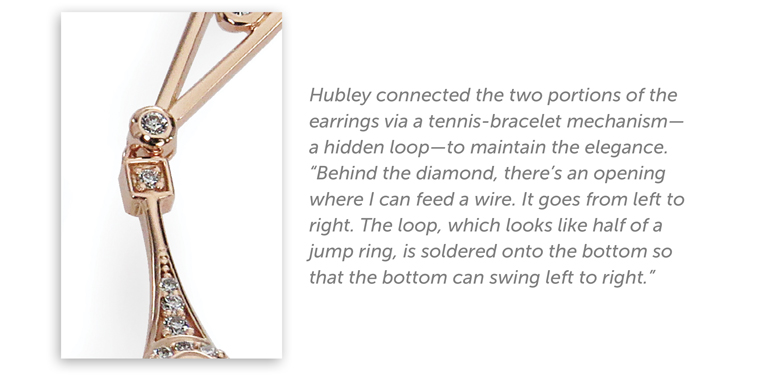
While the earrings are not a reflection of medieval jewelry, thrumming—the final step of their creation—sounds like a process that could have been implemented back in the day. “You rub the polishing compound on the threads and carefully and perpendicularly rub them through [small] openings. It lets you remove all the ‘seam lines’ and gives a high polish in the hard-to-get-to places.”