

The Letter of the Law
A guide to intellectual property rights
By Sara E. Yood, Esq.
Just how important is it to protect your intellectual property? Extremely. It’s especially crucial if you’re a one-person operation or a small design firm. You might have heard about the ordeal of Los Angeles-based illustrator, Tuesday Bassen, with the fashion giant Zara. The designer, alerted by a number of her Instagram followers, learned that some of Zara’s products look almost identical to her pins and patches, which she sells on her site. Along with product images and a portion of Zara’s letter, she recently shared the following note via Instagram:
“Over the past year, @zara has been copying my artwork (thanks to all that have tipped me off—it’s been a lot of you). I had my lawyer contact Zara and they literally said I have no base because I’m an indie artist and they’re a major corporation and that not enough people even know about me for it to matter. I plan to further press charges, but even to have a lawyer get this LETTER has cost me $2k so far.”
The outrage of many bloggers and designers, some of whom claim they too have been plagiarized by Zara, propelled Zara to suspend the items in question from its site and begin negotiations with Bassen’s lawyer. While it’s unclear how this situation will be resolved, one thing that is clear is the need to protect your designs from any possible infringement. Interested to learn how? Read on.
What is intellectual property?
Intellectual property refers to commercially valuable products of the human mind to which the creator has rights, guarding said property from unauthorized use. Protecting intellectual property is not only a crucial part of doing business, but also an aide in building a business, a brand, and a reputation. To navigate this legal field, industry professionals—jewelers, manufacturers, distributors, and marketers—might find it useful to learn more about intellectual property law by understanding the different rights and how they function. (For more information, review the Federal Trade Commission’s Guides for Advertising in the Jewelry Industry and the National Gold & Silver Stamping Act, which clarify legal terms and advise on presenting intellectual property in an accurate manner.) Understanding the nuances of different intellectual property rights is critical for staying compliant with the Federal Trade Commission’s regulations and protecting your work.
What kind of protection do I need?
It’s no surprise that many people get confused when trying to determine whether their intellectual property should be protected by a patent, a trademark, or a copyright. Each covers a certain kind of intellectual property, grants distinct rights to the owner, and lasts a specific amount of time. Here’s a breakdown.
PATENTS | COPYRIGHTS | TRADEMARKS

A patent is an intellectual property right granted to inventors to exclusively make, use, or sell their inventions throughout the U.S. for a limited time. There are two basic types of patents that are pertinent to the jewelry industry:
Utility patents may be granted to anyone who invents, discovers, or improves any new and useful process, machine, article of manufacture, or composition of matter. (Since jewelry is not a new invention, utility patents would not apply to most jewelry designs.) Industry technological inventions can qualify for utility patent protection. A utility patent term begins on the date the patent was granted and usually ends 20 years from the date the inventor first applied for it. Once a utility patent expires, it cannot be renewed.
Design patents may be granted to anyone who invents a new, original, and ornamental design for an article of manufacture. Jewelry designs can qualify for design patent protection. A design patent lasts for 14 years from the date the inventor was granted it and allows inventors to exclusively make, use, or sell their inventions in the U.S. As with utility patents, design patents cannot be renewed.
Where do I get a patent?
Patents are granted by the United States Patent and Trademark Office (USPTO). Patent applications are extremely rigorous and technical, requiring thorough searching of the patent database of all previous public disclosures of inventions in order to prove that your invention or design is unique. If you are not experienced in conducting these searches, I highly recommend that you consult a patent attorney for this process. On average, the total cost to hire an attorney to prepare and file your application can start at approximately $3,000 and go up depending on the complexity of the invention or design.
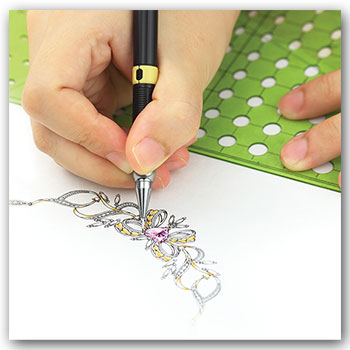

A copyright is an intellectual property right granted to creators of original works, giving them exclusive rights to use, distribute, and receive compensation for their effort for a limited time. Copyright protects artistic works such as literature, paintings, drawings, sculpture, photographs, industrial designs, and jewelry designs, which—for the purposes of copyright—are considered visual artworks. Whereas patents protect inventions that are new and novel, copyright protects original artistic expression, and is more useful to jewelers as it is faster to attach, has a longer term, and has fewer barriers to obtaining protection.
For how long does copyright protection last?
Copyright protection in the U.S. lasts for the lifetime of the last-living author plus 70 years. Any original work created by an author, excluding a fact or a general idea, qualifies for copyright protection. For example, if one person created a pendant in the shape of a lilac flower, she would be able to register for copyright protection for original work. However, that would not prevent others from creating their own interpretations of a lilac pendant and gaining copyright protection for their work. If another lilac pendant design is too close to your original design, you may sue them for copyright infringement, but it’s important to note that there is no hard rule on how much of a design has to be changed before it no longer infringes.
Can I copyright anything that’s not a fact or a general idea, then?
It is important to remember that copyright does not protect mechanical or utilitarian aspects of useful articles. For example, a clasp is generally considered a useful article, and therefore, copyright protection will not be granted.
What if I create a design on the job?
Copyright protection for works for hire—those created by employees within the scope of their employment—lasts for either 120 years after creation or 95 years after publication. Works for hire can also include works specially ordered or commissioned for use as a contribution to a collective work, if the parties expressly agree in a written and signed document that the work shall be considered a work for hire. Most employment contracts have language regarding ownership of these works, and most of the time, it states that any work created within the scope of employment will be owned by the employer. (See the JVC-published Jewelers Employment Manual for a sample of this type of document.)
What’s an easy way to copyright something?
Copying your original work automatically secures its copyright protection. For the purposes of copyright law, an original drawing of a jewelry design is considered a “copy.” That’s why mailing a copy of your work to yourself to get a date-stamped postmark—the “poor-man’s copyright”—is redundant. This step does nothing more than establish the date on which you created your work. It would be better to keep accurate records of when designs were created and register them through the copyright office.
What if I want official proof of my copyright?
You can register your copyright with the U.S. Copyright Office (copyright.gov). Registration is a legal formality that creates a public record of a particular copyright’s basic facts. The copyright owner may file for an application to register a copyright directly; an attorney’s assistance is not required. The fee to submit an application online is $35. To legally submit an application form for copyright registration, you must be the author, the copyright claimant (either the person who created the work, or—if the work was made for hire—the employer for whom the work was created), the owner of exclusive rights to the copyright, or the duly authorized agent of the owner/claimant. Registration for the copyright of an original design must be made within two years after the date on which the design was first made public.
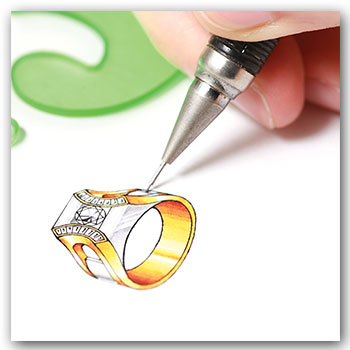

A trademark is most commonly a brand name. The terms trademark or service mark include any word, name, symbol, device, or combination thereof used (or intended to be used) to identify and distinguish the goods and services of one seller or provider from those of others, and to indicate the source of goods and services.
Why should I apply for trademark registration?
A trademark identifies a product of a particular source. It also has a quality-assurance function, as it symbolizes a consistent level of quality associated with the products sold under that trademark. In addition, trademarks serve a promotional function; they endorse the product sold under the mark, building up an identity and goodwill for the mark and product. Once the owner obtains trademark protection, others cannot use the term to describe similar or the same products and services. A term that has already been adopted by another for the same or similar products is not available for trademark registration or use because the prior user has the exclusive right to the trademark to identify products and distinguish them from those of others.
Are there any restrictions to trademarks?
A generic term, such as “diamond,” “gold,” or “precious,” cannot serve as a trademark in the jewelry industry because others must be free to use it to describe their own products. Likewise, an expressive term that merely describes the products for sale, such as “white diamonds,” cannot serve as a trademark. This does not mean, however, that these terms cannot be included in a trademark registration.
How do I register terms that might be considered generic or descriptive?
When used in combination with other terms (i.e., “Rebecca Designs Precious Objects” or “Sunshine White Diamonds”) that can function as a trademark, the phrase as a whole may be acceptable for registration. To register marks containing generic or descriptive terms, you must file a disclaimer showing your understanding that you do not control the term’s exclusive rights. (Visit jvclegal.org to search a database of all generic and descriptive terms in the jewelry industry that, by themselves, cannot be used as trademarks.)
How long does a trademark last?
The length of a trademark has no set term. Trademark protection in the U.S. is indefinite, lasting as long as the trademark is used in commerce. Because trademarks identify the source of goods or services, it is important that companies have the ability to maintain their investments in the products and their reputation indefinitely.
Once a trademark is under consideration for federal registration, a search of the federal USPTO database should be conducted to ensure that another company hasn’t previously used and registered it. Law firms that have a significant trademark practice can do a screening through the USPTO website, evaluate the results, and provide an opinion regarding a trademark’s availability for use and registration.
If the trademark search shows that a mark is not being used otherwise and is available for use and registration, an application may be filed for registration with the USPTO. Although it is possible to apply on your own, I recommend that you consult an attorney to ensure that your application is thorough and complete. The fees to register a trademark start at $225, and many law firms provide trademark registration services for a flat fee.
If you do receive a trademark, note that the National Gold & Silver Stamping Act requires that jewelry businesses stamp their precious metal jewelry with their federally registered trademarks if they are stamping it with a quality mark. This acts as a guarantee of the fineness of the precious metal.
Can you offer examples of the three protection types?
In the jewelry industry, the difference becomes clear when we look at the real-life functions of these concepts. For example, a patent could be applicable for anyone who invents a new machine or method to engrave metal. A copyright could be used to protect the design of a new piece of jewelry made by that machine. And a trademark would protect the name and logo of a company that sells jewelry made by the new machine using the new design.
What if I want more information?
While this article has touched on some important aspects of intellectual property protection, it is by no means meant to be a complete and thorough guide on this fairly detailed and complex subject. For more information on selecting the right intellectual property protection, the registration process, and other aspects of the law, visit the JVC website or check out the JVC’s I Have an Idea! JVC’s Guide to Intellectual Property Law.
Sara E. Yood, Esq. serves as senior counsel of the Jewelers Vigilance Committee in New York City.