

The Hunt Is On
Refiners share tips for hunting down and capturing precious metal waste
By Shawna Kulpa
“Our industry has taught the rest of the world how to capture metal,” says Daniel Ballard, national sales manager of Precious Metals West/Fine Gold in Los Angeles. And he may be on to something.
After all, is there another industry that produces such valuable amounts of scrap, sweeps, and dust? If jewelry makers and designers can’t master the art of capturing metal waste, who can?

But while collecting the large pieces of leftover metal may be easy, it’s sometimes difficult to know where smaller bits lurk. To help with that, we spoke with several industry refiners for their best tips on where to find and how to capture even the smallest particles of precious waste. Let the hunt begin!
Bench Sweeps
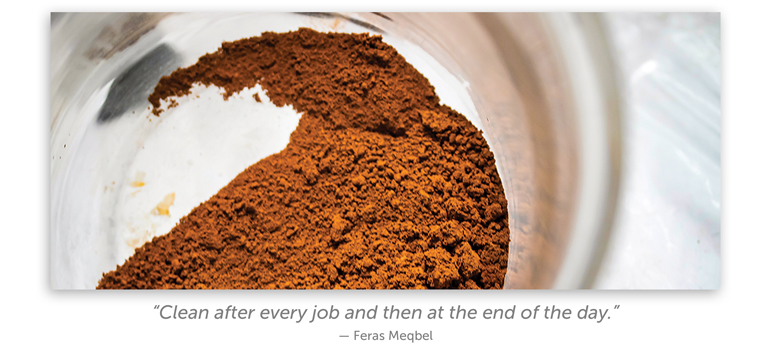
“Clean after every job and then at the end of the day,” advises Feras Meqbel of Hi-Tech Precious Metals & Refinery in Dallas. “Don’t leave metal behind.” This will not only get you in the habit of capturing metal on a regular basis, but also help you better segregate the different metals used from job to job, which will maximize your return.
For cleaning your benchtop, many refiners recommend a shop vac or other handheld vacuum, particularly one with a HEPA filter. Not only will the filter trap the smallest metal particles, but it can also be refined later.
“A good gold shop vac has always been the way,” says David Siminski, vice president of sales and marketing for United Precious Metal Refining in Alden, New York. “You don’t need to reinvent the wheel. It vacuums out crevices, and it works great!”
If vacuuming isn’t an option, you can also sweep up the metal using a paintbrush. “It works perfectly,” says Meqbel. “If the brush is soft, you’ll have better control over it, and the brush isn’t spilling outside of the container [you’re sweeping the metal into].”
When selecting a brush for bench cleanup, Ballard recommends a horsehair one. “It’s really fine, and materials come off of it easily,” he says. Plus, because it’s organic, when it wears out it can be added in with your polishing wheels for refining.
No matter how neat and tidy you are, there’s always a chance that bench sweeps can hitch a ride home on your clothing. Preferably, you should wear a smock or coat that stays in the workshop and then is periodically refined. Another option is to spend a few minutes at the end of the day running a shop vacuum over your clothing. If a vacuum isn’t available, you can also wipe your clothing down with damp paper towels, which can then be dropped in with your floor sweeps for eventual refining.
If you’re planning on overhauling your shop and replacing your old jeweler’s bench, don’t be so quick to put it out by the curb or hand it down. Most jewelers’ benches feature a wooden benchtop, which can accumulate its own stash of precious metal over the years.
“Metal can get caught in the grains of the wood,” explains Siminski. “We’ve refined lots of jewelers’ benches. Usually it’s when someone does a factory redo and they change everything for new equipment.”
To maximize the return on refining your benchtop, consider sanding the top and sending in the dust instead of the whole benchtop. “There won’t be a lot of force pressing particles into the wood so it’s not likely they’ll go too deep,” says Larry Fell of David H. Fell & Co. Inc. in Commerce, California.
While most jewelers shouldn’t expect to see a huge return for refining their benchtop, Siminski notes that for most, “it’ll be like a bonus.”
Floor Sweeps
When it comes to the flooring in a shop, there is no one best type. Many jewelers like carpeting because it’s inexpensive as well as a natural catchall, and it can usually be easily refined and replaced as needed. If you opt for carpeting, Ballard recommends opting for one made of wool or another natural fiber. “Nylon carpet can be a real nightmare to burn out.”
If you want a smoother, more non-porous surface, Siminski recommends going with linoleum. “As long as you’re regularly giving it a good cleaning and mopping it, you’re good to go,” he says. Although precious metal material can still become embedded in it, Siminski notes that the material will have to have been there a long time for that to happen.
However, unlike carpeting, linoleum can’t be as easily refined at the end of its useful life. “Linoleum tiles can be refined, but it’s harder,” he says. “It has a rubber backing and glue on the tiles that can be difficult to burn.”
Ballard is also a fan of linoleum and tile floors but he recommends lining the floor surface with punched-out steel matting. “It suspends everyone’s feet above the floor surface, cleans shoes while you walk, and you can lift the mat to clean the materials that fall through it,” he says.
Regardless of the type of flooring you have, you should clean it daily. That means vacuuming if you have carpet or sweeping and mopping if you have tile and vinyl flooring. “Mop every day, and then throw the water into a tall bucket and allow the metal stuff to settle down,” Meqbel says. “After the drum is full, siphon off the top, since all of the precious metals will have settled. And don’t forget that the mop itself can be refined.”
If you’re outsourcing your janitorial services, make sure you have a good line of communication with the maintenance team. “They’re often focused on cleaning, not capturing metals,” warns Chris Jones, president of Gannon & Scott Inc. in Cranston, Rhode Island. So whether they’re tasked with sweeping or mopping up floors, be sure that the janitors know exactly what must be done with any material they clean up. (If they do pour any liquid down a drain, make sure that drain is connected to a sink trap. See more about this under “Sludge.”)
Give some consideration not just to flooring, but also to footwear. When Meqbel has visited overseas manufacturers, one thing he’s noticed is the preponderance for workers to wear dedicated shoes in the shop. “All of the employees change their shoes when going into the workshop,” he says, and they leave them in the shop when they exit. This prevents employees from tracking any precious-metal material home with them. When the work shoes reach the end of their life cycle, they can be tossed in with the floor sweeps for refining.
Don’t overlook your general shop trash. “About a third of our customers have us refine their trash,” says Jones. “We’ve seen it all—soda cans, bottle caps, hand towels. It could be anything. Nothing leaves their facility that isn’t refined.” Although jewelers should expect to pay for this service on a per-weight basis, Jones notes that most of his customers recover enough precious metal to make it worthwhile.
Polishing/Shop Dust
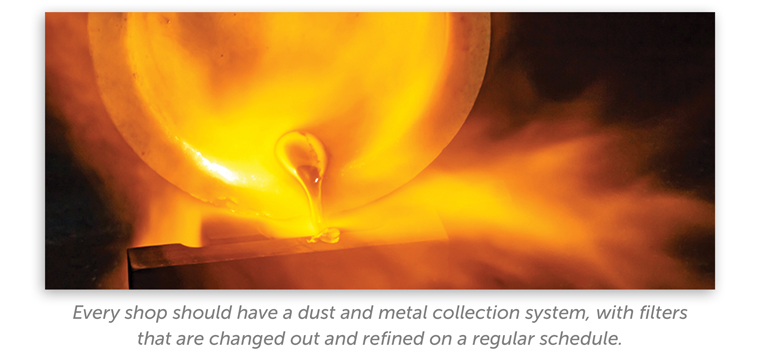
Every shop should have a dust and metal collection system. Dust collector filters should be changed according to a regular schedule, and the entire filter should be sent in for refining.
“When you clean out the machine, clean out the vents too,” adds Siminski, who also recommends replacing the canvas bags within the system every couple of years. “Usually you get enough materials in the bags to pay for the new bags,” he says. But more than that, you get better suction, increasing your overall capture of precious metals in the machine. “When you put brand new bags in a vacuum, it works better. If you can’t find the [appropriate] bags anymore because your system is outdated, it might be better to buy a new system with better suction.”
There’s one other area where dust can collect, and jewelers should be aware of it.
“A lot of dust collectors have a sound blanketing material inside the chamber that will collect material,” says Jones. “It’s not a regularly serviced item because it’s often glued in place by the manufacturer. You can vacuum it, depending on the material. Sometimes it’s like Fiberglass; other times it’s more robust. But even cleaning it periodically, it’s like carpeting in that it’s still going to hold material. Some people will go in and tear out the material and then work with the supplier to have it replaced.”
If you have a large shop area with a central dust collection device, think about where materials could be hanging out in the piping that runs throughout the shop. Metal particles are heavy and tend to settle at the bottom of pipes so it’s worthwhile to take them apart periodically and sweep them clean. If it’s not something you can tackle yourself, contact your refiner.
“A lot of refiners will do that as a service for their customers,” says Jones. “Going into a summer shutdown is a good time to collect those materials.”
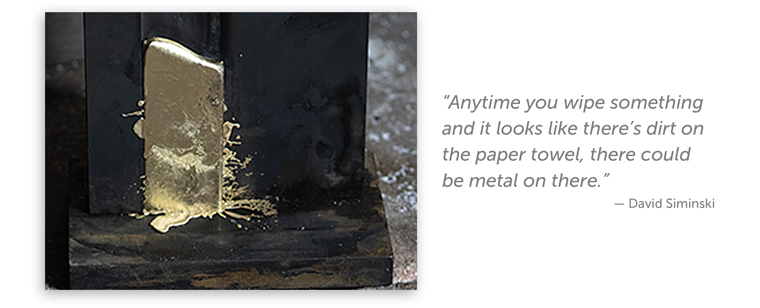
When it comes to capturing precious-metal dust and material that becomes airborne and lands on walls and equipment, Siminski says the best solution is an old-school one: “Paper towels. Wipe everything down, wipe your walls down. Anytime you wipe something and it looks like there’s dirt on the paper towel, there could be metal on there.” Once used, the paper towels can be dropped in with the rest of your floor sweeps for refining.
Don’t overlook the inside of any equipment that’s near your polishing station. “We’ve found quite a bit of gold buildup [in] motors that are inside bench polishing and grinding operations,” says Joe Peixoto, chief executive officer of Gannon & Scott. He notes that while most people will periodically wipe down the outside of other equipment, many don’t pay attention to cleaning the inside. While it’s not necessary to disassemble your equipment regularly on the hunt for precious-metal dust, it’s definitely something to consider before you ever get rid of the unit. “Before you discard, you should probably inspect it and clean it out,” Peixoto says. “Clean it out or send it in altogether.”
Sludge
Precious metal particles can be found in a variety of solutions used in the typical jeweler’s shop—from ultrasonic solutions to plating baths. All of that material can add up, which makes collecting it critical. Solutions should be poured through a filter, such as a coffee filter, which should then be added to your refining lot. The used solution can be either disposed of or put back into the machine for additional use.
The best way to prevent precious metal material from being washed away down a drain is with a sink trap. “Jewelers have to spend time thinking about the traps under their sinks,” says Siminski. “It’ll pay for itself over time.” He advises that jewelers clean out their sink traps every six months to a year, putting the resulting sludge into a barrel that can be sent off to the refiner.
When possible, you’ll want to dry out the contents of the barrel, which makes the container lighter and cheaper to ship. “Refining charges are based on weight, and water adds weight,” says Siminski. Because the metal particles are heavy, they will sink to the bottom, allowing you to skim off any clear water from the top.
“Once it dries down to a cake, it’s the lowest weight you can get for shipping and processing,” says Ballard. Plus, you won’t have to deal with shipping liquids, which most of the major shipping companies have strict restrictions on.
While this is by no means an exhaustive list of all of the places tiny particles of precious-metal material could be lurking, it will hopefully have you hunting around your shop with fresh eyes.