

The Diamond Debate
The diamond industry reacts to the revised FTC Guides
By Deborah A. Yonick
(First published in October 2018 MJSA Journal)
In July 2018, the Federal Trade Commission (FTC) released its final amended version of the Guides for the Jewelry, Precious Metals, and Pewter Industries, which are meant to advise marketers on how to avoid deception in jewelry marketing. The first major overhaul of the Guides in more than two decades, the review process began in 2012, and examined the costs and benefits of the existing guidelines. Input was sought on a variety of topics, with considerable attention to issues concerning diamonds and manmade stones.
In unanimously accepting the final revisions, the FTC said the amendments remove outdated or redundant provisions, guide marketing of certain products to more accurately represent their properties, and eliminate restrictions on product marketing deemed unnecessary to prevent deception. But not all of the changes are sitting well with members of the diamond and gemstone community.
Dropping “Natural”
Rattling the chain of many in the diamond industry was the removal of the word “natural” from the basic definition of diamond, acknowledging that there is now more than one way to create a diamond.
The FTC definition was: “A diamond is a natural mineral consisting essentially of pure carbon crystallized in the isometric system.” Now it states: “A diamond is a mineral consisting essentially of pure carbon crystallized in the isometric system.”
Despite the definition change, the Jewelers Vigilance Committee (JVC), representing a coalition of jewelry trade associations in the review and public comment part of the Guides, believes ample protections remain to prevent diamond growers from marketing their products as diamonds created in the earth, said Sara Yood, JVC senior counsel.
The previous Guides required use of the terms “laboratory-grown,” “laboratory-created,” “[manufacturer name]-created,” or “synthetic” to precede the word “diamond” when describing lab-grown diamonds. The revised Guides retain all but “synthetic” as recommended qualifiers—but do not prohibit the use of “synthetic” as a descriptor, and added “other word or phrase of like meaning” to the section. Lab-grown color gemstones must follow the same rules as lab-grown diamonds.
The Guides did rule it misleading to use the term “synthetic” to imply that a lab-grown diamond, which possesses the same physical, chemical, and optical properties as a diamond found in the earth, is not an actual diamond. Growers argued that consumers equate “synthetic” with “simulated,” confusing diamonds with imitators such as moissanite or cubic zirconia.
Yood acknowledges the risk “other word or phrase of like meaning” poses. But the Guides, she said, make clear that it must be conspicuously apparent in the language used that the stone did not originate in the earth.
The Guides also maintain its guidance to avoid descriptors including “real,” “genuine,” “natural,” “precious,” “semi-precious,” and other similar terms to describe a manufactured or artificially produced product.
Yood recognizes that some of the new revisions give lab-grown diamond marketers more freedom in description and advertising, such as the ability to use the word “cultured.” The previous Guides did not address the use of “cultured” to describe lab-grown diamonds or other gemstones. The revised Guides advise against using “cultured” to describe a lab-grown diamond without additional qualifiers. The accepted descriptors are “laboratory-grown,” “laboratory-created,” “[manufacturer name]-created,” and “some other word or phrase of like meaning,” and the qualification must be clear and prominent.
From a consumer perspective, Yood said that not much has changed for diamonds. She did express concern about eco-friendly and green claims made by lab-created diamond brands that have gone unsubstantiated. “These diamonds are not made in a laboratory, they are made in factories that give off carbon emissions. I’ve already raised this issue with the FTC, and invited multiple manufacturers to send objective, proven information, but no one has yet.”
One person cheering the revisions to the Guides is Amish Shah, president of ALTR Created Diamonds, a lab-grown diamond manufacturer and division of R.A. Riam Group based in New York City, who believes that the revisions will empower consumers with the information they need to make informed decisions.
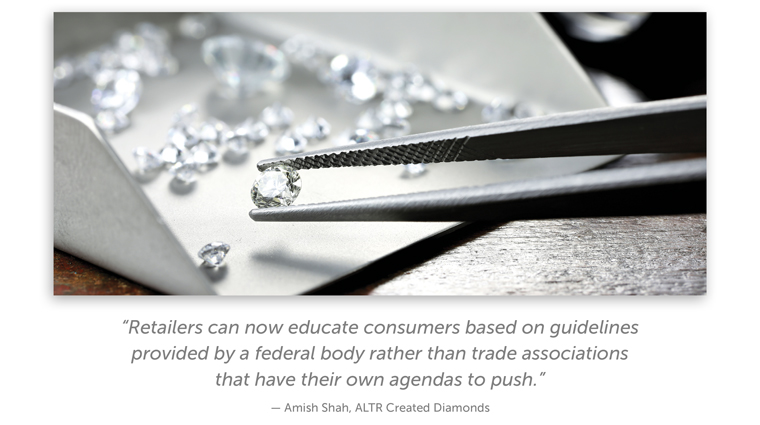
“The FTC clearly classified mined and created diamonds into the same class while separating industry products like moissanite and simulants as non-gem class,” he said. “Retailers can now educate consumers based on guidelines provided by a federal body rather than trade associations that have their own agendas to push. No one can mislead consumers into believing otherwise.”
But diamond industry leaders fear that these changes will create more confusion for consumers, who won’t differentiate between diamonds that originate in the earth and those created in a factory.
“We feel these changes provide too much of a bias toward the lab-grown diamond sector,” said Ernie Blom, president of the World Federation of Diamond Bourses (WFDB) in a statement. He notes that the revised Guides for diamonds are not in line with the Diamond Terminology Guidelines that it helped develop and that were agreed upon and implemented last year by the WFDB, International Diamond Council, International Diamond Manufacturers Association, and CIBJO (World Jewellery Confederation). “We do not feel that the views of the diamond sector were taken sufficiently into account.”
In a statement, Jean-Marc Lieberherr, CEO of the Diamond Producers Association (DPA), expressed serious concerns about the new terminology, especially the use of the word “cultured” to describe a diamond, even with additional qualifiers, and the use of the word “mined” to describe a natural diamond since not all are obtained through extractive mining.
“We remind the industry that all other norms and standards continue to support that a diamond is a mineral of natural origin, and to clarify that the Guides continue to ask marketers to qualify the use of the word ‘diamond’ to describe any product that is not ‘a mined stone,’” says Lieberherr.
DPA stated its surprise at the wide use of the phrase “mined diamond” throughout the revised Guides in lieu of “natural diamond,” a term heavily promoted by manmade diamond producers. But “mined diamonds” refers to an extraction process, not a creation process, underscored DPA, and the majority of the world’s diamonds will never be mined, making this an incorrect qualification.
DPA also is concerned with the addition of “similar words or phrases” to describe lab-grown diamonds, calling it unnecessarily ambiguous, and lacking the clarity needed to avoid potentially incorrect and misleading language. It also cited that the majority of consumers mistakenly interpret “cultured” as a description used for natural diamonds, a subject it plans to engage the FTC further on.