

The Call of Color
Valerie Jo Coulson paints beautifully in gemstone inlay
By John Shanahan
Editor’s Note: This is the next article in a periodic series, “The Art of Handcraft,” in which traditional metalworking techniques will be explored and explained. In this installment, jeweler and lapidary artist Valerie Jo Coulson discusses the art of gemstone inlay.
Ask Valerie Jo Coulson how she got started in making gemstone-inlaid jewelry, and she will tell you about the two people who influenced her direction: her older sister and King Tut. Her sister headed into jewelry first and caught Coulson’s eye with some wax carving.
“I remember her bringing home a small alcohol burner and doing some carving for lost-wax casting,” says Coulson, a jeweler and lapidary artist based in Lancaster, Pennsylvania. “I was fascinated with the process, and she gave me a piece of wax to carve. She took it to school and cast it for me. That was my initial foray into jewelry.”

Later, as a fine arts major, a college jewelry course introduced her to gem cutting. It wasn’t long before Coulson realized she had found the right medium for what she wanted to express in her work. “It let me coalesce the different areas of art, construction, and craft,” she explains.
Which brings us to Egypt’s boy king. “I remember going to see the Treasures of Tutankhamun in the late ’70s and was captivated by the inlay work I saw there,” she says. “That pushed me to thinking about using the stones in a painterly fashion—the ability for me to use them for color to further a narrative. And, of course, the metal work was very important to me as far as building the structural forms.” With that sealing the deal, she got started. “I went to gem shows and met rockhounds and talked to them about processes. I looked for lapidaries who were selling equipment, and set up my studio.”
It was the beginning of a lasting career in creating award-winning gemstone-inlaid jewelry.
Everything in its Place
Like other forms of inlay, gemstone inlay involves placing colored stones within a channel or framework made from metal or some other base material. In some methods of inlay, such as intarsia, marquetry, and pietra dura, the stones are cut in such a way that they fit one to the next with no metal between them. In chip inlay, small pieces of crushed colored stone are set into the channel and bound in place with an epoxy. Coulson works largely in flush inlay, where the metal framework is used between stones, and the stones and metal together are then finished to the same level for a smooth look.
For Coulson, a design begins with creating the framework. She sketches out her idea, often creating a model in poster board to realize it in three dimensions, which helps her see any engineering concerns. Individual pattern pieces are cut from flat sheet using a jeweler’s saw. While she works in both gold and silver, she professes a preference for the latter.
“They both come with their individual challenges in regards to the fabrication/construction process and final polishing of the metal,” she says. “Of course, different stones and their colors pair better with either silver or gold, but as far as their affecting the inlay process, there is not really a difference between the metals. However, sterling silver is more amenable to complex fabrications requiring many soldering steps.”
And whereas those steps can number more than a hundred, it’s easy to see why she prefers a metal that more readily takes to the process.
“I do all the metalwork first,” she says. “It’s like building a bridge or creating windows and cells into which I’ll inlay the stone. Once the metal structure is completed, I cut my stones.”
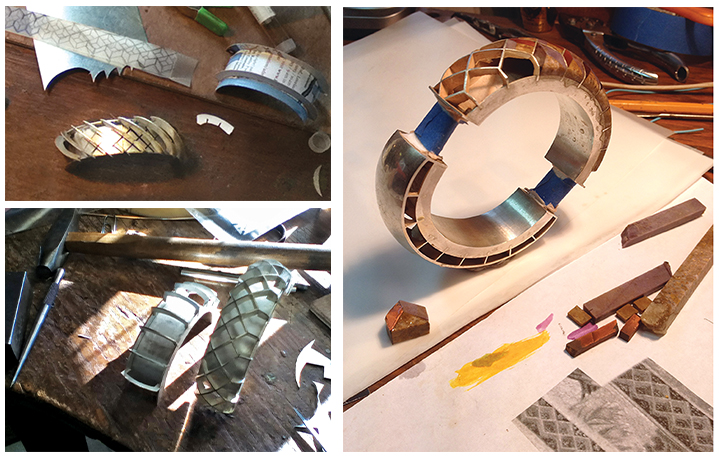
Crafted in sterling silver, Coulson’s Firenze bracelet is inlaid with Australian tiger iron, purple agate, and a pattered agate or flower agate. The bracelet won Best of Show in the 2017 Saul Bell Design Award Competition.
Prior to cutting a stone into a certain shape, Coulson draws that shape directly onto the rough. Sometimes, with complex shapes such as the black jade curves she once created for a platinum knife handle crafted by fellow jeweler Ron Finch of Finch Jewelers, she’ll start by putting tracing paper on the metal form to trace the well or window. She cuts out the traced form and places it on her rough as a guide marking out the cutting template. More often, though, given her many years of practice, she lets her eye and instinct gauge how to coax each shape out of the stone. She uses a 6-inch trim saw to cut her rough.
“For the studio lapidary, I know of only these two types of equipment for cutting—the trim saw and diamond band saw,” she says. “A trim saw is better for making straight cuts as well as for slabbing a piece of stone. A diamond band saw is ideal for making curved cuts from a piece of slab.” On the black jade knife handle, with its very flowing, organic curves, she was able to borrow Finch’s diamond band saw. The density of the stone, combined with the demands of the curves, made the use of that tool necessary. For the majority of her work, however, the trim saw is her go-to.
After the initial cut, she carefully shapes the stones using a carborundum wheel. This choice, she says, is partly a matter of personal preference, and certainly not the only way to do shaping. “Some people use diamond wheels, but I find them rough. It can put little chips on the edges of the stones.”
As she shapes and trims the stones, she checks the fit of each in its intended space within the framework. The idea is to bring the stone down, bit by bit, to its ultimate dimensions. “I cut and fit, cut and fit, putting each individual stone into its window. As I’m cutting them, I taper the stone, taking off certain areas where it’s getting hung up on the metal, until I have the ideal fit.”
When the stones fit perfectly, she takes them back out and applies a two-part epoxy resin onto the metal chambers. This is the method by which the stones get held in place. It’s not typical, in flush inlay, to push down an edge of metal to hold the stones in place as one might in other forms of stone setting. The grinding of the stones flush with the metal instead serves as a way to burnish the metal alongside the edges of the stone.
“When I epoxy the stones into their respective windows, I take a metal pick or toothpick and just go over each demarcating line, spreading the epoxy to make certain there are no voids or air bubbles,” she says.
The manner in which the stones are laid in is determined in part by the piece. “Sometimes I epoxy a portion of the stones in, let it harden, and then epoxy in the remainder. Or I might epoxy them all in at one time, and wrap thin binding wire around them and over the top to make sure none lift up during the curing due to air that got trapped inside.”
Typically, Coulson gives the epoxy 24 hours to cure and dry before she moves to her next steps. Of course, not everything always goes as planned. “There have been occasions where I bring everything to its final polish and I see an inclusion in the stone that was not evident until I ground it down,” Coulson says. That’s when she breaks out the flex-shaft fit with diamond bit cutters, grinds out the stone, and replaces it.
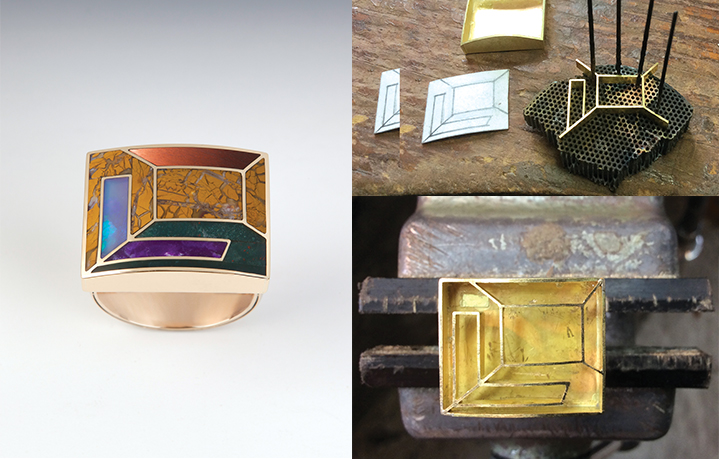
To create her Threshold ring, Coulson began by assembling the metalwork frame, creating the window to hold the stones. Once the metal structure was complete, she began cutting the stones.
Coulson further notes that she approaches using translucent and opaque stones differently. With clearer stones, you’ve got to be mindful of how much metal is going to show through—or how much you want to show through—and the role light is going to play in the finished look. “I love chatoyant stones like tiger iron and opal, but I also love translucent stones like topaz and garnet, which are more difficult to use for inlay. The light is passing through them, so the metal structure has to be very uniform on the inside, like a shell, so that you see the uniformity of the outline of the metal through the stones.”
To offset the effect, Coulson might give the interior faces of the metal structures a bead-blasted matte finish before applying the epoxy. Also, she makes sure the interiors are uniform. Cutting angles or facets into the backsides of the stones provides dimension as light passes through. She points to one of her pieces, the star ring, as an example. “In that ring, I not only angled the backs of the rose almandite garnet and blue topaz, but also incorporated titanium dioxide into the epoxy resin behind the topazes to cut down the light penetration for a more desirable return.”
When the epoxy is cured, Coulson heads back to the carborundum wheel to smooth out and level the stones to the surface of the metal. From there, Coulson refines the surface with various techniques. “I’ll go to my Diamond Pacific Genie grinder/polisher with different grits of diamond belts, starting with a 220 grit and working up to a 10,000 grit,” she says. “I put a slightly convex lap with a polishing pad of leather or canvas on the end, put my polishing compound on there, usually cerium ox-ide, and then polish the piece.”
As noted, as the stones are getting polished, the metal is, too. So a jeweler needs to keep an eye on the metal to avoid undercutting it. “Since the metal is softer than the stones, you need to be sure you don’t polish too hard for too long,” Coulson says. “There’s a fine line there that you have to be mindful of.”
She notes that her technique, tools, and polishing compounds vary by stone. “They polish differently based on their hardness and composition,” she says. “Sometimes you need to experiment to find out the ideal compounds.”
And as you begin to experiment, keep in mind that safety—as always—is vital.
Play It Safe
With the amount of grinding going on in creating gemstone inlay, there’s going to be a lot of particulate matter in the air, along with the occasional stone chip taking a hypersonic jaunt across your studio. The grinding process also creates a lot of heat and friction, and as many jewelers may know, grinding wheels in action are not exactly the quietest tools in the shop. Coulson recommends breathing, eye, and hearing protection.
“Any time you’re grinding stone, you need to be mindful of not breathing any dust particles,” she says. “Some stones, like malachite, are toxic in that regard. I wear a very good dust mask when I work, and I use water on the wheel when I grind, which cuts down on the dust, along with the heat.”

To cut the black jade for this knife crafted by Ron Finch, Coulson placed tracing paper of the handle to trace the wells. She then placed the traced form on the rough material to use as a guide to mark out the cutting template.
Keeping your ears and eyes protected is important particularly when running the belts. “They’re loud when you’re cutting and polishing, so you need ear protection,” she says, pointing out that it can add up over the course of a day or days of work. For her eye protection, Coulson wears a visor with a magnifying lens. “It’s not like a safety glass,” she admits, “but it does offer some protection.” Coulson makes sure to keep her hair pulled back, and doesn’t wear long sleeves or other clothing that could get caught up in the wheel.
If you’re interested in gemstone inlay, Coulson says, the good news is that inspiration is everywhere. As she did, you can seek out beautiful examples of intarsia and pietra dura. You can lose yourself in the colors and quantities of material laid out for you at gem shows. And, of course, there are other artisans. “Talk to people,” she says. “There are people who’ve been doing this for years, and they’re so open with their knowledge and experience. That’s where I learned so much.”
In fact, it’s where she first learned how to create gemstone-inlaid jewelry fit for a king.