

The Art of the Bead
Three unique approaches to beadwork
By Gerry Davies and Tina Wojtkielo Snyder
When you hear the term “bead,” what do you think of? A simple round object, be it plastic, glass, metal, or some other material, with a hole through the middle?
Take one look at the jewelry pieces in this article, and you’ll never think of beads in the same way again. The craftsmanship featured here is anything but simple, and it exemplifies the many different ways jewelry makers approach the art of the bead. From carefully researched geometries to meticulously woven mosaics to computer-aided re-interpretations, these pieces showcase the diversity of modern beadwork.
Valerie Hector
Chicago
The past is a constant source of inspiration for bead artist Valerie Hector. “I’m fascinated with the history of beadwork,” says Hector, who has made 14 trips to China in the past 11 years to collect examples of ancient Chinese bead art. She scavenges curio shops tucked away in alleys for old bead forms that she can take home, study, and re-create in her own style. She recently located a century-old icosahedron “worry bead” made from brown seed pods. The Chinese would hold a pair of these beads in their hands and rub them together to rid themselves of worry.

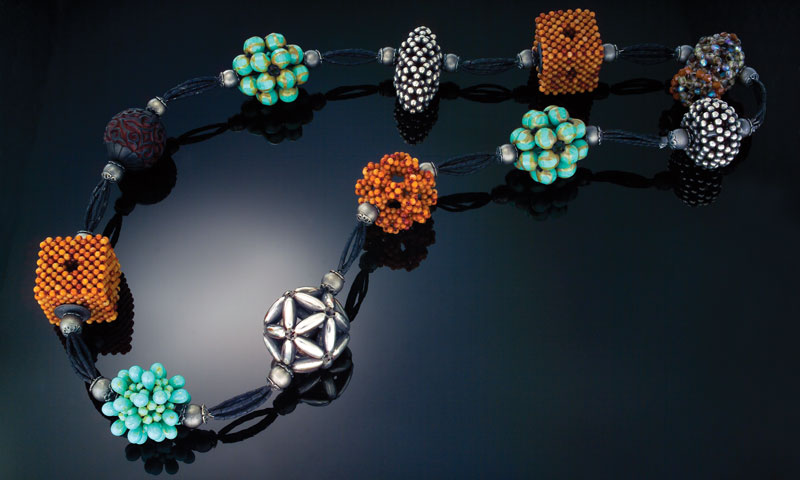
This icosahedron structure was the template for one of the sterling silver beads (1) on the “Elements” necklace shown here. One of the most complex jewelry pieces Hector has created to date, this necklace symbolizes her love of ancient Chinese beadwork and her appreciation of the current work of her contemporaries in the bead world. All of the beads in this necklace are strung on Coats & Clark hand quilting thread, which Hector has been using for 21 years because “it doesn’t fray or stretch.”
The artist’s appreciation of China and its crafts tradition is evident in many of the beads in this necklace and is punctuated by her use of a single 19th century cinnabar bead (2) from China. It comprises nine layers of hand-carved red and brown lacquer. Several of the other bead forms in this piece are replicas of forms that Hector first stumbled upon in China, such as the round sterling silver bead (3) that is based on the beaded lanterns created in Beijing during festival time, or the turquoise color forms (4, 5, 6) that are based on plastic beaded objects that she purchased in Chinese shops.
The vase-like bead (7) on the necklace actually inspired the pointed oval-shaped sterling silver bead (8) that Hector invented herself. “It’s an evolution of the vase bead,” she says. “I picked up a tiny plastic beaded vase in a shop in Guangzhou, China, that was unlike any structure I had seen before, and I modeled it in my work. The form has many different curves and angles that are created by combining circles of four, five, and six beads. By varying them, you get the gradations in structure.”
Hector explains that to create the vase structure or others like it, each circle component shares a bead with its neighbor. It takes much careful planning to weave together an accurate final product.
This is perhaps most complicated to do in the red cube beads (9, 10) shown here, which are created with a technique called the cubic right angle weave that Hector learned from colleague David Chatt of Penland, North Carolina. Chatt’s technique is based on a classic Chinese technique, the earliest example of which dates back to the Ming Dynasty. Using synthetic resin beads from 1960s Japan, she strings together this solid form that comprises many individual cubes linked together. It is six cubes wide by six cubes tall by six cubes deep. “Each cube has 12 beads, many of which are shared with neighboring cubes,” she explains, “so the west wall of one cube is the east wall of another, and so on.”
Another bead form that Hector learned from a colleague is also executed in the red resin beads (11). Laura Shea of Parker, Colorado, taught Hector how to build the spherical form shown in this necklace, for which Hector exchanged the blueprint for one of her forms. This 3.5 mm structure, which is an embellished version of what geometricians call the “great rhombicosidodecahedron,” takes an experienced beadworker one and a half days to make.
Hector says it takes much trial and error to replicate ancient forms and create new ones never before seen in beadwork, but the satisfaction of building a new shape, and the resulting mark left in the history of beadwork, is unmatched. Her “Rust Lotus” necklace will be featured in the upcoming re-issue of The History of Beads from 30,000 B.C. to the Present by Lois Sherr Dubin. “When this book came out 20 years ago I was just beginning my career and I looked at it as the Bible for the bead field,” she says. “I couldn’t have imagined that today I would have one of my pieces featured in this book. This is the greatest honor.”
Jennifer Wood
Port Coquitlam, British Columbia, Canada
Glass beads are neither a shortcut nor a cost-cutter for Jennifer Wood. Indeed, nothing about her contemporary jewelry remotely suggests either possibility. Meticulously handcrafted— including the beads, which she makes herself from rods of Italian glass— her necklaces, pendants, rings, and other pieces charmingly combine stunning color, delightfully fanciful shapes, and soothing sterling silver.
But still, why beads? Because Woods can create beads in any color or color combination that strikes her fancy, make them opaque or transparent, and add as she desires silver, gold, or palladium leaf or intricate patterns that make each bead unique.
“Color is really important to me,” she says. “That’s why glass connected with me. I love metal and gems, but glass gives me color possibilities.”
And with silver she adds balance—in two ways. It harmonizes with the oftenvibrant colors of her beads, and because it’s precious, “it offsets the feeling some people have that glass is cheap.”
In terms of the time and expertise they require, Wood’s beads are actually a costly material. Glasswork at her level takes a steady hand, a keen eye, and years of practice. It is not a forgiving medium, she says. In addition, beads are much lighter than silver, and too delicate for metal to be soldered after the beads are in place. Wood must give much thought to how a piece will wear and how it will be fabricated.
“I consider my work high-end,” she says. “Jewelry doesn’t have to be gold or diamond to make it precious. The most important thing to me is to make something stunning and unique—an eye-popper. I always want to push the boundaries in design.”
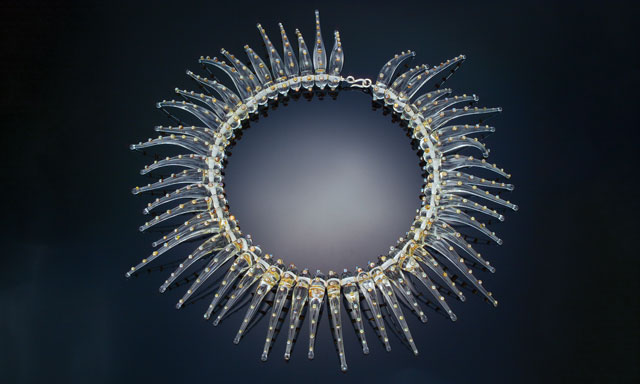
The term “eye-popper” may come to mind upon seeing her “Vitality” necklace (shown here), which won first place in the beads category in this year’s Saul Bell Design Award competition. It’s not as colorful as much of her other work, but it showcases her design eye and her bead-making skills.
The necklace comprises 49 clear glass “claws,” each slightly different in length and arch, and strung on stainless steel cable with silver spacers in between to allow movement. Wood accented each claw with rows of raised dots, a common feature of her work.
“The dots sparkle in the light and they add texture,” she says, “so a piece looks stunning and feels interesting. When people see my work they have to touch it. I love that.”
The claws and dots both required careful work, Wood says. First she had to get the claws’ curves right using gravity and flame, watching not to overheat the Moretti glass. Then she had to add the dots without ruining the claws—a task made more difficult by using reduction glass for the beads and Moretti glass for the claws. They have dfferent annealing and cooling points, which can create weak spots, so the two can be mixed only in small quantities.
In its finished form, the “Vitality” necklace is a vision of balanced aesthetics. Ironically, the process by which it was designed was anything but balanced. Wood typically creates on the fly. “I start with a rough idea and see where it takes me,” she says. “I feel like I’m playing when I’m in there.”
Sherry Serafini
Pittsburgh
For Sherry Serafini, the most elaborate embroidered-bead jewelry starts with a single rock.
“First and foremost I’m drawn to a stone, a focal point,” she says. “From there something speaks to me and says this [stone] has to become a neckpiece.”

Her approach to the ensuing details is similar. She draws inspiration from Egyptian and vintage jewelry, as well as her palette of colored beads and stones—“I literally paint with my beads,” she says—and she designs as she goes, usually without so much as a sketch.
Serafini’s overall aesthetic is sensual and rebellious. “I want texture to be dominant— I don’t want beads to just lie flat—and I like to give [my work] attitude, a rock ’n’ roll attitude,” she says. “I want to give it an edge.”
Texture abounds in her work. Some of it comes from her preference for unshaped stones. “I don’t like to think symmetrically,” she says. “I tell my [cabochon] guy to give me his throwaways. Irregular shapes make awesome bracelets. I like to use what others find ugly. Depending on what you do with them, you can make them absolutely beautiful.”
Symmetry and balance she saves for the colors and the physical layout and shape of her neckpieces, earrings, bracelets, and pins. Colors are dispersed throughout a piece, sometimes in clusters, sometimes as one color in a pattern, creating a mosaic-like effect. “I don’t do anything for too long with one color,” Serafini says.
“Mermaid’s Attire” (shown here), which is the first neckpiece she ever made, is characteristic of her work.
She put her simple tools—needles, glue, heavy nylon thread, suede backing, and beads and stones—to work after pondering the centerpiece, a large turquoise with a touch of bronze coloring. At first, she planned to just make a pendant, but “I looked at the crystals around it and thought I had to go further.”
She added side panels, turning it into a neckpiece. Uncertain about getting the curve and hang right, she created a basic template and learned to work using a jeweler’s bust.
For stone and bead placement and other details, Serafini says, “I looked at it like a puzzle.” Ideas came to her as she worked for mixing her turquoise, Pacific opals, Swarovski crystals, bronze-coated Japanese seed beads, and freshwater pearls. Another moment’s inspiration led to one of the piece’s most distinctive features: the dangling, asymmetrical spirals of gems and beads. “I thought, ‘I haven’t seen anyone using spirals,’” she says. “Spirals took it from ordinary and made it really pop. They gave it texture, depth, interest.”
Those spirals combine with the colors and mix of symmetries and asymmetries in “Mermaid’s Attire” to fulfill Serafini’s key goal as an artist:
“I totally strive to be different in my jewelry,” she says.