

Striking a Balance
Crafting exquisite jewelry with unique gems
By Alishan Halebian
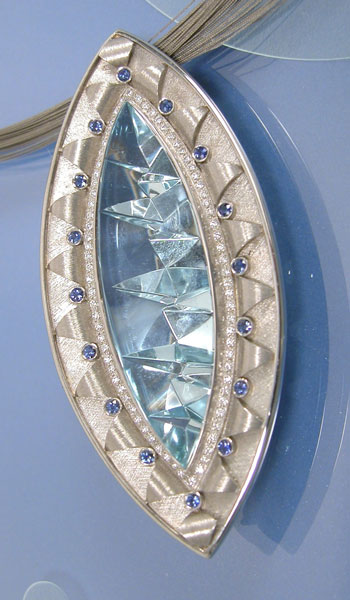
Working with unusual cut gemstones can be challenging for the designer, but the end result is often very interesting. There are generally two ways to approach designing with a gemstone. The first is when an idea for a piece comes to mind and you must find just the right gemstone to execute your vision. The second is when you acquire a unique gemstone and decide to make it the focal point of a piece, therefore evolving the design around the gemstone. In both instances, the two critical questions to ask yourself are, How little is too little? And how much is too much? You have to balance the power of the design with the power of the gemstone.
Zip and Zap
In Calypso (right), I acquired this amazing near 40 carat aquamarine cut by Tom Munsteiner and I had to decide how to best showcase it in a jewelry piece. I actually named the cut “Zip Zip” because that is what I saw when I looked at it—the beautiful angular cuts add great dimension to the gem. When working with a masterfully carved stone such as this one, the challenge is to create a design that accentuates it without going overboard, but being creative enough with your design that it is not underwhelmed by the gem. The gemstone itself is already a designed and finished piece in shape, form, color, texture, and cut. It’s up to you as a jeweler to decide how best to complement the existing design.
Here I wanted to continue Munsteiner’s cuts through to my design in metal, without mimicking them exactly. I decided to encase the marquis aquamarine in a frame of platinum that borrows the triangular elements of his cut. I made very simple and symmetric triangles, altering the finish between the triangular components and the main marquis-shaped frame. The contrasting finishes are similar to the bright spots and shadows in the gemstone, capturing the essence of what Munsteiner achieved with his cut. It’s all about light and shadows, both in the gem and in the metal components of the piece. When the light hits it, you get reflection in the gem, but also in the textures of the metalwork surrounding it.
My choice of blue sapphires was also a deliberate play on the lightness and darkness in the aquamarine. The deep blues pick up on the darker hues that rest in the shadows of the gem.
As a final note, the frame of pavé diamonds encasing the stone was not simply a design accent, but rather a deliberate attempt to divide Munsteiner’s design from mine. The two exist cohesively together, yet they each have their own space and voice.