

Strategic Budgeting
Transform your budget into an innovation engine
By Andrea Hill
It’s almost budget time again. Time to make plans for how you want to spend your money next year. And, if you don’t already operate from a budget, you’re likely feeling guilty because you know that you should.

But what if I told you that the typical approach to budgeting is inherently flawed? What if I could show you a method of budgeting that would make your business more forward-looking, more innovative, and more resilient?
Well, I can. And here’s how.
Focus On Your Strategy
For most companies, strategy boils down to three or four things that, together, give them differentiation and competitive advantage. If you’re thinking that you now have to come up with three or four things that nobody has ever thought of before, stop worrying. That’s not really how strategy works. It is a rare thing to come up with an entirely new idea. Strategic elements can be made up of:
- What you sell and how you sell it
- The experiences you provide
- The services you offer
- The specific and unique things you do that make what you sell more affordable, accessible, or memorable.
An example of a set of strategic elements is:
- We sell gold jewelry.
- We produce private collections that retail partners can brand as their own.
- We create specific brand attributes for each of our clients.
- We produce just-in-time inventory so our clients don’t have to take significant inventory risks.
As you can see, none of those elements is brand new, but when you combine them together, they tell a story that is compelling and unique in its construction. This is how you achieve differentiation. Even if other companies have one or even two of those elements in their sales or service offering, they are probably not focused on being the absolute best at them the way you are, and this will give you competitive advantage.
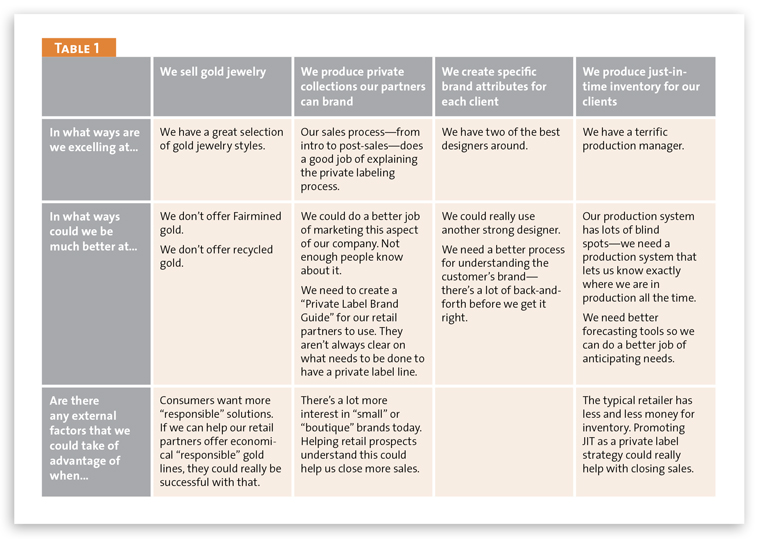
Before you start creating your budgeting spreadsheets, you need to consider your strategic elements. I like to do it by asking three questions of each element:
Question #1: In what ways are we excelling at {insert element here}?
Question #2: In what ways could we be much better at {insert element here}
Question #3: Are there any external factors that we could take of advantage of when {insert element here}?
You may end up with a table that looks like Table 1.
Turn Your Strategy Into Action
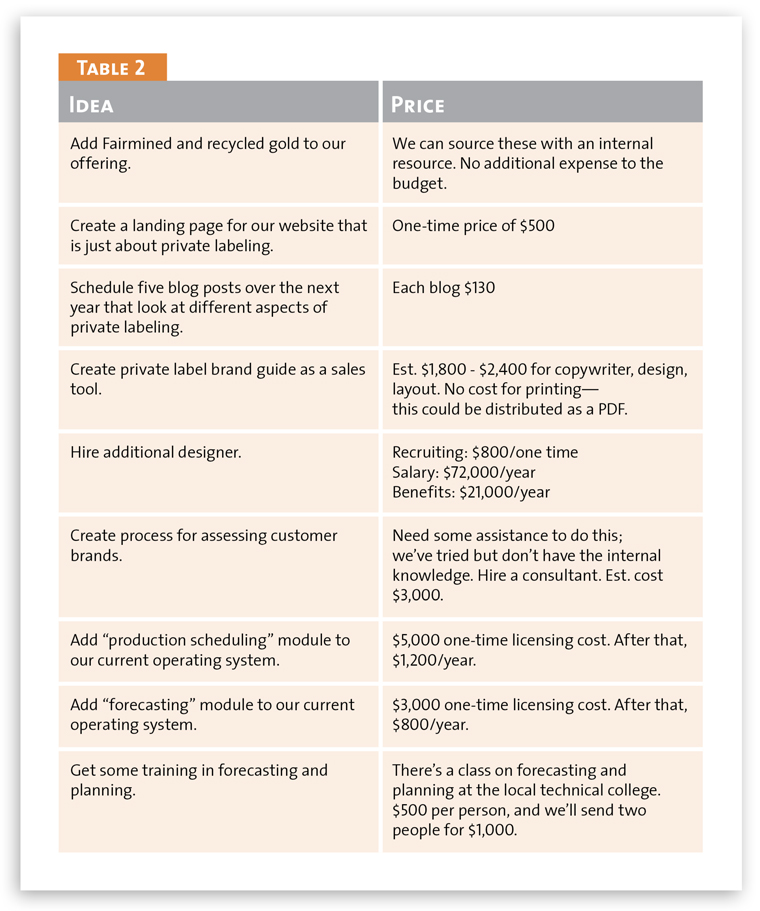
Now that you’ve brainstormed a list of ways you could improve your performance relative to your strategic elements, convert that table into a list of meaningful activities, tasks, projects, or processes. For each item on the list, consider how much that item will cost to accomplish. The list could look like Table 2.
Now Do the Budget
Once you start budgeting this way, you’ll never want to budget the old way again. After all—why do a process that looks backward for inspiration when you can do a process that propels you into the future?
Once you complete your strategic evaluation, it’s time to pull out the budgeting spreadsheets. You’ll do all the usual work, such as showing rent increases, salaries, travel expenses for planned trade shows, and monthly utility rates. But by analyzing your strategy first, you have come up with a list of relevant and meaningful projects and expenses.