

Storytelling
Announcing the winners of the 2015 MJSA Vision Awards
There’s a story behind every design. Sometimes it’s a short story inspired by a fleeting moment in time. Others are longer tales that are the culmination of years of study and practice. Yet others are works-in-progress, projects under constant scrutiny and revision.
Whatever the story, it was one worth telling for the winners of this year’s 2015 MJSA Vision Awards competition.
For 25 years, the Vision Awards have recognized outstanding achievement in jewelry making and design, by professionals and students alike. And on the following pages, you’ll discover the stories behind this year’s winners. They range from a pendant created with a homemade gold alloy to a pair of earrings that came to be only because its maker was fooling around at the bench one day. There’s even a story about a company that’s perfected the art of telling its own stories, in an attempt to market to today’s digital consumers. (For the Custom Design Distinction winner, please see MJSA Custom Jeweler.)
But before you settle in for a good read, we’d like to take a minute to say a few thank yous to those who help make these awards possible.
First, we’d like to thank the MJSA Vision Award sponsors, without whose support these awards would not be possible.
We’d also like to thank the judges of this year’s competition: Eugene Brill of Jewelry.com; Michael Coan of the Fashion Institute of Technology; Jason Dow of Jason Dow Inc.; Cindy Edelstein of the Jeweler’s Resource Bureau; Andrea Hill of StrategyWerx; Lee Krombholz of Krombholz Jewelers/Just Like You Designs; Eva Martin of Eva Martin Jeweler; and Joel McFadden of Joel McFadden Designs. Selecting the winners is never easy, but our judges handle the job with grace and aplomb.
Now please, sit back and enjoy as you get lost in the stories behind this year’s winning entries…
Riding the Wave
By John Shanahan
Adam Neeley
Adam Neeley Fine Art Jewelry, San Francisco
First Place, Professional Excellence (4 Years)
Laser Distinction
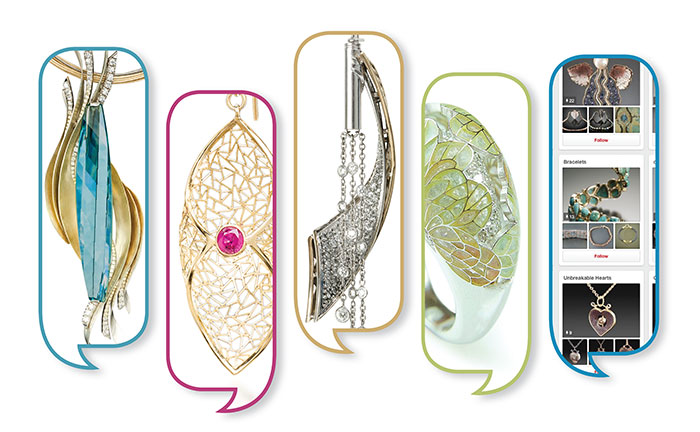
When MJSA began giving out accolades in the Laser Distinction category of the Vision Awards, Adam Neeley was one of the initial recipients. He’s been a near-constant presence in the top tiers of the awards since then, and this year returned to claim both the Laser Distinction and first place in the Professional Design category (for business four years and older). The winning piece, the Oceana necklace, features flowing, layered curves and liquid beauty accented with colored pavé diamonds, all framing an eye-catching, AGTA award-winning 32.86-carat aquamarine called Tsunami, cut by renowned lapidary Stephen Avery.
“The cut is really interesting,” Neeley says of the 2.5-inch-long aquamarine. “As it’s rotated, it has a scintillation effect like a wave, a gleam and shimmer. That started the inspiration for Oceana.”
As he headed into the design stage he knew he wanted the piece to be “something grand looking” to complement the size of the stone. He also wanted to highlight his own use of curved lines, as well as his custom alloy, Spectra gold.
“Spectra gold is a color gradient process I’ve developed that goes seamlessly from a rich pure yellow to a very cool white, encompassing seven colors of gold,” he says. Made by hand, this labor-intensive alloy contains karat golds ranging from 23k to 9k. The separate metals are prepared ahead of time using a patent-pending process, then fused into a brick using a hand torch. “Part of the challenge during the fusing process is that there are seven different melting temperatures,” he says. “A split second too long and it can turn into a 13k glob of caramel-colored gold and the whole process has to be started over.”
The gold’s unusual makeup is also one of the reasons that Neeley turned to laser welding to bring Oceana together. He notes that there is a secret element in the alloy that gives it a hardness equivalent to standard 18k yellow, but which also makes traditional soldering a complicated proposition. The laser provides a quick solution, as it allows him to forgo solder entirely and instead make the welds using the exact karat gold as the area he’s working on. The connection is seamless, and allows the smooth color gradient effect to continue unabated.
He worked through more than 20 sketches for Oceana over a two-week period before settling on the final look. Next, he prototyped the graceful curves in sterling to get a feel for their size, curvature, and the way they would align and interact—both with themselves and with Tsunami.
“Once I had the curves down, I created them in Spectra,” he says. “The brick is cut into slices, and each piece is fabricated from that. I roll them into a thin sheet, then forge one end down to an even thinner point. Once the forging is complete, I hand-finish it to remove hammer marks and make the surface even. I bring it to a satin finish using 400 grit sandpaper.” The satin finish, he says, most effectively shows the gradient. The edges of each curve then get a high polish with 1000 grit sandpaper and 3M’s 3-micron level paper to create contrast and shimmer.
Next come the stones. Ranging from canary yellow to white, the pavé diamonds are set in 14k rectangle stock that’s been rolled and finished. The aquamarine was something more of a challenge. “I’ve set many of Stephen’s stones and they aren’t usual cuts,” he explains. “There’s a little bit of engineering that goes into the setting. You can’t just order it online.”
Two “blades” of white gold, measuring 63 mm long by 7 mm wide, run beneath the stone and parallel to it on either side, both as support and to act like a mirror. “I wanted the stone to constantly look like it has a sparkling effect and not have any read-through to the mechanics of the setting. Each blade spans the length of the stone and on either side is captured in semi-bezels at the top and bottom.”
The diamonds and the aquamarine could be set ahead of assembly and finishing thanks once again to the laser. “The laser keeps the surface finishes pristine,” says Neeley. “If I was torch welding, I’d have to go back and refinish everything, which would be particularly hard with so many undulating and hidden surfaces. With the laser you just refinish where the welds are.”
The laser’s tack welding ability was invaluable when it came time to put the piece together. Neeley could make small, temporary welds as he checked and refined the way the curves layered and hung. He could build, consider, and then rebuild if need be, just by breaking off the tack and coming at it again. In a piece where the final balance was critical, this was a major plus.
“With so many pieces, everything had to be structurally sound and beautiful from the front and the back,” Neeley explains. “And it had to lay flat. I would lightly tack the piece, adding one element at a time. I could change the angle of the gold or where it was welded. Then I’d hold the piece up to make sure everything aligned.” When he had the pieces where he wanted, he simply reinforced the tacked areas with additional laser welding.
With everything in place, Adam Neeley rode this wave all the way to the Vision Awards winners’ circle.
Petal Pushing
By Ettagale Blauer
Baiyang Qiu
BQ Jewelry LLC, Milpitas, California
First Place, Professional (1-3 Years)
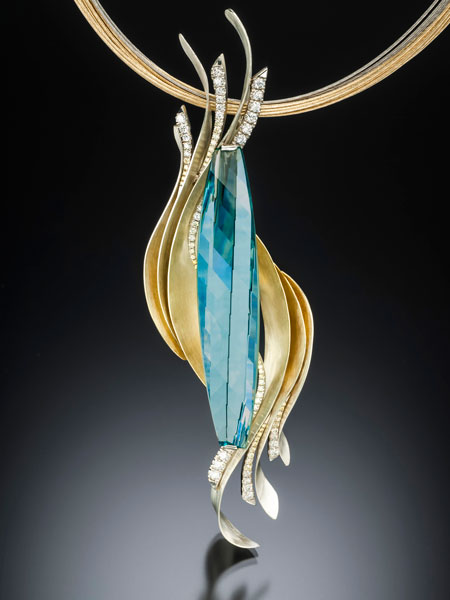
Baiyang Qiu often draws inspiration from the details of everyday life, and that was certainly the case with these 18k gold ruby earrings, which were inspired by a petal that had fallen from a flower.
“I was trying to capture a delicate beauty in a permanent form,” she explains. “There is a temporary, short time when you have beauty. It happens in everyday life, and is extremely easy to overlook. [For this] particular piece, I was walking in the garden after the rain. One whole flower petal dropped on the ground. It’s a beautiful form; I liked the shape and wanted to explore the possibility of making this moment into a permanent form.”
Although she wanted to pay tribute to this moment of beauty, Qiu did not want to replicate the actual petal. “When we talk about flower jewelry, it is always so literal, like the invisibly set flowers. All the great masterpieces are already existing,” she says, referencing the classic flower brooches made by Van Cleef & Arpels, where the stones are fitted together to appear as if there is no metalwork. Instead, Qiu spent time in the library researching the look of flowers and making sketches of different flower images.
“I went wild with research,” she says. “I looked at flower images, shapes, colors.” All during her research, she had in mind the idea “to catch the temporary, to try to catch those moments, the fragile, delicate look into a permanent piece.”
She began developing the shape of the flower petal design by drawing—a lot of drawing. “I did over a hundred drawings,” she says, explaining that it was how she worked while in school at the Savannah College of Design, where she earned her Master of Fine Arts degree in jewelry. “We always [had] a project in school [where we spent] three to four days drawing a concept.”
With her mind full of the knowledge garnered from her research, Qiu homed in on the design she was looking for. “I developed the shape in a symmetrical work,” she says. Her drawings enabled her to transform the shape into a more abstract form, which she believes is more appealing. “I draw to make it interesting to me, and the audience.”
Once she felt she was done sketching designs, she pulled all the sketches together and picked the one she thought was the most interesting. Part of the challenge for Qiu is to make things that are different from her previous work. She enjoys innovation, and always likes to make sure she’s pushing herself to try new things.
With the design now decided upon, Qiu had to determine the materials she needed to transform it into a rounded piece of jewelry. The key to the earrings’ construction was choosing the right type of 18k gold wire. Qiu turned to CAD to create a 3-D sketch of the design. “This let me get the accurate size and shape, to try to see how it looks,” she explains. “The computer rendering work showed the petal shape, how it curled. It helped me determine how big the center stone would be.” Although she prefers sketching by hand because she feels it allows her to experiment, she admits that “using the computer is faster, and you have exact measurements.”
Since the piece would be constructed almost entirely of wires, Qiu also used CAD to decide whether to use 26 or 29 gauge. “The 26 was so thick,” she says, “so I changed it to 29. It was very nice [and more delicate] but still strong enough to be wearable.” The CAD rendering also gave her the overall 3-D shape of the piece, something she couldn’t see in her 2-D sketches.
“Using rectangular 1.5 mm wire, I did the outer frame,” she says. In spite of her exacting design process, when it came time to decide how to place the myriad wires that make up most of the structure, she worked randomly. “With 29 gauge [wire] I took small lengths, 6 to 8 mm in length, and fused together six to eight pieces with a laser welder.” She made many sections like that, joining small section to small section, until she had enough of the wirework pattern to fill the frame of the earring.
Once she had the wirework structure complete, she needed to shape it. In order to get the earrings to curve around as she envisioned them, Qiu made a plastic forming tool using CAD/CAM because she did not have the right shape available.
“Then I put [the frames and wirework] onto my forming tool (to get the rounded shape), and hammered sections around [it],” she says. After she shaped the components, she welded the frames in place around the wirework.
The last step was to add the gemstones. Having already used CAD to determine the correct size gemstone to use, Qiu made two plain bezels and set each with a faceted ruby. “I chose to [place] the stone in the center, [like] the dew on the petal after the morning rain. Dew turns [a] reddish color from the sun, a moment I loved to capture.” To create a proper joining point, Qiu filed the points where the frames came together and then welded the bezel-set stones in place to complete the piece.
Despite all the time spent researching and sketching, Qiu admits that it only “took me about a week for the whole process.” Time well spent to capture a fleeting moment of beauty.

Not So Simple
By Shannon L. Brown
Annie Koenig
Annie K. Jewelry, Louisville, Kentucky
CAD/CAM Distinction
Second Place, Professional Excellence (4 Years)
When a summer day left Annie Koenig feeling landlocked in Louisville, Kentucky, and longing to be at a beach, any beach, she took a break and played with pieces of brass at the bench. She bent and shaped them, discarding piece after piece until one wave-shaped piece captured her attention.
Making it again from silver, assembling chain, and attaching an ear wire, she tried it on. “I saw that I really liked it,” says Koenig. “I wanted to do what I felt had to be earrings, moving, with textures and organic shapes, [and] to line them with diamonds. That’s what took me to CAD. I couldn’t make this at the bench—to saw out all those little pieces for the lattice would have been very difficult, and the texture I had in mind for the lattice could not be done by hand. I always look at the best way to make a piece. Some are best fabricated, some carved in wax, some cast using CAD.”
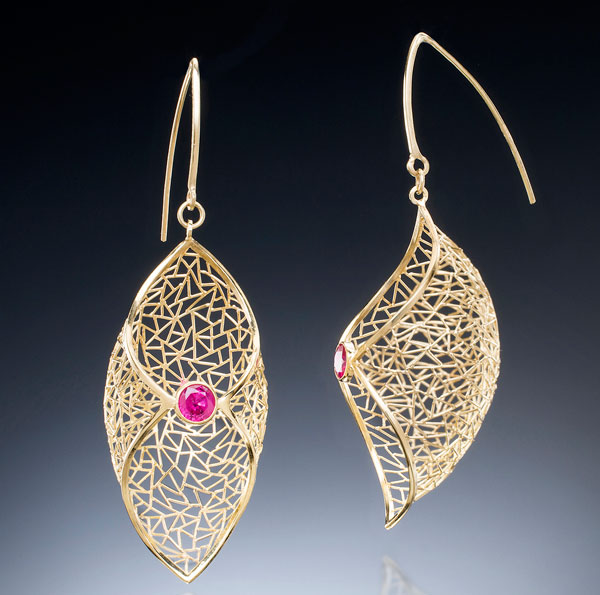
Because she wanted the earrings to rotate while being worn, she decided to create the earrings with two layered “waves,” one side composed of 14k white gold and the other of 14k yellow gold. “As the earrings rotated, I wanted to emphasize the contrast between the inner and outer surfaces,” she explains. “Since the inner surface was diamond pavé, I chose white gold for it, and continued the white metal color for the core of the earrings (the chains, tubing, and ear wires). I chose yellow gold for the contrasting outer surface that would be textured with a 3-D fish-scale-like pattern I created in CAD just for this earring.”
Bringing photos of her original brass shapes into CAD as a starting point, Koenig was able to manipulate the waves in CAD in a way that would have been too difficult to do by hand. The gold waves don’t simply twist; the bottom of each section also bends backward into a convex shape that gives more fluidity. “CAD was a timesaver because it allowed me to go through different shapes quickly to choose the most fluid shape,” she says.
CAD also helped her make sure that the yellow and gold layers of each wave would have uniform curvature, and would fit together perfectly: “Getting the layers to fit together is much easier to accomplish in CAD.” To join the layers, Koenig added spacer bars to the white gold waves that had pegs corresponding to holes she created in the yellow gold waves. These helped to ensure the layers stayed aligned until they could be welded together.
Although she planned to create the remaining components by hand, she used CAD to create versions of the tube, chain, and ear wire so that she could verify that the earrings would rotate correctly. The digital mock-up showed good clearance and confirmed the proper angle to weld the tubing to the waves, but it also showed that there was an issue with the ear wire running through the tubing.
“I needed the ear wire to stay centered through the tubing so that the earring would hang correctly,” Koenig explains. “The bottom of the wire is kept centered because it sits on the jump ring. At the top, it was going from side-to-side so I added a cap to the tubing with a small hole.” By feeding the ear wire through the hole, Koenig was able to keep the wire from moving. “The balance was critical, and if that balance was off, the earring wouldn’t work.”
Creating the settings for the 140 pavé-set diamonds (3.15 ctw) also proved challenging in CAD. Her CAD program’s automatic setting feature didn’t give her the results she wanted, so she ended up creating and placing every setting and prong herself.
“Because of the tapering and the curvature [of the waves], I varied the size [of the diamonds] to get the look I wanted,” she explains. “I wanted to fit them as tight as I could, so I used the edges as a guide to start laying out the diamonds, and then filled in and shifted sizes to keep those lines.”
In addition to the work being time-consuming, the compound curvature of the surface proved to be a challenge. “While all the stones were parallel to the surface and all the prongs were perpendicular to the surface, the angle of the surface itself was constantly changing. This meant each stone and individual prong had its own unique angle as well,” she says.
Once she was confident that her design in CAD would be successful, she had the pieces printed and prepared to cast them, which brought up a different set of challenges. Flowing yellow gold through the
55-mm-long open lattice of the yellow gold layer became a major hurdle that needed several castings to overcome.
“I wanted it to be as light as it could possibly be, but I needed to have enough thickness for the metal to flow [and] the openings [to be] large enough so investment wouldn’t break off,” says Koenig. She and her caster developed a sprue system with six sprues that fed the rims forming the edge of each wave piece. These thin rims “almost acted as feeder sprues or pathways for the metal to flow. It was the perfect solution for appearance, flow, and stability.”
All the time and effort was worth it in the end for Koenig, who credits CAD with helping make these earrings possible. “The design is simple, but there’s a lot going on to make it simple,” she says.
Forever in Flight
By Shannon L. Brown
Diana Telesheva
Moscow State University of Design & Technology, Moscow
First Place, Future of the Industry
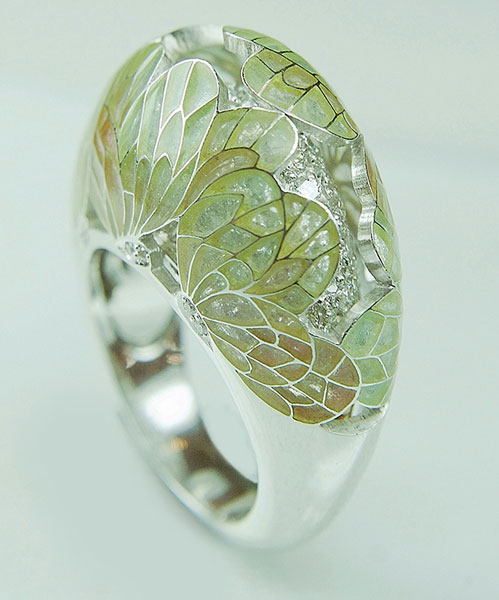
A childhood image inspired Diana Telesheva of the Moscow State University of Design & Technology in Moscow, Russia, to create her Butterflies ring. “On an unpaved village road I saw butterflies that were sticking close together in a ball,” she says. “They were literally clamped to each other’s wings. I decided that the same image may be used in jewelry, and I decided to bring it to life.” The colorful enameled wings arch over rhodium-plated 18k gold and 3.4 ctw of diamonds, sized 1 mm, 1.5 mm, and 2 mm.
With six years of experience in enamel, Telesheva employed the plique-a-jour technique of enameling for her butterfly’s wings. “I wanted to make the butterflies transparent, bright, and delicate,” she says, explaining that she wanted “to be able to see the diamonds through the thin wings.” As she began the project though, she wondered if she could bring her butterfly vision to life. “At the beginning, I even thought that I would not be able to do this work.”
Plique-a-jour, often described as backless cloisonné and translated to “open to light,” has the appearance of a miniature stained glass window with wires separating areas of fired glass. “I like this technique very much because it is complicated in performance and requires a lot of skills,” she explains. “We are constantly faced with surprises during firing in the oven. At the same time, we gain new experience and learn to do things better and nicer.”
After drawing several pencil and watercolor sketches to decide on the wing’s colors, she got to work creating the metal areas for the enameling. She then filled the cells with ground glass that was mixed with water. “The product needs to be allowed to dry out completely or else when it begins to boil, it sprays enamel,” she says. When completely dry, the enameled piece is put on a support and placed in a furnace pre-heated to 800°C (1,450°F). Once fired, it is removed and allowed to slowly cool with no abrupt temperature changes, thus lessening chances of breakage. Different shades of enamel are layered one by one until reaching the desired result. Becoming skilled in plique-a-jour, she says, requires “much patience and experimentation.”
To the novice she says, “The only advice I can give is a little more patience and a lot of experimenting. The technique of stained enamel is quite complicated at the beginning and requires a lot of time to gain experience and to achieve a high quality, without which it is impossible to talk about the art of jewelry.”
The wings arch over a raised field of diamonds, which bring light up into the enamel. She carved the ring’s shank with a convex insert in wax and cast them in 18k gold. Because some areas would be inaccessible later, she polished the shank before welding the wings to the sides of the shank and setting diamonds at their bases. She then polished and set the diamonds in the insert before slipping it through the opening in the bottom of the ring and welding it in place. She next cut out a piece of gold and welded it over the opening, giving beauty to the underside and making it more comfortable for the woman wearing the ring.
Telesheva acknowledges that projects like this ring don’t always come out exactly as she envisioned. “We always have to make changes in the work, because the sketch on the paper is not the same as the product in the metal, especially when working with enamel,” she says. “During firing, the enamel may give unexpected results.”
She took on the challenge and produced the vision in her mind in what is considered a challenging medium. “I love difficulties and I like to overcome them—to challenge myself and to cope well with a problem, then I feel satisfaction,” she says. And overcoming challenges in enameling are even more rewarding to Telesheva. “If the work has been done with the best quality and has an artistic value, it will be saved for centuries, because the enamel as well as the gold and diamonds do not get old with time and do not change color.”
It also means that her butterflies will fly forever.
 A Custom Education
By Terri Wallo Strauss
Llyn Strong
Llyn Strong Fine Jewelry, Greenville, South Carolina
Digital Marketing Distinction
Llyn Strong is doing a small bit of remodeling in her gallery. Strong, who’s been in the business for 35 years and whose gallery is located literally on Main Street in downtown Greenville, offers custom-made pieces, unique jewelry, and glassware from various artisans. With the changes in the gallery came the idea to place four flat-screen televisions near the windows. People visiting the gallery or just walking by could watch Strong and her employees craft jewelry or design in CAD. Cameras would be on the workbenches and show the craftsmanship for which her staff are known. This idea is still in its infancy, but is one of the marketing concepts that she is considering and an insight into how she aligns her marketing with her desire to educate people on how her jewelry is designed and made.
“The main goal…is to let potential customers see the new designs produced and get them excited about buying jewelry,” says Strong. “I think people sometimes don’t know that we produce most of our jewelry here, with the exception of some work that is sent out to a stone setter or hand engraver because we simply can’t work 24 hours a day. We produce most of the designs here, and I think it’s important for people to know that.”
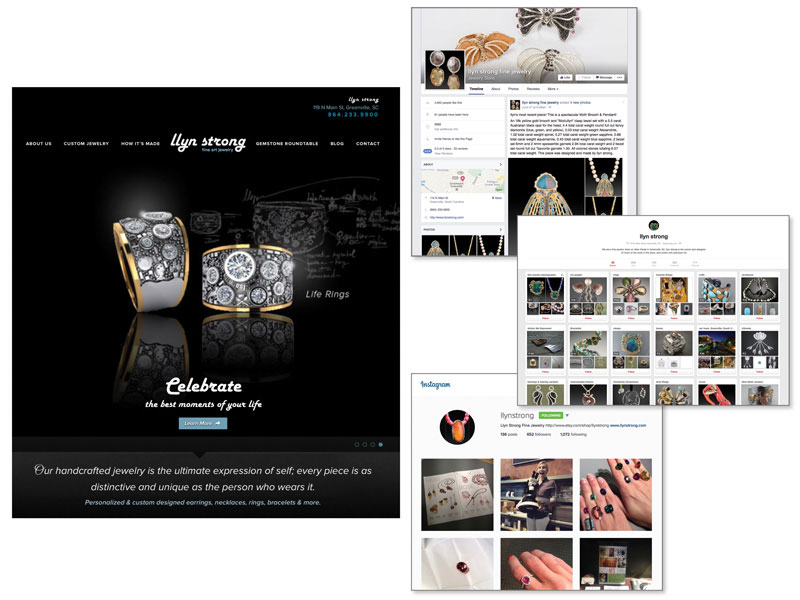
Believing it critical to always keep thinking about new marketing ideas, she recognized that the website she created years ago was out of date and not in line with her desire to push the custom design process. The site featured some images of custom-made jewelry, but it also showed a lot of jewelry that was in stock, without any real differentiation between the two. Customers found it confusing, and the site needed freshening up.
She turned to her website developer to update the site, taking six months and several revisions to get it just right, and to make sure it told their story and was customer friendly. Rather than showing all of their pieces online, they consolidated the images to give a good sampling of their style, and changed the site to focus more on the actual process of custom designing jewelry. And instead of offering jewelry for sale through the site, they encouraged people to contact them directly so they could work with each individual customer to find something in stock or meet their desire for something custom made. The result of this painstaking process is a solid website that explains the custom design process.
Although she acknowledges that younger, Millennial buyers tend to want immediate gratification when shopping online, she kept the site’s focus on custom design. “Primarily, we focus on custom jewelry, and so our customer has to wait a few weeks for a piece, which is hardly instant gratification,” she says. “We focus on promoting what we do, which is handmade craftsmanship.”
She offsets instant gratification with ensuring the customer is part of the design process—selecting the stone, sharing ideas for the design, and looking at sketches and CAD renderings. She says customers have fun with the process, and each phase is like a little surprise, so it makes the time not seem so long.
Vision Award judge Eugene Brill, vice president of operations at Jewelry.com, cited Strong’s website as “compelling” and a site that “urges the user to stay for a while and browse.” He also commended the site’s “How It’s Made” section for reinforcing her focus on craftsmanship.
“Creating the in-store jewelry buying experience online is hard, but here you have the opportunity to educate the customer before they come to the store,” says Brill. “This empowers the customer…they already know what they’re in for.”
Along with updating her website, Strong revised her print advertisements to follow the style of her new site, generating a sense of cohesiveness throughout her marketing. She also looked at how she approached other forms of digital marketing, including maintaining a blog to keep things personal as well as regularly sending out a newsletter to share special news and events.
She carried her personal approach to jewelry through to her social media presence. Although the company has accounts on most major social media sites, including LinkedIn, Twitter, and YouTube, Strong focuses primarily on Facebook, Pinterest, and Instagram. She believes that as a visual arts business, these sites make the most sense to focus on because of the agility to show and share images. Whatever site they use, she makes sure they always emphasize the personal.
For example, on Facebook, the company posts customers’ personal stories and shows images of the creations made for them. In addition, they share images their customers send in of them wearing their custom jewels.
As they became more consistent with sharing stories through social media, they realized that customers loved seeing Strong’s latest works. The more regular Strong and her team are about updating news and images, the more they showed up on people’s newsfeeds, and the better response they receive.
They have dabbled a little in Facebook advertising, using a paid ad for a few months. Although they were successful in getting more likes, they did not see a significant increase in sales. However, they are open to trying it again down the road if their marketing budget calls for it.
For now, Strong says they’ll continue to focus on telling the story of their custom craftsmanship. “Our jewelry is personal—it’s often made as a remembrance, celebration, or special occasion. We want people to read about us and look at our designs and understand how we make it. Maybe that will inspire them to call us for their own custom piece.”