

Sophia Hu: Fabric & Fabrication
Sophia Hu
Fabric & Fabrication
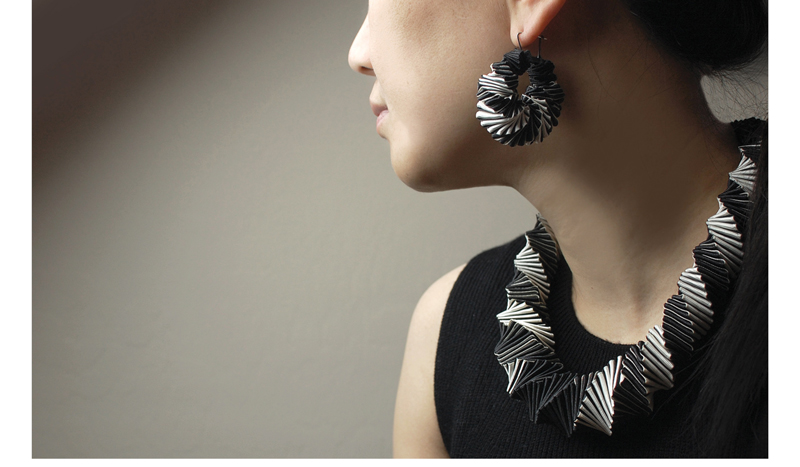
The tale behind Sophia Hu’s Saul Bell Award-winning Turning pieces involves three quite disparate elements: fabric, jewelry design, and traditional Chinese woodworking. A former architect who came to jewelry only six years ago, Hu brings together the technical skill of her professional life and the inspiration of the grand structures she saw all around her childhood home in Beijing—and captures them in soft fabric.
“Growing up in Beijing, I was always fascinated by the joints in Chinese wood structure,” she says. “The beauty of it is how it depends on the way the wood is joined together, with intersecting or overlapping joints. From small furniture to a grand palace, they all use some basic joints. There’s a perfect logic in that construction, so I tried to learn from that.”
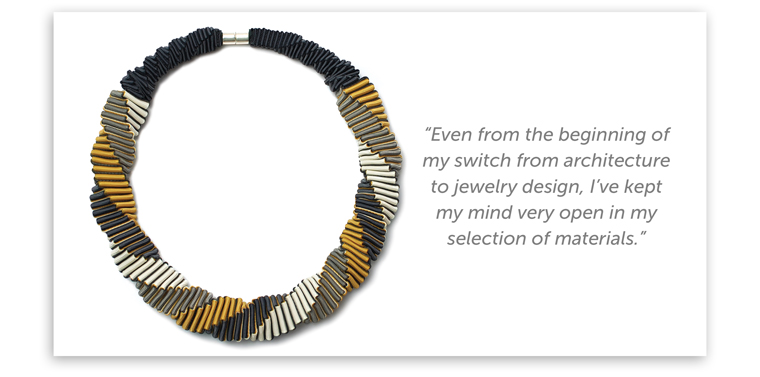
That fascination fostered her career in architecture, which subsequently informed how she approaches her jewelry work. “One of an architect’s main roles is to specify the right material in the right area according to its function,” she says. “And there are always new materials to discover, and techniques of using them that might not have been possible before. Even from the beginning of my switch from architecture to jewelry design, I’ve kept my mind very open in my selection of materials.”
That open-mindedness led her to the idea of using fabric, largely because she saw the connection between it and jewelry. “To me, fabric is a very intimate material,” she says. “We wear it all the time; we can feel the texture, and it moves with us. Jewelry also moves with the body. It’s a very special and intimate form of art. And I thought, why not combine these two things?”
Which, as happens often when jewelers work with alternative materials, was surprisingly more difficult than Hu initially thought. “The most challenging part of working with the polyester is dealing with its softness,” she says. “It’s not easy to get it to keep its shape, compared to metal where you can forge or shape the material to achieve its structure.”
Polyester is where Hu landed after trying other fabrics, such as cotton, wool, and felt—fabrics that might be considered “stiffer” and easier to work. She compared them side-by-side, and polyester won out. “It works perfectly in my Turning designs,” she says. “Its softness and stiffness, texture, tension, and gloss, all help to show the style’s signature turning rotations smoothly and naturally.”
Aside from the inherent difficulties of working with polyester, Hu chose to complicate the matter further with the decision to emulate the techniques of traditional Chinese woodworking. “In a Chinese wood structure, there is no gluing or nailing. It’s only joints, and these joints are very complicated. I try to honor that craftsmanship by challenging myself to stay away from what some might consider the usual tools for working with fabric: needles and thread, sewing, or gluing. I use only my regular jewelry tools. Pliers, stainless steel wires, and metal clasps.”
Her main tools, however, are her bare hands. Her Turning pieces are built from strips of polyester manually woven around stainless steel wire. “Quite often I weave four different colors at three different widths in a single necklace design,” she says. “I use our dining table as my weaving station since I need a large working surface to get all the polyester strips organized. As you can imagine, my hands are flying crazy while I’m weaving because they’re acting like a weaving machine!”
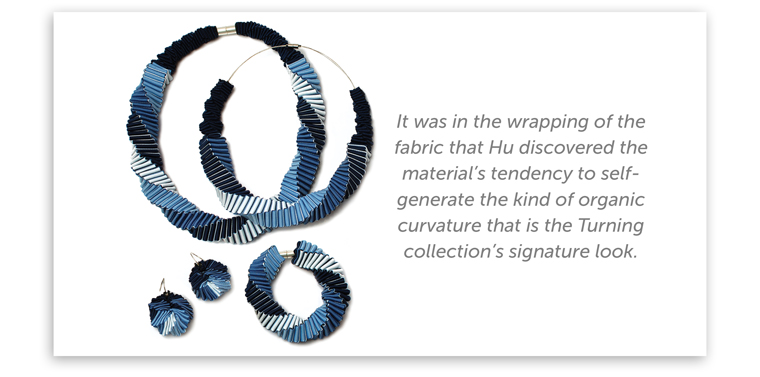
It was in the wrapping of the fabric that Hu discovered the material’s tendency to self-generate the kind of organic curvature that is the Turning collection’s signature look. She can control the degree of these curves and rotations through the tightness of the weave.
Even as she developed and solidified the technique, Hu was questioning how her fabric jewelry would be received in the marketplace. She wondered how to approach the issue of value. “I worried how the customer would perceive the value, if they only thought of it in terms of the material,” she says. “How would I back up the price I was putting on it? I thought that the same formula I use in pricing my metal designs could kind of work here, but I might need to explain it to the customer.”
The answer surprised her. When she started bringing the pieces to shows, the expected level of interest in this intriguing look was there—but the value judgments were not. “In most cases, I didn’t need to explain anything to the customer beyond the fact that these are polyester designs,” she says. “There was a natural connection and communication with my customers. When they first saw it they were surprised because they’d never thought of using fabric in this way.
“At first I wasn’t sure my customers had the same understanding of the value of art jewelry as I did,” she admits. “But with their reaction, my customers educated me about how they think about the true value of art jewelry.”
Up to the Challenge • Composed in Composites • String Theory • To the Point