

Silver Stories
Two users of anti-tarnish silvers discuss the benefits of working with these alloys
By Tina Wojtkielo Snyder
Editor’s Note: In the July 2013 issue of MJSA Journal, we presented a comprehensive comparison chart of all the tarnish-resistant alloys currently available to the jewelry industry. Using this data, you can compare and contrast to find the best alloy for your needs.
In the following article, two entities—an artisan and a large manufacturer—discuss their use of their chosen tarnish-resistant alloys, as well as offer examples of their work.
Ronda Coryell
Austin, Texas
A goldsmith by training and JA Certified Master Bench Jeweler, Ronda Coryell of Jewelry Studies International in Austin, Texas, has never compared the tarnish-resistant silver alloys she uses to standard sterling silver. “I don’t have much experience with standard sterling,” she says. “I compare tarnish-resistant silvers to gold.”
Opting to work with Argentium 935 in all of her hand-fabricated pieces, Coryell turned to the metal because of its bright white color and greater resistance to tarnish, but also because of its tendency to work like a gold alloy.
“Argentium transfers heat like gold, not sterling, which allows you to spot fuse it,” she says. “And the beauty of this metal is that you can fuse it to virtually any other metal—gold, copper, steel, platinum.”
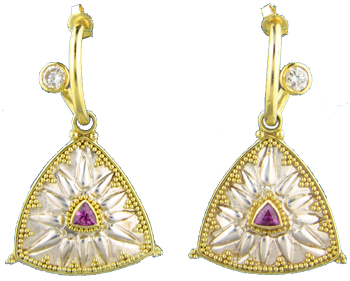
Coryell believes Argentium’s ability to fuse to itself and other metals is one of the alloy’s most important attributes. “When heating metal to just below the melting point, the atoms ‘vibrate,’” she explains. “As the temperature rises, they vibrate more, causing diffusion of the molecules to take place. When two different metals with similar properties are close together, the atoms will mingle and form a bond between the parts. That is called diffusion bonding, eliminating the need to add solder to the piece on which you are working.” Coryell uses this method to fuse 22k granules to Argentium in pendants, earrings, and rings. Also, she notes that the fact that she uses no solder enables her to melt all of her scrap and reuse it.
She notes that when heating Argentium, unlike sterling, the use of Firescoff or boric acid and alcohol is unnecessary because Argentium doesn’t firescale. “Believe me, I’ve tried to make it firescale, but it just won’t,” she says.
In addition, Argentium’s ability to be heat-treated to 570°F (300°C) for two hours in a kiln enables even the thinnest designs to be made more structurally sound through a simple but effective process. “Heat-treating Argentium pieces in a kiln will make even the most lightweight, delicate pieces stronger and more rigid, adding to wear quality,” she says.
RW Manufacturing Co.
East Rochester, New York
Both a contract manufacturer and a manufacturer of finished product for its own retail store, RW Manufacturing in East Rochester, New York, recently switched to Stuller’s Continuum alloy for all of its silver castings stocked in its own retail store. “We decided to use Continuum in part because of its enhanced tarnish resistance,” says Melissa Holthoff, who is in charge of CAD design and development for RW. “The anti-tarnish properties help because you aren’t always re-polishing the jewelry.”
Holthoff says that as more and more manufacturers turn to silver as a lower-cost alternative to gold, retailers are reminded of the extra work involved in displaying a product that tarnishes. Since many manufacturers today are e-coating or rhodium plating their silver, Holthoff says retailers are expecting tarnish-free product, which is an unrealistic expectation.
“I have been getting phone calls from my wholesale clients who say their retail customers are calling them and saying their sterling silver product is tarnishing in the cases,” she says. “For the manufacturer who wants to present a pure sterling silver product without a coating or plating, Continuum offers a longer shelf life. But manufacturers still need to educate the retailers that even the newer tarnish-resistant alloys will eventually tarnish—it’s just the nature of the metal.”
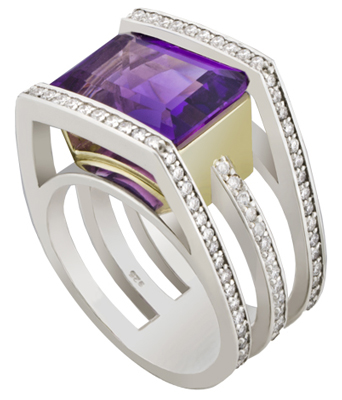
In addition to greater resistance to tarnish, Continuum offers a high hardness that Holthoff says is very beneficial to some of the designs RW casts. In the example of the custom ring shown (top right), the large size of the center stone (approximately 6.67 carats) and relative thinness of the three-part shank (the edges of the shank that hold the stone are 2.3 mm thick) required a very hard metal for security. “Continuum is one-third stronger than standard sterling, but you can heat-treat it to be as hard as 14k gold,” says Holthoff. “Because this is a three-part ring with lots of negative space, we needed a strong metal that could support the center stone yet be affordable enough for the client. Not knowing if this was a ring the client would wear only occasionally or daily, we needed to make sure it was structurally sound and that the stone wasn’t in danger of wear damage from a bump against the refrigerator door.”
The ring was designed in CAD, grown on the Solidscape T66 printer, and cast in a centrifugal caster. Holthoff says the force of the centrifugal machine versus a standard vacuum caster was necessary to fill all of the small prongs securing the diamonds around the shank, which measure just about 0.4 mm in diameter.
In addition to being used for custom and stock designs in RW’s retail outlet, Continuum is finding favor among the company’s contract clients who use enameling in their lines. “Continuum enamels like fine silver, not sterling,” says Holthoff, “but it offers the strength of sterling silver, which is harder than fine silver. Our clients appreciate the added strength of the metal.”