

Shifting Sand
Keiko Mita’s earrings reflect her childhood by the sea
By Tina Snyder
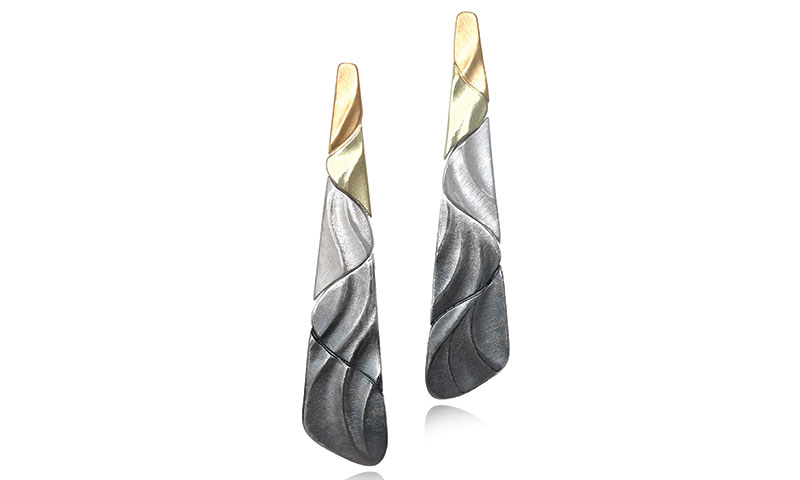
Growing up on Rebun Island in the Sea of Japan, Keiko Mita of K. Mita Design was surrounded by the sea. The New York City–based designer was fascinated by the shoreline’s beauty, and she could spend hours in the dunes watching the waves wash over the sand. The beautiful patterns and colors left in the sand by the ebbing and flowing tide are the inspiration behind Mita’s Sand Dune Collection.
The Ombre Earrings from the Sand Dune Collection, which won second place in the silver category of the 2017 InStore Design Awards, are designed to emulate the patterns on the seashore. The first challenge in crafting the earrings was selecting the right alloys. “I wanted to capture the color of the sand shifting from dry to wet as the waves lap up on the shoreline,” says Mita. “The metal color needed to graduate in an ombré pattern from a warm yellow for the dry sand to a deep gray for the wet sand.”
The designer selected 18k yellow gold, 14k green gold, and Argentium silver, planning to oxidize the components that would represent the wet sand. “The warm yellow of the 18k transitions nicely to the pale green of the 14k, and then to the cooler Argentium silver, reflecting the contrasts you see at the shore,” says Mita.
In addition to achieving the subtle color transition, Mita wanted to capture the movement in the sand, including the shifts caused by erosion and wind. Each earring measures 55 mm long and comprises five separate components, all of which Mita originally planned to link. She carved the entire earring in one piece of wax, creating a flowing pattern of ripples and scoops, and then segmented it into five sections. The five pieces were cast in their respective alloys and cleaned up prior to connecting. But when Mita initially fashioned connections between each of the five components, the earrings didn’t fall how she had hoped. “I thought the bottom piece, which is 12 mm wide, was going to be heavy enough to hang straight, but when I hinged it, it was always a bit tilted,” she explains. “It curved under and disrupted the flow between the pieces.”
Her solution was to solder the bottom silver component to the one above it, creating a more solid, heavy base to anchor the earrings. For stability, she also elected to solder the top 18k yellow gold component to the second 14k green gold one below it, hinging only the pieces in between.
The hinges were fashioned by soldering four half-circle links to the backs of the two components, then connecting them with a loop. In total there are four hinges on the earrings: two connecting the top two gold components to the third silver component, and two more connecting the third silver component to the bottom two silver components. “The earrings would have been easier to make if I simply soldered all of the pieces, but they would have lacked the subtle movement I was looking for to emphasize the changing patterns in the sand,” says Mita. “And I intentionally left distinct lines between the soldered components, so the earrings still appear to be five separate pieces.”
The earrings were textured with a rough bur split lap and high polished at the peaks to add further dimension. The Argentium silver components were blackened to varying degrees using a traditional liver of sulfur solution.
Though long, the earrings are flexible without losing the continuous pattern that originates in the carved wax. Like shifting sand, they have a subtle movement reminiscent of the picturesque seashore of Mita’s childhood.
Keiko Mita is the owner of K. Mita Design in New York City.