

Shedding Light
How refiners increase transparency and resolve differences
By Shawna Kulpa
Like many jewelers, you probably have the process of preparing your scrap for refining down pat. You separate your scrap and scour all of your work surfaces clean, placing the cleaning cloths in with your used buffs and sweeps. You clean out your sink traps and periodically even tear up the carpeting in your shop to send along with your sweeps. And off the material goes to the refiner, where it will be melted down and eventually a check (or metal, if you prefer) will be sent back as payment for the recovered precious metals.
It seems like a pretty clear-cut process, and it usually runs smoothly. But what if the check you get back is less than what you were expecting? You separated your metal scrap, weighed it, and kept meticulous records of everything that was shipped to the refiner. And yet, you look at the check and think, “This can’t be right.” What’s a confused jeweler to do?
Luckily, many of today’s refiners are all about transparency—and they’ve designed their processes so clients can be involved and informed.
A Little Background
Since scrap lots from jewelers tend to be on the small side, many of the major refiners serving the industry don’t refine each customer’s lot individually. Instead, these refiners will take a jeweler’s lot, melt it down, and then take a pin sample from the center of the melt. A portion of that sample is sent to the refiner’s lab (with the rest held in reserve) where it is assayed to determine the metal content. The refiner pays the customer based on the assay result, and the metal from the customer’s lot is then added to a larger batch of metal scrap that will eventually be melted down and refined.
In an effort to keep the process as transparent as possible, most refiners welcome customers in to witness the processing of their lot. “It’s in a company’s best interest to rep their materials,” says John Antonacci of Advanced Chemical Co. in Warwick, Rhode Island. “We do our best to maintain the integrity of the samples we pull. But if we’re doing it without a customer rep there to witness, how are they going to know?”
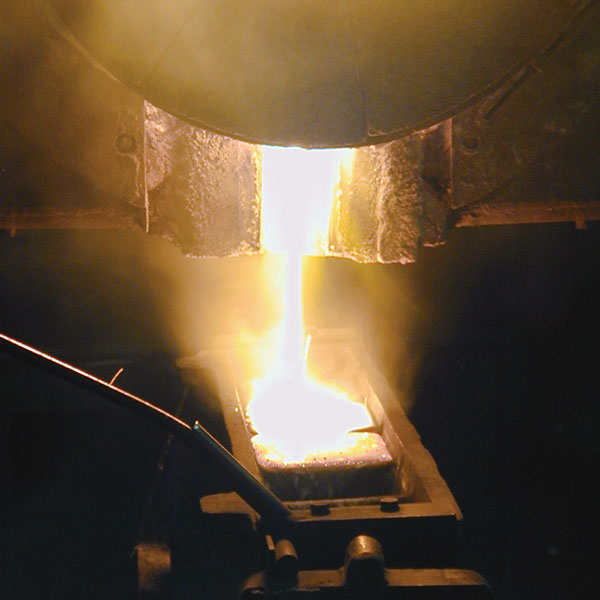
If you plan to witness your lot being sampled, your refiner will wait to open your containers until you are present. You can verify that the containers are just as you sent them from your shop before they are opened. (Refiners recommend sealing your containers with special seals so you will know if they’ve been tampered with.) Your materials will be weighed before they are placed in a container for melting. Once the materials are molten, the refiner will pour them into a bar mold. Before the metal cools and hardens, the refiner will insert pins into the center of the mold to take the samples. You’ll then witness as the samples are bagged up and secured.
If you can’t be there to witness the lot being processed, there are organizations such as independent laboratories or inspection companies that offer third-party representatives who will go in and watch the processing for you.
Whether or not you send a representative to witness your lot being processed, you can request that the refiner take multiple samples of your material: One for them to test in-house, one for you to take to have tested, and a third sample that would be used only in the event of a large discrepancy between the refiner’s results and your own.
“We recommend that customers take a sample with them,” says Jack Brill of Johnson Matthey in New York City. “It’s a way to make the customer a part of the settlement. They don’t just have a number that they don’t know where it came from. This way, they have a say.”
However, if you plan on witnessing your lot being processed or requesting samples, let your request be known early. “Everything should be spelled out before a lot is received,” says Larry Fell of David H. Fell & Co. in Commerce, California. This would include the lab you plan on using for your testing as well as how and when you and your refiner will share your results.
“Each party presents results to the other party simultaneously,” says Brill. “It can be by e-mail, at a set date and time, or postal mail, with the results postmarked on the same date.”
Customers can have their sample tested at a lab of their choosing, but most refiners request that the lab their customers select use the same testing method they use. “Some testing methods are more exact,” explains Antonacci. “So if there’s a large disparity, initially we’re going to want to know what testing procedures were used. This could save the customer time and money before jumping right into an expensive umpire.”
Once each party has the other’s results, a comparison can be made. No one ever expects the results to be identical, but each refiner has its own tolerances for discrepancies between the test results. “We have guidelines on how close those results need to be in order for us to settle on the average of the results,” says Brill, who notes that all of a refiner’s guidelines and tolerances should be clearly spelled out in an agreement that is given to the customer ahead of time.
“Generally it comes down to dollars,” explains Anthony Arricale of United Precious Metal Refining in Alden, New York. “If we’re only a couple hundred dollars apart, we usually agree to split the difference in the middle to avoid the umpire process.” Although tolerances will vary from refiner to refiner, all seem to agree that at around the $300 mark, the discrepancy becomes large enough to potentially warrant a third-party test. “This is because charges usually start at about $350,” says Arricale.
If the difference is great enough, however, it may be time to go to umpiring. Here’s how the process works.
1. The umpire sample is put into play. When a customer’s lot is melted and the refiner takes samples, the sample meant for the umpire is sealed and secured, usually with a type of security tape that will show if it’s been tampered with. Refiners will then have the customer (or their rep) sign and date the seal, adding the lot number and any other identifying information. When sending a sample to a lab for umpiring, the refiner will include a letter describing the type of material being sent, the reference number or lot ID, and how to report the results (i.e., troy ounces, etc.). The letter will also spell out how and to whom the results should be sent.
Although some companies will allow customers to take the sealed umpire sample with them, most require that it stay in their custody until the time it is needed. If the company does allow you to take the umpire sample with you, be aware that there may be charges involved.
“Our policy is that ‘if it stays, it weighs, and the customer gets paid,’” says Antonacci, which means that if the sample stays in Advanced Chemical’s facility, the company will pay the customer for the weight of it. “If the customer takes the third sample with them, we deduct the weight of the sample from our payment.”
2. The sample is sent to an agreed-upon lab. Every refiner maintains a list of labs they’ve approved for use as an umpire, but many will also allow you to select another lab; however, the refiner has to agree with your choice.
“If a customer wants a specific company, we need to verify the lab’s validity in order to approve them,” says Antonacci. “Part of that is making sure they are capable of doing the same assaying processes we do, and that they follow standard industry procedures.”
Bill Doyle of Elemental Refining in Jackson, Ohio, agrees. “The sample has to be sent to an umpire using the same analytical procedures, so everyone is on the same page.”
In addition, the umpiring company can’t already be involved in the process. “If a customer uses an outside lab to test their sample, that same lab can’t be used as the umpire,” warns Brill. “That would be a conflict of interest.”
Also, be aware that if you go to umpire for multiple tests, it’s best to rotate the companies used. “We typically like to rotate the umpires so we’re not always going to the same lab,” says Bob Bouchard of Gannon & Scott in Cranston, Rhode Island. “It adds transparency and statistical variances. We might let the customer choose a certain lab from the ones we’ve certified, and then we choose a different one the next time. It’s a rotation.”
3. The lab goes to work. Once you’ve agreed on an umpire with your refiner, the sample will be sent off for testing. “When the umpire receives the sample, they’ll send a photo or photocopy of the seal,” says Fell. “They’ll also document that they received one sample in an envelope with the signature of the client so the customer will know that the sealing tape wasn’t broken or tampered with.”
Depending on how many metals the lab is testing for and the number of tests being run, the process can take a few weeks. Once the lab has the results, it will report them simultaneously to both the refiner and the customer.
4. The results are in. Contrary to what some might think, the umpire’s result is never automatically used to settle on. Although methods vary, most refiners will settle on the result that falls in the middle of the three, whether it’s theirs, the customer’s, or the umpire’s. The party with the result furthest away from the middle number is then stuck with the bill for the umpire’s testing.
For most refiners, the umpire results are the final say.
“Once it comes down to umpire, that’s the final word,” says Antonacci, noting that by going to umpire, the customer has agreed to abide by the test results. “Sometimes we win, sometimes we lose, but we keep track of the results and use them internally to improve our processes and determine why there was a discrepancy. And in the end, no one is really a ‘loser.’ The bottom line is you want to get it right.”
For many refiners, the umpire process isn’t used that often, but they acknowledge its importance in helping keep the refining process transparent and to earn their customers’ trust. “It’s important that customers know about the option,” says Fell. “The more they know about their materials, the better off everyone is.