

Selling Stories: Branding and Sales Strategies for Designers
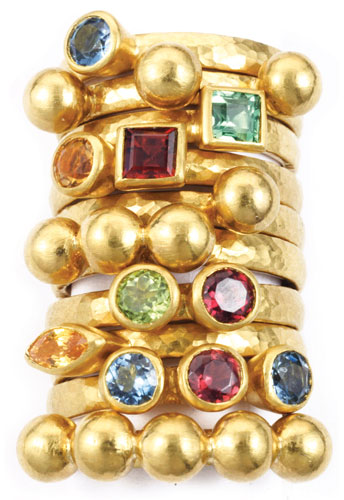
Rings by George Sawyer
Selling Stories
Brilliant branding and sales strategies for designers
By John Shanahan and Tina Wojtielo Snyder
What’s your story? If this question—when asked in the context of your jewelry—is a difficult one to answer, you may want to consider a new career. “Having a clear, concise message that captures the story behind your designs is critical to the success of your business,” says Cindy Edelstein of the Jeweler’s Resource Bureau in Pelham Manor, New York. “You should be able to sum up in a phrase the essence of your jewelry design business.”
Start by taking a close look at your jewelry. The core message that you are trying to convey with your work will often stem from the materials featured, the techniques used, or the overall style of the work. Sure, all of these elements work in concert, but it’s essential to hone in on that which sets you apart—your differentiator. You need to figure out exactly what your jewelry would say if it could talk and take that message to heart. It should define your company and infiltrate everything you do—from direct mail marketing to advertising to exhibiting at trade shows.
In the story that follows, you’ll read about designers who have crafted clear, powerful stories behind their designs, and how they’re making sure the message gets across to the retailers and the end consumer. You’ll also read tips from marketing experts on how to ensure you are getting your message across to potential clients. Use this information to help you define the message behind your work—because selling stories is what selling designer jewelry is all about.
Raw Elegance:
Todd Reed Expresses the Meaning of a Material
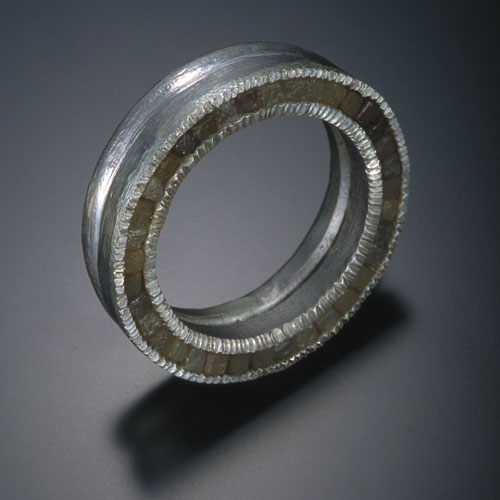
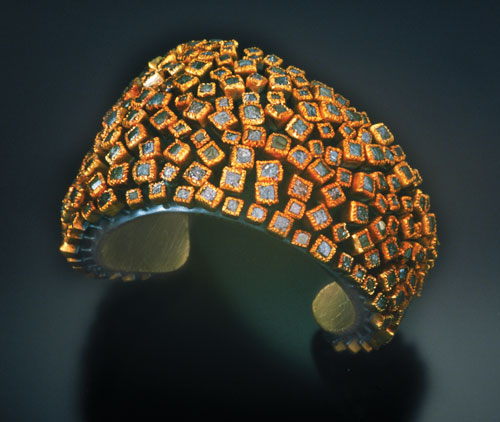
The message that jeweler Todd Reed of Boulder, Colorado, wants to convey through his work is a mixture of equal parts mindset and metaphor. He knows that most people like their diamonds cut and shiny. But he also knows how beautiful they are raw—and he uses that knowledge to change minds.
“The reason that I stopped using [only] cut diamonds and [switched to] cut and uncut was to bring an awareness to society’s odd obsession with diamonds,” he says. “I wanted to make jewelry using this material that people are fascinated with in a way that they weren’t familiar with.”
The trick, of course, is in working around the preconceived notion of what a diamond ought to be. But Reed recognizes that there’s no sense in trying to fight against it. “I think of it as an alternative,” he says. “I like cut diamonds, rubies, sapphires. I appreciate those great stones. I’m not saying it’s not valuable or it’s not socially redeeming to have a big, cut diamond rather than a small, uncut diamond. I’m just trying to push this concept.”
And that concept—elegance—is what sets Reed’s work apart. In this case, the material of choice drives the story behind the design.
How Reed disseminates the word of raw diamonds as an alternative is a work in progress. Early on, he distributed a quarterly newsletter among his established customers and to potential retailers. More recently, as exposure for his work has moved from private galleries to more retail stores, he has switched to ads in consumer and trade magazines. “One of my main goals is to keep my name attached to raw diamonds in print at least once a month,” he says. “That can be my name in a trade newsletter all the way up to a ring appearing on the cover of a bridal magazine—something that lets people know we’re here and we’re doing raw diamonds.”
When it comes to getting the information to the stores that carry his work, Reed believes in roadwork. “I used to get out on the road more and talk to salespeople,” he says. “I’d make sure the message was there as I presented it. I’d been selling them myself for so long, I’d gotten pretty good at it. One of my main goals now is to be on the road more again.”
In the meantime, printed material has taken the place of hitting the road. The word of raw diamonds is spread by a bit of the written word sent with every box of jewelry that gets shipped to a retailer.
“When they get a piece of jewelry, they also get quite a bit of information about each individual piece,” he says. “If it’s supposed to be worn a certain way, if the stones are from a certain area, how we made it—that’s all written down. And we’re always available to answer questions.”
Retailers also get a CD jammed with information: Reed’s writings on the subject, magazine articles about his process, why he uses these diamonds, and more.
“Our hope is that the retailer will pass the information along,” he says. One way of ensuring the transfer of knowledge, Reed says, is through a commitment to doing business well. Good general business practices keeps customers and buyers coming back. Collectors will naturally talk up the raw diamond story, and word-of-mouth goes a long way.
Todd Reed jewelry images Azad.
Mirror Image Patterns:
George Sawyer Uses Technique to Evoke Emotion
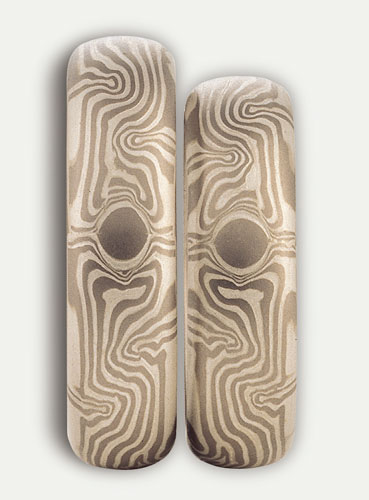
George Sawyer’s mokumé gane practically sells itself. With its unique wood-grain look, his mokumé has visual appeal with real power to draw buyers. Some may even want to know how it’s done. But the Minneapolis-based designer would rather avoid bogging them down with technical talk and instead focus on what each mokumé piece means to the buyer on a personal level. Because it’s the emotional tale that mokumé has to tell that will truly close the sale. And where he once looked to communicate the meaning of his craft to the customer through his retailers, Sawyer now finds more value in the direct route, in large part courtesy of the internet.
“I could tell the same technical story that other mokumé makers tell,” he says. “But it’s like telling the story of lost-wax casting. It’s interesting the first time you hear it, but technique doesn’t speak to the buyer’s heart.”
Instead, Sawyer says, he prefers to tell a story that will let the buyer see the connection between the piece and themselves. His mirror-image, pattern-matched wedding band sets bring that sort of connection: a couple can emotionally relate to the parallel between their one-of-a-kind relationship and their one-of-a-kind rings.
“All art has a story, and what I’ve found is that not only do people closely follow the story when I tell it, but they repeat it,” he says. “They use their jewelry as a visual example when they talk to their friends. They become an advocate of my jewelry art.”
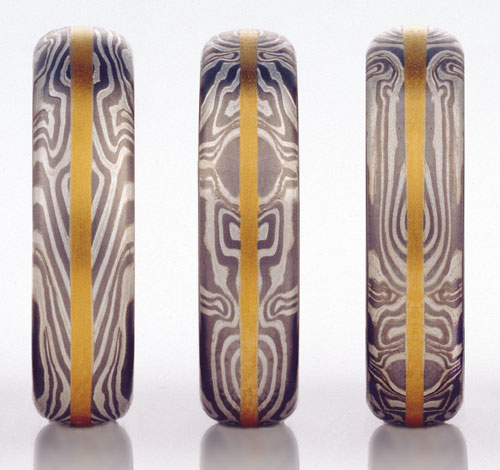
How that story is told has changed for Sawyer over the years. Initially, he would visit retailers and train salespeople to tell the story of his work. “I found that in stores that had genuinely interested staff, the story would get to the customer and the customer would buy the piece,” he says. “If the staff weren’t interested, the store wouldn’t do as well [with my product].” A clear transfer of the story behind the design is essential to successful sales.
Another barrier to consistently getting the message out was employee turnover and the need to retrain new salespeople in the story. “It means you have to go to the stores periodically and do trunk shows,” says Sawyer. “But the reason for doing the show isn’t to meet their customers and be the designer on display. It’s to reconnect with the staff and reinfect them with some enthusiasm for the story.”
Sawyer would provide three-ring binders of written materials to help train staff, but, he says, “sometimes the stores didn’t even realized they had them.”
Rather than having an uneducated consumer go to a jewelry store salesperson who has hopefully latched on to the story of his work, Sawyer decided to take a more proactive approach. He educates the end customer and points them directly to where they can find George Sawyer jewelry.
“I’ve found that it’s difficult to keep [educating] a store staff that’s constantly rolling over,” he explains. Sawyer’s new path is to place “an evocative ad” in consumer magazines that will drive customers to his website. The site then brings them deeper into the Sawyer mokumé story, and helps them locate a retailer. “Then, when they go to the store, [the sale] isn’t dependent on having a trained staff member there,” he says. The customer walks in the door knowing exactly why they want a George Sawyer piece.
Modern Primitive:
Lisa Jenks Forges a Spiritual Link to the Past
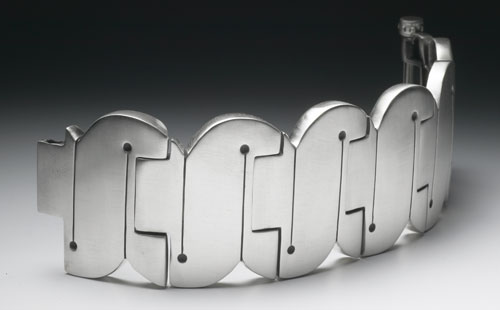
Feedback. Sometimes it can help you find something in your own work that you didn’t even know was there. When New York City-based designer Lisa Jenks was rolling out some of her early work, the feedback she was getting from customers shed interesting light on the way she would come to market her designs.
“It was very individualistic,” she says of the responses. “The thing that resonated is that the aesthetics of ancient cultures [which people see in my work] are based on their views of religion. There is something intrinsically spirtual about it.” Customers felt that spirituality in their own unique ways, and commented on it. “Everyone saw a different thing in each piece. They brought their own experience to it.”
Jenks took that feedback and used it to perpetuate the developing story going forward. Word of her connection to this cultural aesthetic—which she came to refer to as “modern primitive”—began a sort of organic growth.
“Initially, I did pieces that just came naturally to me,” she says. “Getting that kind of reaction made me push on in different ways.”
As she headed off in new directions, Jenks embraced the feedback as part of her marketing efforts. “Part of the story is what people see in the jewelry and how it influences their experiences,” she says. “It’s an ever-evolving narrative.”
To get the evolving story out to retailers, Jenks relied on legwork. “Trunk shows and a lot of written information,” she says. “Though, to be honest, I’m not sure how well written information works. A lot of people just don’t read.” What did work, she says, is having her salespeople get out and work with buyers and the people on the sales floor. “We found the greatest success when the owner of the store naturally understood what we were trying to achieve,” she says. “The ones whose stores were open to receiving the information—who truly ’got it’—made our jobs easier.”
The personal connection that can be made between a salesperson and the work from doing trunk shows can also become an effective sales tool. “Meeting the salespeople matters,” she says. “When they make a connection with the designer and they can say, “I met Lisa, and she told me this’ or ’she showed me this,’ it makes it very intimate. It’s a phenomenal tool.”
The best approach to getting the story out, she says, remains a “multi-headed” plan—combining personal visits with printed training materials and maintaining a Web presence. “It’s hard to tell what’s going to hit a particular consumer,” she says. “You have to stick all this stuff out there and see who it reaches, and how. It’s all important.”
The Three-Minute Sales Pitch
Gallery and retail store owners are busy running their businesses. Once you’ve convinced them to take time away from their schedules to meet with you and view your line, you’d better be prepared to make a great impression—and fast.
Laura Brown of ViewPoint, a New York City-based sales and marketing organization for the luxury jewelry market, advocates designers go into these situations with a strong, three-minute pitch. If you can hook store owners in this short amount of time, they’ll want to know more about you and your jewelry.
So how do you convey the story behind your designs in three minutes? Brown offered the following tips during a presentation she gave at Designer Day (sponsored by the Jeweler’s Resource Bureau and MJSA) in March:
• Focus on what makes you different. Open your pitch with a three- to five-sentence statement about what makes your work different from all the other designer jewelry out there. A good exercise to help you compose this statement is to think of key words that describe your product. Once you have a list, narrow it down to the few choice words that really capture the meaning behind your jewelry.
• Choose key pieces to showcase and describe. Many designers make the mistake of laying out their entire line in front of the gallery owner from the outset of the meeting, which can be overwhelming.
Instead, try choosing three pieces: a signature piece that defines your work, a new piece that shows in which direction you are taking your work, and a few bestsellers (and be prepared to explain why these pieces are so popular).
• Talk as you show your work. As you show each piece, describe the materials and techniques used, the name and where it came from, and any special story attached to the piece. Romance your work. Remember: You are selling.
• Include wholesale price tags on each piece. You want the store owner to get a feel for your price points without having to ask you for them.
• Bring your collection groups in a separate case. By this point, your three minutes are up. If you’ve engaged the store owner and they want to see more, now is the time to break out your collection groups for display and discussion. Be sure to have a catalog of prices handy.
• Carry a press kit that you can leave behind. Always have a professional press kit that you can give out. It should include a one-page bio that conveys your message and the story behind you and your work, four to six product photos of the pieces you used in your three-minute pitch, any press coverage you’ve received that you are proud of, and all of your contact information so the gallery owner can reach you. Keep in mind that a press kit that fits into a filing cabinet is easy to store.
• Practice your pitch. Before you do any of this in real life, practice your pitch in front of friends and family. Also, arrange the stores on your pitch list by order of importance. Get comfortable showing your work to other stores before you pitch your number one store.
• Always send a thank-you note. No matter how you think the meeting went, mail a hand-written thank-you note to the store owner. Your last impression may be just as important as your first.