

Right on Track
Made in the USA case study: RW Manufacturing
KEY MANUFACTURING INITIATIVE: Developing a specialized software system to efficiently track repairs and wholesale orders throughout the facility
Before: In 2005, RW Manufacturing (East Rochester, New York) realized that it needed to invest in a business software program to properly manage its repair and contract manufacturing operation. It had just become the national jewelry service center for one of the nation’s leading jewelry designers—meaning the company would be managing double to triple the volume that it was accustomed to.
With the number of jobs coming into the facility per week averaging about 250 to 400, work in progress was getting more difficult to track. The company invested in a system written on the Microsoft Access platform, which at the time was sufficient. But as they continued to grow, and production and repair intake increased at an average rate of 10 to 25 percent per year, the software needed to be updated to keep up with increased and changing demands.
The software was also incapable of tracking jobs through every stage of manufacturing, so when a project was due to ship on a specific day, it was often hard to locate in the factory. “For example, if something was scheduled to cast one day, but the casting failed for some reason, there was no way of inputting into the software that it needed to be re-cast,” explains Gary Keim, vice president of RW. “So you’d be running around the factory trying to find a piece, not knowing it was stuck in casting.”
In addition, the changing face of the jewelry manufacturing industry has meant more small orders coming in—one or two samples, for instance, or five versions of a style, versus a high volume of the same design. “Not only were we seeing more ‘onesie’ and ‘twosie’ orders, but clients were asking for items in nonstandard metals for us, such as bronze or plated product,” says Keim. “We didn’t have all the parameters set into our software system to efficiently track all of the smaller and specialty orders we were getting, so we needed to make changes.”
As more independent designers, small retail jewelry outlets, and new designers began to compose a larger segment of RW’s customer base, the company realized that its current tracking system had to be updated. The independent tracking required of these small volume orders was cutting into profit margin because the company simply couldn’t keep up with it all efficiently.
After: In 2011, RW hired a full-time programmer to work on-site and re-write its software to better fit the company’s needs. “We found that we were making changes almost daily to our software and paying a contractor a significant fee to institute those changes,” says Keim. “Financially, it made more sense to hire him to effect all the changes—and be on-site to constantly improve and adapt the program.” (It also minimized the disruption caused by having to learn a completely new out-of-the-box system; RW was able to keep the best of the old system, so staff had at least some familiarity with the new program from the outset, and it was much easier to learn small changes as they were implemented.)
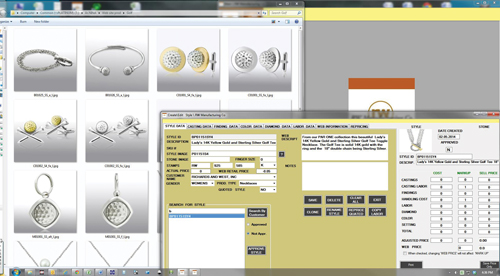
It was Keim’s goal to not only eliminate the limitations of the existing software program, but also to continually adapt and improve with changing times. The company decided to develop a new software program in the Sequel platform, which Keim says can handle an immense amount of data quickly. Access, he says, is a limited database, whereas Sequel allows users to store unlimited amounts of data—and to access that data at an increased rate of speed.
“When we realized how many different variables were needed to maximize production, using Sequel gave us the ability to enter more information and access it faster,” says Keim. “This enabled us to streamline our production and give our clients faster delivery of information and product.”
Sequel also allowed the program, which the company named RW Jewel, to integrate with the e-commerce side of the company’s online catalog. Clients would be able to have full visibility of their order or repair status online, 24 hours a day.
In preparation for developing a program that would flex to fit the needs of RW’s manufacturing process, Keim and the programmer met with each department to discuss concerns with order tracking and input. “We took it to the floor,” says Keim. “We watched how things were done and asked the employees what they thought could be done quicker. We literally noted how many keystrokes it took to do a task, and tried to find ways to minimize those keystrokes.”
For example, using the old system, someone in the polishing department would get a basket of jobs and was required to log them in on a specific computer. The process involved scanning each job individually and pressing enter. “There could be 15 jobs in the basket, and the polisher would have to scan each one and press enter every time,” says Keim. “We figured out a way to take that down to scanning and pressing the enter button once everything was scanned. It’s 14 keystrokes saved, but when you have dozens of employees processing hundreds—sometimes thousands—of jobs a day, it all adds up.”
In fact, minimizing keystrokes in the repair department actually enabled RW to do more work with fewer staff. “Our data entry and job tracking personnel became so streamlined with these changes that we were actually able to eliminate one of these positions,” says Keim. “We don’t need extra staff running around chasing down jobs anymore, because we know where everything is at all stages of manufacturing.”
Not only does inefficiency cost money, but it’s also frustrating, stresses Keim. “How frustrating is it when you have a job that must go out that day and you can’t find it,” he relays. “You knew it was in casting that morning but it didn’t make it to [finishing], and now it’s sitting in a bag in casting because [finishing] didn’t know it had to get out the door that day.”
In the new program, jobs that must go out on the current day are flagged, so anyone who goes into the system can see that those orders need to be expedited, and can watch out for them. In the case of failed castings, the orders now get scanned as “scrapped,” so everyone in the system is aware that that order will need to be re-cast.
“It eliminates the need we had in the past to walk down to the casting room and see why something hasn’t left,” says Keim. “It’s all logged into the system. You get a report each morning or at any time, telling you where every job is in the facility.”
The fact that anyone with access to the system can now log in, at any computer in the facility, and track a job is an especially valuable feature of the new program.

“If you are a salesperson and you need to check the status of an order, you can see where every component part of that order is in the facility,” explains Keim. “If you have a 20-piece order for rings cast in gold with stones, and you are missing 10 diamonds from the diamond picking, you can see if the order has been placed and what is the projected receipt date. This enables better communication between our salespeople and our clients about our processes and expected ship dates.”
Keim says that RW is currently in the process of adding another change to its software program that would place a due date on every stage of the manufacturing process; instead of having a single ship date, the order will have due dates for wax model making, casting, polishing, etc.
“After one scan into the wax room, there will be a maximum of X hours for that piece to be made and scanned into casting,” says Keim. “Then casting will have a given time to get it over to [finishing].”
By assigning due dates to each task, the company can identify any trouble spots in its production line. And by identifying those trouble spots, they can address them proactively—and sharpen their competitive edge. “It’s all about being more efficient, and you can always find ways to improve—it’s a never-ending pursuit,” says Keim.
And this is a great time to pursue such excellence; Keim adds that he’s seen many U.S. companies bring their manufacturing back from China because of that country’s increased labor costs, as well as quality control issues. And that just offers more opportunity for companies such as his.
“The more efficient we can be,” he says, “without sacrificing the quality that we are known for, the better we can compete with overseas manufacturers.”