

Planning Ahead
Using a promotional calendar
By Andrea Hill
I was initially unimpressed with my first boss. He was bland as clear broth, spoke few words, and rarely changed his expression. But soon I realized that he was teaching me more than some of my fine university professors. From him I learned that communication could take many forms, and that the best forms of communication are forms of leadership.
The regional manager of a retail chain, he understood that his primary objective was to sell, and that all other activities must support the sales objectives. What made him special was how he helped the rest of us to know that, too.
He kept a large, two-sided blackboard on wheels in our back room. One side of the blackboard showed our sales goals and actual performance, by day and by week, compared to the same day and week the prior year. The other side of the board was a marvel. Using a pack of pastel chalk, he illustrated the store plan for each weekly meeting. Using words, pictures, arrows, and dotted lines, he demonstrated how each function of the store must do its job to achieve the sales goal for the week. If leadership is the process of showing people where they need to go and giving them the tools to go there, this was leadership by chalkboard…and it worked.
Better Communication Improves Sales
The relationship between sales, marketing, and product development is particularly complex, and many business problems are a direct result of failure to build communication between these areas. Because salespeople tend to operate independently, it is tempting to view them as a separate entity, but this could not be further from the truth. Sales staff is more dependent on all the functions of the company than any other function. If production does not meet its deadlines, sales takes the customer heat. If quality slips, sales has to make it right. If someone makes a promise that cannot be met or is not communicated to other departments, sales is left holding the bag. The simple process of making a promotional calendar can better communications between departments and improve performance.
A promotional calendar is a planning tool developed by the sales, marketing, and product development staff. Its main purpose is to illustrate the monthly (or quarterly) sales goals and clarify how marketing, product development, and sales will work together to achieve those goals.
Use the following steps to develop a promotional calendar for your business:
1. Plan annual advertisements and promotions.
Answer all of the following questions when planning your yearly marketing efforts:
• How many trade or consumer ads will you place?
• In which publications and media will you place them?
• How much online marketing will you do (when and where)?
• Will you produce catalogs or flyers?
• Do you have an annual sale?
Once you define precisely how much marketing you will do in the next year (which you need to do for budgeting reasons anyway), plot those plans on a 12-month graphical calendar.
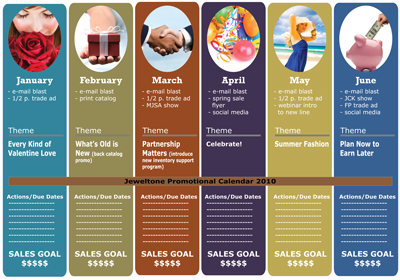
2. Develop themes.
Information overload is a fact of life. You have little time to capture the attention of your prospects and customers, so you must make sure every element of your communications works together to create one cohesive message. The best way to accomplish this is to select one theme at a time and hammer it home—in marketing copy, sales support material, public relations content, sales scripts, and through your graphic elements, font types, and color selection.
Theme development can include concepts such as:
• New collection introduction
• Seasonal messages
• Service messages
• Advice and support ideas
• Social messages
When creating themes for your promotional calendar, take into account any new product introduction plans for the next year, back-catalog promotions, goals related to smoothing seasonal sales trends, and all other business plans. Consider how these plans fit with or complement general industry trends and promotions. Brainstorm theme ideas and select a theme for each month (or quarter, if you are doing a quarterly promotional calendar). Give each theme a title and a visual prompt to make it more memorable.
3. Align sales, marketing, and operations.
Using the theme as a focal point and your monthly sales goals as your guide, identify what you must accomplish in sales, marketing, and operations each month. Develop global understanding of the various functions’ needs and responsibilities. Ask the following questions:
• Which products must be finished, and by what date?
• When will you need a prototype for photography?
• What are the sales goals for each month (not just in terms of gross dollars, but also in terms of specific products)?
• If you have more than one customer type, which type(s) of customer(s) should be targeted?
• What materials will the sales team need to do its job, and when should marketing have those materials ready?
• Does marketing need input from sales to produce those materials, and when can they expect to receive that input?
While you are asking and answering these questions together, your staff is gaining knowledge about and sensitivity for the interconnectedness of their various jobs. For the cost of a planning activity, you can end up with better coordination between sales, marketing, and product development, more reasons to pick up the phone and initiate dialog with customers, and a visual reference—in poster, pen-and-ink, or chalkboard—to help your teams work together to meet sales goals.