

Painting in Metals
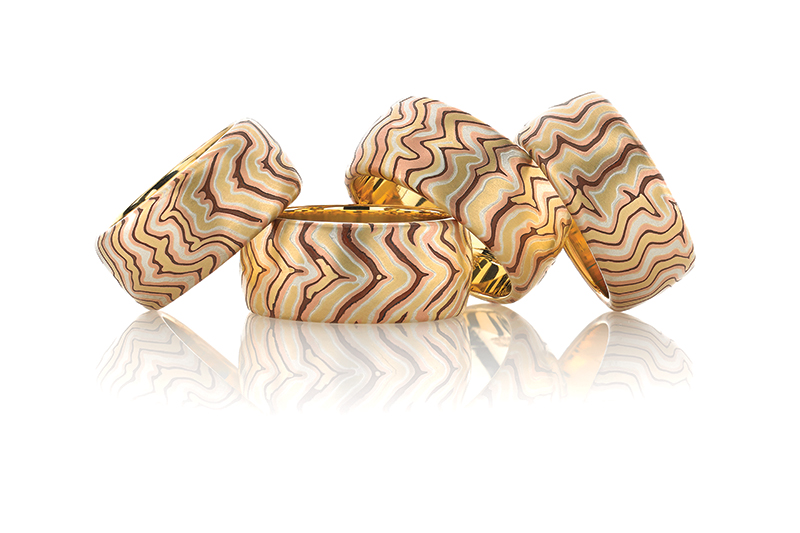
George Sawyer on the art of mokumé gane
By John Shanahan
There is perhaps no jewelry look more immediately distinctive than mokumé gane. With its multiple colors of precious metals flowing in wood-grain patterns, the art traces its roots back to Japanese sword-forging techniques that originated before 1000 A.D. George Sawyer’s fascination with mokumé began upon seeing just such a weapon back in the 1970s. The art had largely been lost or forgotten in the west. Even the definitive metalsmithing text of the time, Oppi Untracht’s Metal Techniques for Craftsmen, showed “mokumé” items that were soldered together and did not exhibit the wood-grain pattern. Sawyer, though utterly new to the technique, felt that what Untracht presented as mokumé gane did not represent the true methodology of the genuine art. He started experimenting with copper and silver, diving into whatever texts he could find on the subject, though most were vague at best and focused on weaponry. As he began to master it, his technique and confidence improving, he moved into karat golds and set himself on a path that has defined his career.
In mokumé gane, multiple sheets of metal are stacked into a billet, then heated in a reducing atmosphere until they begin to come together in a process called diffusion bonding—although, Sawyer notes, it’s less about melting than it is about the metals finding a sort of common ground within themselves. “Metals are crystalline substances,” Sawyer explains. “Some reach a state, when heated, between liquid and solid. It’s a plastic-like zone. They hold their shape, but they’re not hard. If you take two dissimilar metals that reach that state in the same temperature range, press them together and heat them under pressure in an atmosphere that inhibits oxidation, the crystals will grow into each other and lock up physically as they intertwine.” When the metals cool, they remain locked together.
Yellow and red gold, for example, both have gold, copper, and silver in them in differing amounts. Clean the metals and bring them to temperature, and the crystals of all the metals that make these alloys will, as Sawyer puts it, “cross over the boundaries” to join together. This, in simplified terms, is the first step in creating mokumé gane.
Heat It and Beat It
Mokumé gane begins with a stack of metal sheets. It is imperative that they be, as Sawyer puts it, “surgically clean.” In order for the metals to bond they must have perfect surface contact. This can only happen when the metals are totally flat and free of oxides and oils. “Even oil from your skin can contaminate the surface,” Sawyer says. “I usually clean the metal sheets with Scotchbrite pads and moist pumice powder, then rinse them in distilled water. I check [to see] that the water sheets completely on the metal surface, then I dry it with a clean cloth or paper towel so they are free of water spots.”
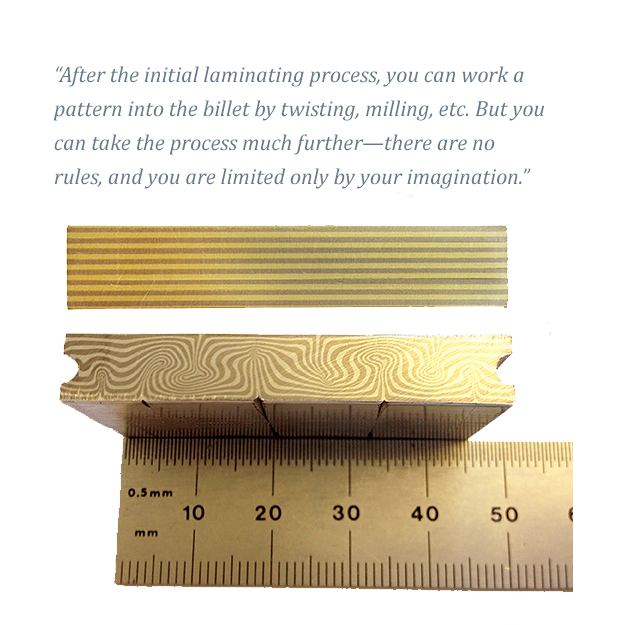
The sheets are then stacked in the order of the artist’s choosing, with consideration given to the bonding compatibility of adjacent metals as well as their aesthetic appearance. They are clamped tightly together, often with steel plates and bolts that are tightened down to press the thin sheets together or in a custom-made diffusion-bonding tool. (See sidebar, “Layer On the Learning,” on page 38 for more.) Because most jewelry is small in scale, the sheets are typically very thin so that the resulting pattern will be in scale. “I just did a two-color batch in silver and palladium gray gold, and the sheets were about 0.4 to 0.6 mm thick, and I had a stack of 19 pieces—the whole stack was maybe 11 mm thick.” By comparison, he knows of artists who make Japanese-style hollowware using the mokumé technique, and each of their sheets may run as thick as 1 to 2 mm. “But their stack might be six inches tall and six inches square. The shape and size of a billet varies depending on what you plan to make,” Sawyer notes.
The bound stack is then fired—these days, most likely in an electric kiln that offers accurate control over the all-important temperature. “For controlled and efficient production of precious-metal pattern-work, it’s important to have a computer-controlled kiln and refer to phase diagrams and bonding charts to determine temperatures,” Sawyer says. “However, it’s also easy to make a reducing atmosphere oven using a couple of firebricks and a torch, although you’ll need to ‘eyeball’ the bonding process.” The metals in the billet need to be compatible in that they share a temperature zone where they both reach that neither-solid-nor-liquid state. “You watch for the point when the exposed edges of the billet ‘shimmer,’ as you see when granulating metals or fusing 24k gold to sterling silver,” Sawyer advises. Like many aspects of mokumé, with this method, getting it right will be all about trial and error.
After the billet cools, you’re ready for what Sawyer says is the fun part. It’s time to play. “For me, this is the most important step, the wonderful point where technique meets art. After the initial laminating process, you can work a pattern into the billet by twisting, milling, etc. But you can take the process much further—there are no rules, and you are limited only by your imagination,” he says. “I work almost exclusively in edge-grain patterning, where the edges of the laminate describe the entire pattern, because I like the crisp quality and deep ‘etchability’ of the finished pattern. Depending on the effect I’m after, I might work a laminated billet into sheet, then hammer forge it into spirals like you would fold a pastry sheet. I might assemble preformed patterns of metals a bit like a puzzle before bonding, so the bonded billet already has the pattern within it. I sometimes cold forge and deform billets in dies with a hydraulic press and re-bond them. I even make intertwined color combinations in wire and compress them into billets for bonding, adding larger shaped elements of contrasting colors for accents,” he says, citing his Koi and Wabi Sabi collections.
One of his favorite pattern series is “Rhythm”—a visual representation of music in a ring. “It is composed of four metal colors arranged in 128 layers. The layers are divided into the four quarters of a circle, each quarter having a different sequence of the four colors to create a color ‘rhythm’ that encircles the ring. Within each quarter of the ring, a color shift describes a visual pattern or ‘melody’ that coordinates with the rhythm.” Rhythm, along with Koi and Wabi Sabi, are newer expressions of this art that Sawyer has researched and created over the last several years.
Pattern Behavior
One thing to remember when working with mokumé gane is that what you’ve got in your hand is not a piece of metal. It’s a piece of several metals, all of which have their own attitude about being worked. To make things as easy as possible, your focus should be on the characteristics of the least workable metal or bond in the alloy. If you work it to the point where the most resistant of the metals in the mix is just about to fail yet remains workable, the easier metals will fall in line and behave as well. Some metal combinations like gold and platinum alloys will bond, but are very difficult to work beyond the most basic form without breaking up. On the easy end of the workability scale are laminates of palladium gold and silver, yellow gold and silver, and, the recommended blend for beginners, copper and silver. “Plan your experiments carefully, anneal early, and don’t be tempted to push the workability of the metal,” he says. “If a piece delaminates, it won’t re-bond and will probably have to be scrapped. If you see a small delamination beginning, cut it completely out of the piece or it will certainly spread.”
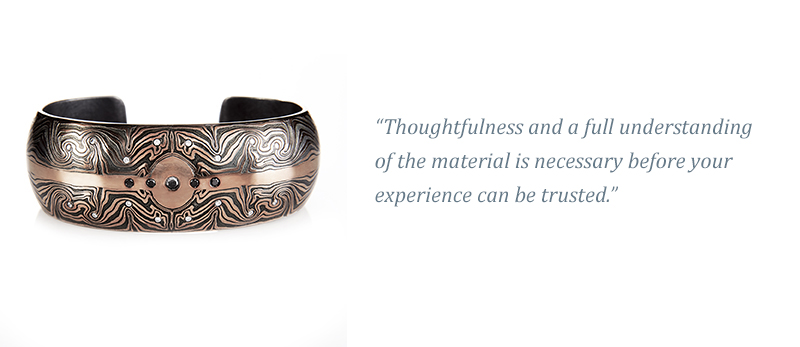
Because patterned metal does not always work like a solid single alloy and has its unique limitations, Sawyer suggests planning your pattern to be compatible with the shape you intend to make. “This is an important part of the process. The workability of patterned metals depends on the physical characteristics of the metals in the mix, the characteristics of the bonds between particular metals, and the orientation of the bonds to the direction required to form the shape. The laminates and patterns that are the easiest to work have all of their bonds parallel to the top surface. The most difficult have their bonds or joints perpendicular to the surface and at right angles to the direction of any outside curvature.”
Sawyer has found that because of the variable physical characteristics of the metals and the diffusion joints in a billet, patterned metals are often much stronger in compression than tension. A major key to working with mokumé is to understand the difference between the two. “Let’s say you start out with a flat piece of metal and you’re going to bend it into a circle,” he says. “When you bend that strip, the outside has to stretch to get longer. It is in tension. Keep in mind that the places where the colors of metal meet are joints. And like all joints, they are the weakest points in the surface and will break if the tension exceeds their strength.” Instead of creating a circle by bending, he suggests compressing the patterned surface of the ring by forging or rolling, thereby lengthening the outside surface more than the inside to form the circle and thus avoiding tension completely. “Die striking is a great way to form a patterned metal piece, as it expands the work piece against the immovable steel die, creating compression in all dimensions,” he adds.
The personalities of the metals in a mokumé piece will also affect how it takes to certain bench procedures, like stone setting. In Sawyer’s silver and gray gold piece, for example, the silver moved easily when being hammered into place over a stone. The gray gold was somewhat less capitulatory. “You get soft spots and hard spots,” he says. “With mokumé, it’s not a uniform hardness. It’s something you learn to deal with.” Beyond that, he adds, mokumé doesn’t require any special tools; all the bench favorites will work fine.
However, if you’re an experienced metalsmith who hasn’t delved into mokumé, be ready to forget some of what you know. If you’re new to the craft, you might fare better. “I’ve had goldsmiths with 40 years of experience come to work for me and they can’t get it to work. I’ve had other people that have never worked with jewelry, whom I’ve trained from scratch, and as long as they pay attention to the rules of patterned metal, they do fine. If a person with a lot of experience in regular metals applies that to a piece of mokumé, it can be very frustrating.”
One problem that experienced jewelers may encounter is that their own intuitive feel for how certain metals work may actually mislead them when working in patterned metals. “Do not assume that they will behave the same way,” Sawyer says. “Heat treating and specific annealing processes are required for particular metal combinations, hammer or hydraulic forging might be much safer than rolling, and you have to constantly be on the watch for early signs of cracking. There are many individual differences in the strength and workability of different metal combinations and even in different patterns of the same metals, so thoughtfulness and a full understanding of the material is necessary before your experience can be trusted.”
At First
If you’re now thinking about trying your hand at mokumé gane, Sawyer offers two pieces of advice. The first is to start with the easy stuff, the same stuff those ancient smiths favored: silver and copper. “It’s a great practice metal because it’s very forgiving,” Sawyer says. “It will do almost anything any other piece of metal will do.”
Second, find your own mokumé gane voice. “There is no reason for anyone who’s just starting out, who wants to develop into any kind of a designer, to do something other people have done,” he says. “It works against you. If you want to go somewhere in pattern development in mokumé gane, start in those easy metals and get creative in how you manipulate them. Once you get it worked out and you are in a pattern design track that you’re excited about, that speaks to you, and that anyone who saw it would know someone in particular made it, then go to precious metals. Otherwise, you’ll just be making a generic product.”
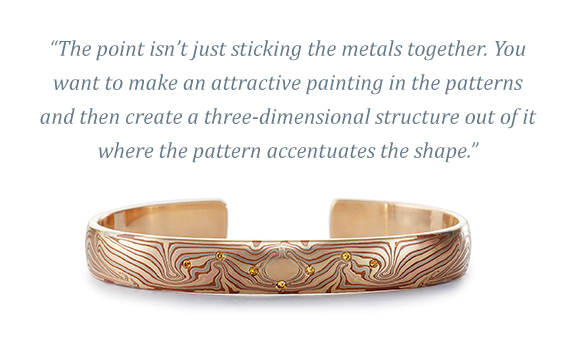
When he speaks about mokumé, Sawyer often compares it to painting, with metal as the medium. “The point isn’t just sticking the metals together. You want to make an attractive painting in the patterns and then create a three-dimensional structure out of it where the pattern accentuates the shape. For instance, we use a lot of symmetry to create strong center lines in elongated shapes or to give radial symmetry to round objects.”
One suggestion he offers is to create a sheet of mokumé before actually deciding what you intend to make. “Cut it up and lay it out in different sequential patterns to see how the symmetries work,” he says. “You will see things emerge that weren’t in the original block, and those things that emerge will suggest pieces of jewelry to you.”
What are you waiting for? Grab some metals and start painting.
Additional Resources
Layer on the Learning | Advancing the Art | Online Extra—Mokumé Gane Step-by-Step