

Off the Beaten Path
Crafting jewelry around unusual gemstones
By Tina Wojtkielo Snyder
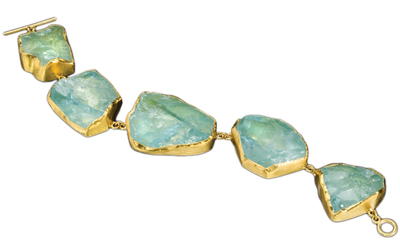
Faced with sky-high metals prices and penny-pinching consumers, jewelers who want to work with color today need alternatives to such expensive standards as sapphires, rubies, and emeralds. These jewelers need gems that offer a “big bang for the buck”—with the bang coming from the stone’s style and distinctiveness, rather than its cost.
Fortunately, although consumers are most familiar with the “big three” precious gems, they are now more than ever open to wearing jewelry that feature an unusual twist of color. “Today’s consumer knows about a wide range of gems, thanks to years of television shopping education, the web, and the fashion industry’s regular editorial coverage of gemmy jewelry designs—not to mention strong brands that have pushed interest in color,” says gem and jewelry trend forecaster Debbie Yonick of Glen Rock, Pennsylvania.
And that knowledge is translating into new opportunities for jewelry makers and designers. On the following pages you’ll meet two such jewelers who are experts at designing around uncommon gemstones. Whether creating custom pieces to suit a client’s needs or crafting one-of-a-kind creations for a line of work, they understand the care required to best showcase a unique stone. Here, they share the stories behind their creations, as well as offer tips and tricks they’ve learned along the way for working with various gem materials.
Lightening Up
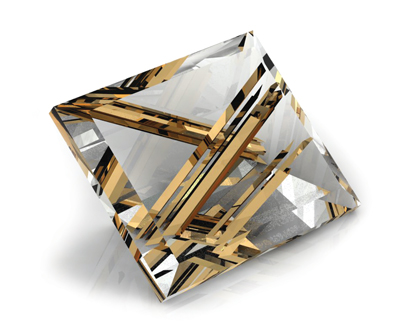
Unusual gemstones find their way into Tom Linenberger’s work on a regular basis. An independent retail jewelers who specializes in CAD, Linenberger owns Goldworks, with locations in Garden City, Kansas, and Fort Collins, Colorado. He believes consumers today are searching for “something different” when they shop for jewelry, and he’s built up his inventory around that belief: Many of his pieces feature gems with unique shapes, cuts, and styles that are bound to elicit comments.
“Customers love it when they wear a piece of jewelry and someone asks them, ’What is that stone?’” he says. “The jewelry becomes a conversation starter because of the stone it houses.”
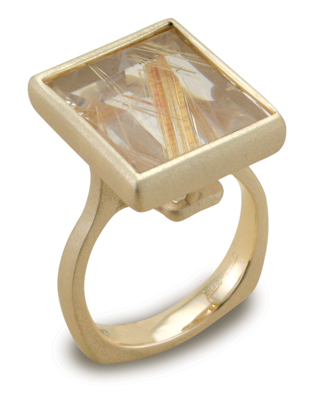
Recently a client came to Linenberger with a request to build a ring around a rectangular rutilated quartz with a deep pavilion. She wanted a very simple ring that would show off the stone—a challenge for Linenberger, who is used to designing more elaborate pieces with unusual metalwork. “I had to put aside my desire to always design something really unique and create a simple ring that would make the stone the main priority of the design,” he says.
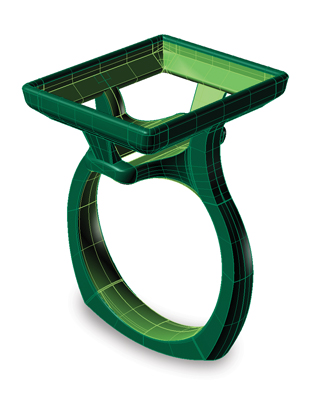
Linenberger started by creating the stone in the Matrix CAD program—a task made more challenging by the gold rutiles contained within the clear quartz stone. To create the basic shape of the stone, he duplicated the dimensions (18 mm long by 15 mm wide by 8 mm deep) in the software. He then created a profile of the angular lines of the rutiles and extruded them.
“It was important to create the rutiles in CAD so I could see how they would flow with the mounting that I was going to build for the stone,” Linenberger explains. “I also wanted to see how the stone would render in the setting before actually creating the piece in metal.”
With the stone reconstructed on the screen in front of him, Linenberger was ready to begin designing around it. He knew from the start that he wanted to use yellow gold to pick up on the color of the gold rutiles inside the quartz. He opted for 14k to stay within the client’s budget.
When considering how to set the stone, he ruled out prong setting because he had to protect the sides of the stone from getting chipped by the neighboring rings that the client would be wearing on the same hand. He decided to construct a stair-step bezel, which would protect the edges of the stone around the girdle and the base, as well as provide a window for light to enter the stone from all sides.
“The quartz itself is a window, so you don’t just want to stick it in a full bezel and block out the light,” says Linenberger. “By creating this double-bezel setting, I am letting light into the stone from the top, sides, and base while still supporting it well.”
The simple yet elegant bezel design begged for an equally subtle shank, which Linenberger squared off at the base to echo the geometry of the ring top. He settled on a matte, bead-blasted finish on the exterior surfaces—another attempt at preventing the metal from competing with the stone—and a high polish on the interior surfaces to enhance the reflectivity of the quartz. The completed design was milled in wax and cast.
When setting the quartz in the double bezel, Linenberger approached the task as he does all stone-setting projects. “Whenever I’m setting a gemstone with points, I assume it is going to fail at those points,” he says. “No matter how durable the gem, I always approach it with extreme caution.”
In this case, Linenberger notched the four corners in the upper supporting bezel using ball burs and bud burs, opening up the areas where the points of the stone would lay. With the stone in place, he carefully hammer-set it, first pulling the metal onto the stone along all of the flat edges, then moving to the corners. Linenberger always uses a bench microscope when setting, adding that it has become an essential tool in his shop.
“It allows you to zoom in really tight and see where all the pressure is going on the stone and the metal as you move things around,” he says. “It’s critical if you want to set stones well and avoid damaging them.”
Another tool that has proven to be a lifesaver for setting jobs such as this one is the laser welder. In this case, Linenberger made some relief cuts in bezel area at the top four corners of the stone prior to hammering them flat. “Think of it as a dart in fabric,” he explains. “You cut the metal and when you fold it in, it makes a nice tight edge.”
Once all of the corners were hammered down, Linenberger used the laser welder to weld the two flaps together, joining them as one. “This offers a clean solid setting,” he says. “With the help of a laser, you can set stones that previously would have been very labor-intensive and time-consuming due to their fragility or shape.”
In fact, without his powerful trio of high-tech tools—CAD/CAM, bench microscope, and laser welder—Linenberger says he would not be able to craft the type of jewelry he makes today with unusual gemstones.
“These tools have re-energized me,” he says. “They have opened up a new world of possibilities for my design.”
Roughing It
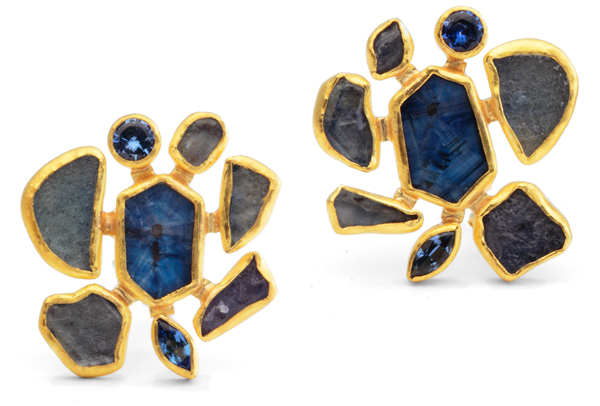
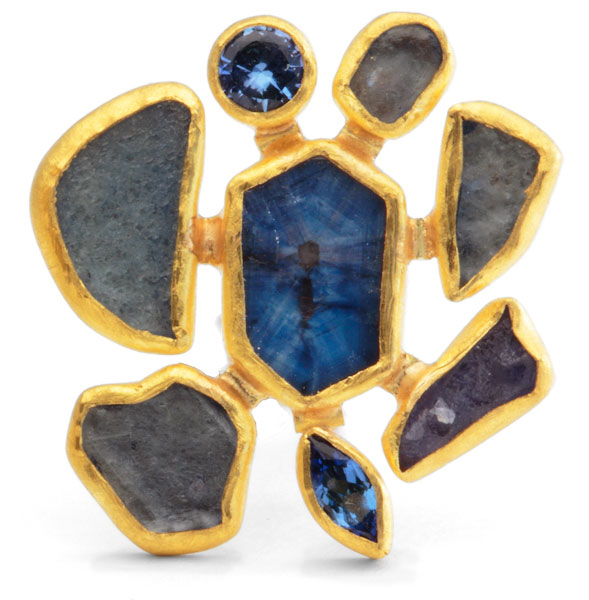
Working with any gemstone in its rough state may be considered an unusual choice for fine jewelry, but its very rawness is what gives it appeal. “The beauty of these stones is that they are not refined,” says designer Petra Class of San Francisco, a classically trained metalsmith who works with a variety of colored gems. “They have a certain vibration and character that a faceted stone doesn’t have.”
Class often juxtaposes rough unfaceted and uncut gemstones with faceted stones in her work. She purposely chooses stones with inclusions so they will not reflect light as much as a clear stone would, making the colors appear deeper. “I try to create tension between the types of gemstones in a piece, as if they are communicating with each other,” she explains.
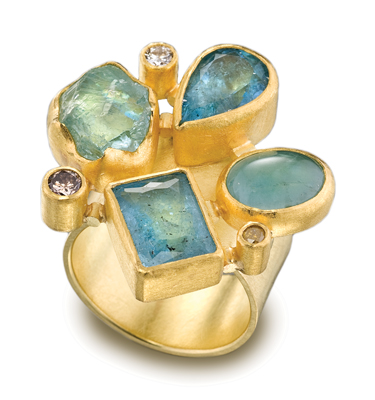
In this aquamarine ring (right), Class set four different cuts and shapes of aquamarine (clockwise from top left): rough, faceted pear, oval cabochon, and faceted rectangle. “The composition of the gemstones in this ring results in an interesting imbalance,” Class describes. “The two faceted stones that oppose each other anchor the ring, while the cabochon sits calm and timid. The rough stone is the odd man out, guarded on each side by a white and gray diamond, and opposed at the bottom right by a yellow diamond. There’s a rhythm to the piece, as if the stones are dancing together.”
To construct this ring, Class starts by fabricating the shank in 18k gold and the bezels for the gemstones in 22k. “I like to use 22k for the bezels because it’s a softer metal, so it’s easier to follow the unusual shapes of the gemstones that I tend to work with,” she says. “I also prefer the warmer, deeper yellow color next to the colored stones.”
To fabricate the bezels, Class forms sheets of 22k to match the contours of the stones. She then uses 18k sheet to form the seats atop which the stones will sit in the bezel settings and solders those 18k seats into the 22k forms. “Because the 22k gold is soft, we build the seats in 18k to make the settings more durable and stable.” She makes all of the bezels by hand. “Whenever you work with rough stones or unique cuts, you can’t buy pre-fabricated parts or cast in multiples, because each stone is different,” she says. When they’re completed, Class solders them to the 18k shank and sets the gemstones.
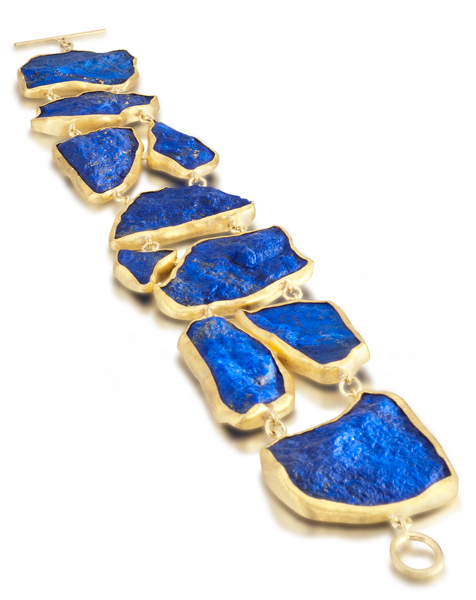
Class finds that when working with rough stones there are a few key factors to consider. First, she cautions, it’s important to check for any cracks or cleavages in a rough stone prior to designing around it. “Because rough pieces are so uniquely shaped, it’s almost impossible to get an exact replica if something goes wrong,” she explains. “If you try to bezel-set a rough gemstone with a crack in it, it could very easily break in half-leaving you with a hole in your design. Prior to designing around a rough stone, inspect it with a loupe carefully. If you see any cracks, choose another stone to work with.”
You may also need to make some adjustments to rough stones that pose setting challenges. “Sometimes I might have a stone that sticks up too high in a setting, or doesn’t lay flat in a bezel,” she describes. “In these cases, I use lapidary equipment to grind down the stone to ensure that I’m getting the look and feel that I want for the piece.”
Class uses a combination of diamond blades, grinders, sandpaper, and polishing wheels to perform her lapidary work. She encourages jewelers who are interested in working with rough stones to study their gemology and take some courses in lapidary before attempting to alter them. “Just as you learned how to work with metal and polished gemstones, you should understand the material before you attempt to use tools on it,” she says.
For Class, the beauty that results from showcasing a gemstone in its rough state is unmatched. “The colors and textures of the rough stones communicate a certain mood,” she says. “They evoke a different emotion than a polished stone, and they are fascinating to work with.”
Tips for Designing Around, Setting, and Selling Unusual Stones
• When designing a setting for an unusual gemstone, consider how much light you want to let in. Whereas a clear or translucent stone might benefit from multiple points of entry for optimum light reflection, a highly included or rough stone may appear deeper in color if less light is allowed into it.
• To enhance the reflectivity of a clear or translucent gemstone, highly polish the interior surfaces of the setting.
• Creating a 3-D render of a gemstone is an ideal first step for designing a piece around it in CAD. When working with a gemstone that has unique inclusions or other features, be sure to include those features in the render so you can see how they flow with the overall design.
• When the gemstone is the focal point of the piece, the metal should complement it, not compete with it. Consider a matte or hammered finish as opposed to a high polish when showcasing rare or unusual gems.
• When working with rough or uncut stones, always use a loupe to check for cracks of cleavages in the stone prior to designing around it. If you find a crack, choose another stone with which to work.
• No matter how durable the gem material, always approach setting with extreme caution. If the gemstone has points, assume they will break off. You can never be too careful.
• If you are designing a custom ring around a client’s gemstone, be sure to ask her about her activities—an active lifestyle may require a design that affords the gem more protection. Also as if she plans to wear other rings on her hand while wearing your piece. This, too, may affect how you set the stone to protect it from damage when bumping up against neighboring rings.
• When selling a piece with an unusual gemstone to a client, educate her about its origin and history. Since many of these stones are often unenhanced, romance the natural aspect of the gem. And remind her that unusual gemstones are great conversation starters. People will want to know, “What is that gemstone you are wearing?”