

Night Light
Read about the challenges Adam Neeley faced when creating his Moonlight and Caviar ring, which won first place, Professional Design Excellence in the 2012 MJSA Vision Awards
By Shannon L. Brown
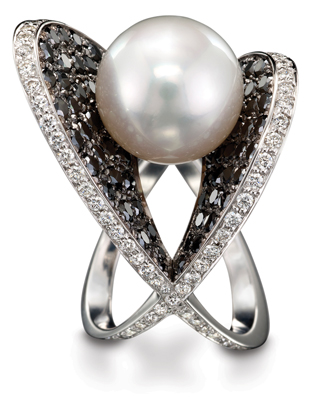
The idea for a ring design that would elegantly present a pearl in a bed of diamonds came to Adam Neeley of Adam Neeley Fine Art Jewelry Inc. in Laguna Beach, California, when he was studying jewelry design in Italy almost a decade ago. But the concept didn’t gel in his mind until last year during a night out with friends. “We were having dinner outside in Palm Springs and a friend purchased caviar for my birthday,” recalls Neeley. “When I noticed the shimmer of the moon in the caviar, I had the design—and the name for the piece.”
The double-shank Moonlight and Caviar ring, which won first place for Professional Design Excellence in the 2012 MJSA Vision Awards, features a completely round, blemish-free, 12 mm pearl—the moon—nestled among 2.52 carats of pavé-set black diamond “caviar.” A diamond-trimmed edge (1.2 tcw) encircles the ring around both shanks. “The diamonds add sparkle onto the pearl, while the pearl reflects onto the diamonds,” says Neeley.
With his vision for the design finalized, Neeley relied on the exacting capabilities of CAD to bring it to life, resolving two key technical issues that the design poses. First, because the two shanks meet at an “X” on each side, Neeley had to ensure that the distance between them wasn’t too wire as the shanks pass under the finger. “If it was too wide, the client would have a hard time closing her fist,” he says. He used CAD to resolve the issue by precisely aligning the shanks and rounding them on the inside, ensuring the lines of the ring were maintained but making it comfortable to wear. “With CAD, it’s possible to make a perfect, slanted oval,” says Neeley. “The piece is completely symmetrical.”
Second, because the pavé-set white diamonds wrap completely around the edges of the shanks, they press against neighboring fingers and therefore must not impede comfort. Neeley used trial and error in CAD to make the pavé thick enough to set but not too thick for wearability. There are 105 white diamonds that range is size from 1.4 to 1.6 mm set into the shank, which varies in thickness from 1.8 to 2.1 mm.
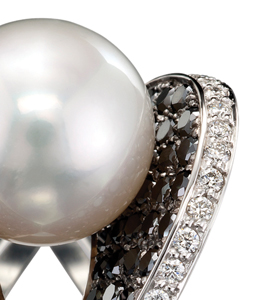
“You’d have to carve dozens of waxes to get everything perfect, as there is a very small tolerance to fit the pearl and make the pavé areas thick enough for a high quality piece of jewelry yet thin enough to be wearable,” he says. “In CAD, the tolerances are so exact that I built a model of a hand and tested the ring on it to make sure everything was precise.”
To make it easier to set the diamonds, Neeley cast the 14k white gold ring in two halves: the left half-moon shaped component with pegs extending from the base that would later be inserted into corresponding holes in the right half-moon shaped component, which was cast as one piece with both shanks. After bringing the components to an almost final finish and laser welding a threaded post to the center of the left half-moon to later hold the pearl, Neeley pavé-set the 105 white diamonds and 90 black diamonds by hand. None of the settings were designed into the CAD file, as Neeley prefers the sharper look of hand-pavé.
Once all of the diamonds were set, Neeley pen-plated black rhodium around the black diamonds, knowing that it would wear well on the protected inner part of the ring. He then laser welded the two ring components together to avoid heating the black diamonds.
The last step in the process was the delicate task of nestling the pearl, with its “nacre of glowing moonlight,” into place. He glued it onto the threaded post, positioning it to ride just above the diamonds so it wouldn’t be scratched. And in that final moment, he had captured the moonlight. “When I looked at it,” he says, “I was thrilled to say, ‘This is exactly it.’”