

Natural Curves
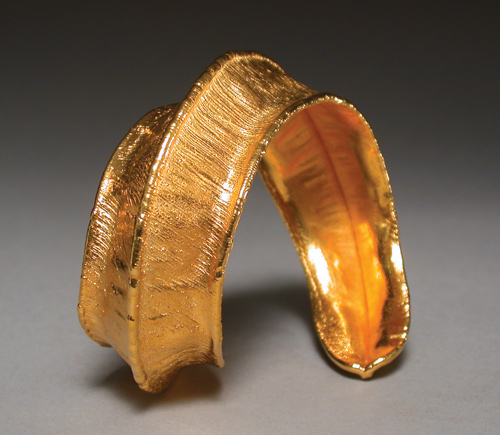
A step-by-step guide to making a foldform bracelet using a line fold.
By Charles Lewton-Brain
Foldforming is a rapid way of working with sheet metal using hand tools to create complex three-dimensional shapes and relief surfaces. There are hundreds of specific forms that are predictable, lightweight, conservative of materials, and fast to make—fast enough that they have production applications.
Foldforming works well in all metals, including silver, gold, platinum, and especially palladium. I sometimes place 24k gold onto sterling silver sheet using the keum-boo technique of hot burnishing, then fold and forge to produce a gold and silver piece.
You can quickly and easily make a bracelet by forging a line fold. The working time, going carefully, is less than 20 minutes, including finishing time (depending on the design).
I generally use 24 gauge sheet metal, but a thicker gauge also works well, and it adds strength and value to the object. You can also create a solid-like appearance for the bracelet by soldering a sheet of metal across the inside.

The tooling required is pretty basic: an anvil surface, annealing torch, and forging hammer. The trick is that the forging peen is slightly curved—a synclastic hammer (right). This allows the peen to strike just inside the fold edge of the strip being made into a bracelet and prevents a sharp edge on the spine of the bracelet.
Use the following steps to forge a sheet of metal into a bracelet using the foldforming technique:
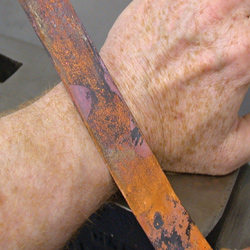
1. Wrap a long strip of metal around your wrist until the ends almost meet. (I suggest testing this in copper a time or two before committing to precious metals.)
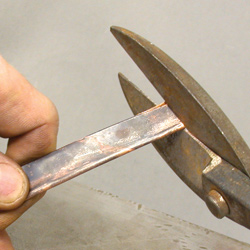
2. Trim the ends to blunt curves. The strip width is a design choice, depending on how large you want the final bracelet to be.
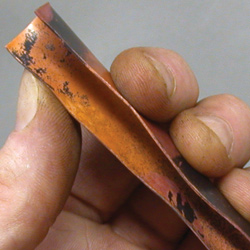
3. Fold the strip in half lengthwise.
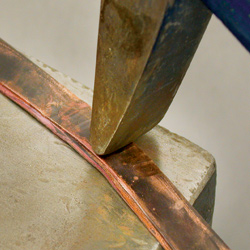
4. Forge the folded edge—the closed side of the fold. To obtain maximum curvature, make sure the blow is at right angles to the fold edge, and is a single mark that runs exactly halfway across the folded sheet. Turn the metal over periodically while forging to develop an even texture on both sides.
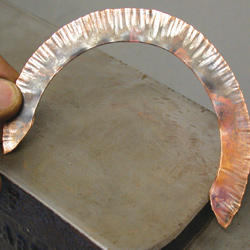
5. Be careful not to forge too much before opening. Stop forging when the bracelet is half an oval.
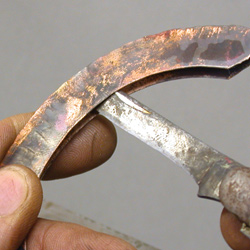
6. When opened, the bracelet will curl around the arm. Anneal the piece before opening it with a knife or similar tool.
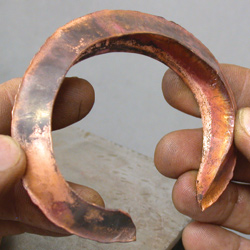
7. If you desire a smooth, polished surface, carefully planish out the hammer marks as much as possible, anneal, polish while flat, and then open.